
Method and system for optimizing a finite element mesh
a mesh and finite element technology, applied in the field of methods and systems for optimizing finite element meshes, can solve the problem that the method does not necessarily generate elements having a better overall quality, and achieve the effect of improving the overall improving the quality of the mesh, and improving the quality scor
- Summary
- Abstract
- Description
- Claims
- Application Information
AI Technical Summary
Benefits of technology
Problems solved by technology
Method used
Image

Examples
Embodiment Construction
Method Overview
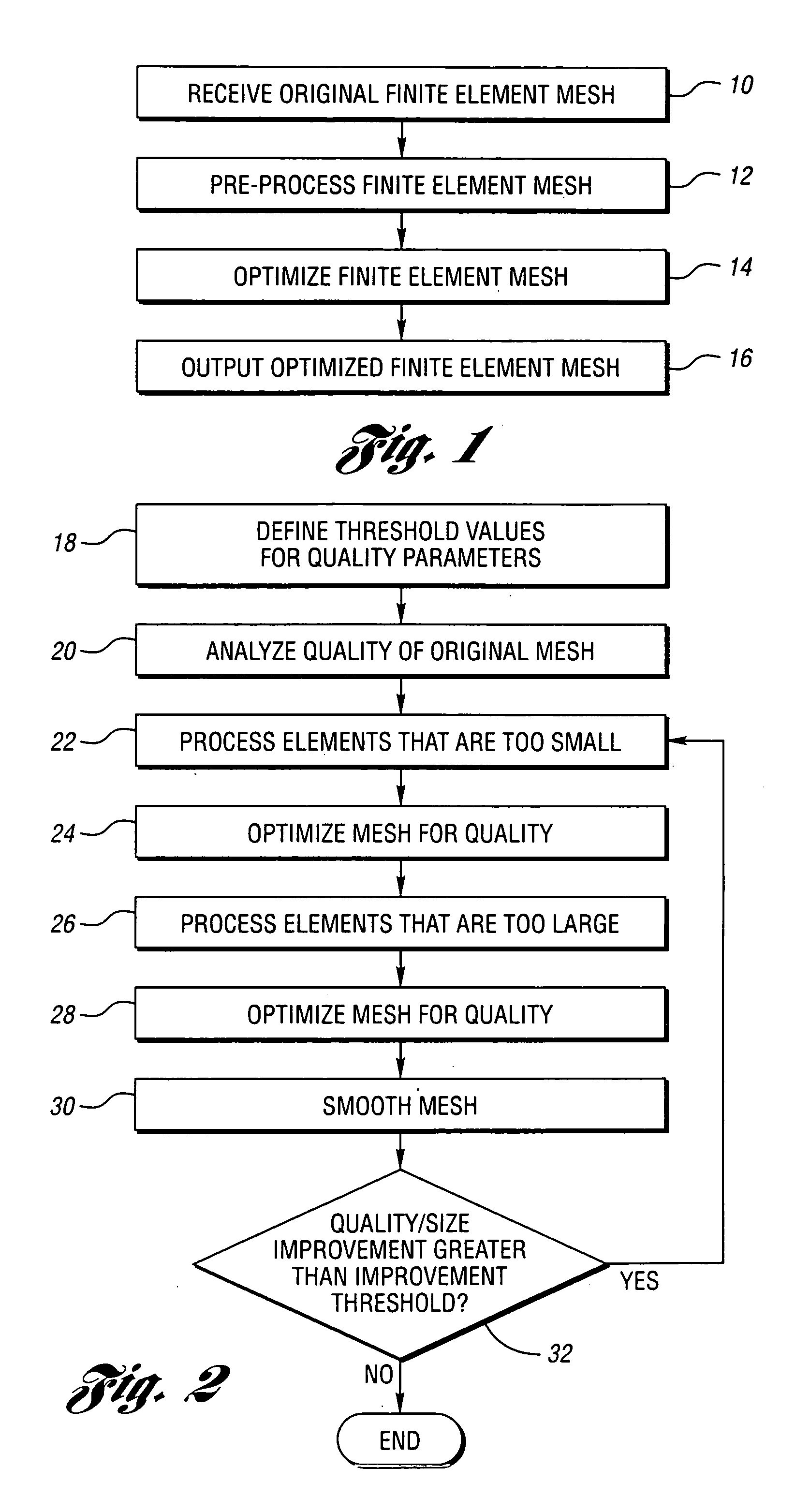
[0027]FIG. 1 is a block flow diagram illustrating a preferred methodology for implementing the present invention. Notably, the content and arrangement of items illustrated in FIG. 1 may be rearranged or adapted to best fit a particular implementation of the present invention. As represented in block 10, an original finite element mesh is received in an electronic format. Electronic file formats for finite element meshes include NASTRAN and RADIOSS. As represented in block 12, the finite element mesh is pre-processed in a computer-automated fashion. This aspect of the present invention is described in greater detail below. As represented in block 14, the mesh is optimized utilizing a computer-implemented optimization algorithm described in greater detail below. As represented in block 16, the optimized mesh is output in an electronic format.
Mesh Preprocessing
[0028] In accordance with a preferred embodiment of the present invention, original mesh preprocessing or b...
PUM
 Login to View More
 Abstract
Description
Claims
Application Information
 Login to View More