
Cast cover and method of use
- Summary
- Abstract
- Description
- Claims
- Application Information
AI Technical Summary
Benefits of technology
Problems solved by technology
Method used
Image

Examples
Embodiment Construction
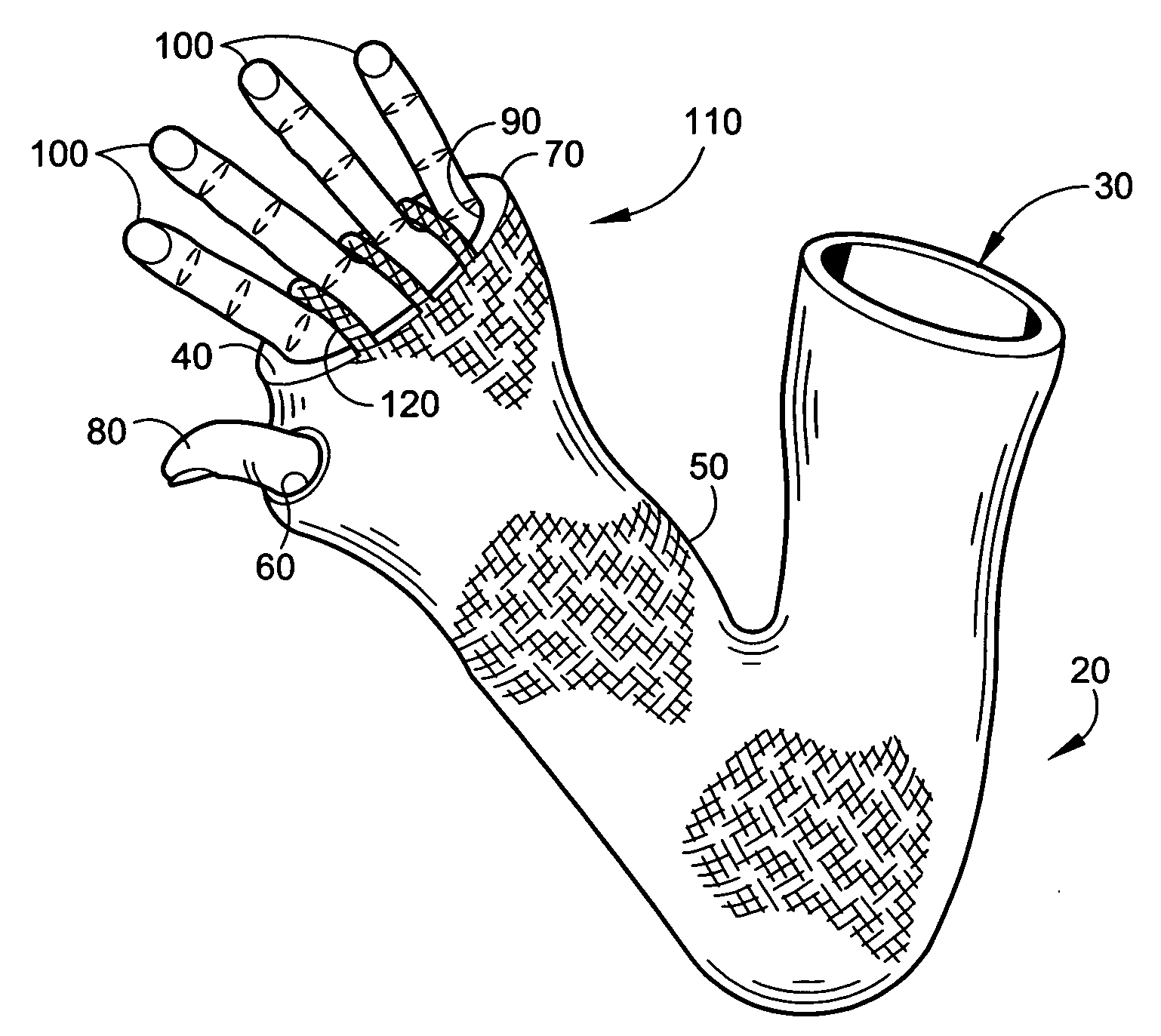
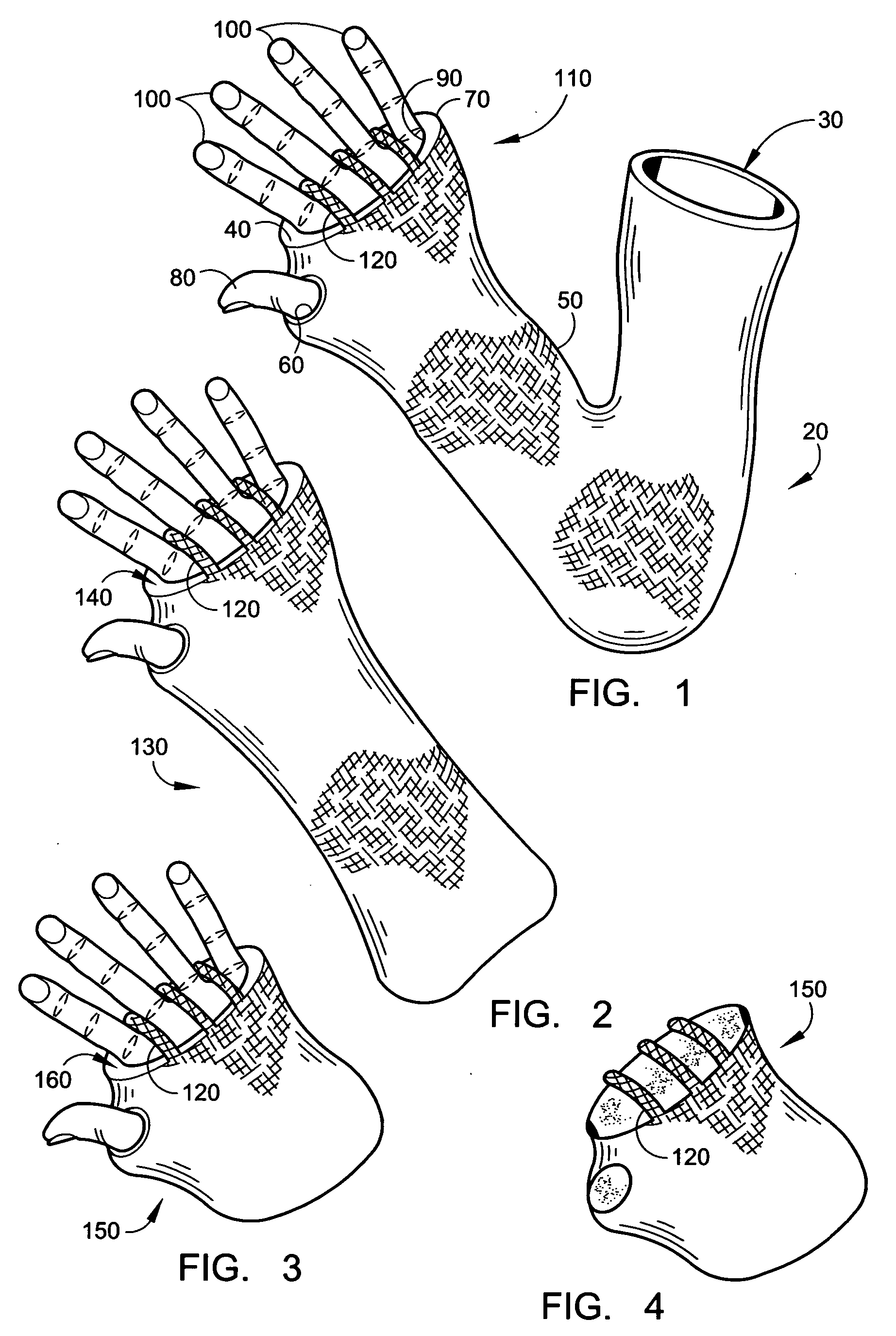
[0016] With reference to FIGS. 1-4, and initially FIG. 1, an orthopedic cast cover (hereinafter “cover”) 20 constructed in accordance with an embodiment of the invention will now be described. The cover 20 is a long-arm cast cover and is shown applied over a long-arm cast 30 with a user's fingers shown extending from a distal end 40 of the cast 30.
[0017] The cover 20 is made of a washable, stretchable material that slips over the cast 30. The cover 20 has a generally tubular portion (“tube”) 50 that serves as a protective and decorative covering. The cover 20 may include a finished binding for the thumb, around the fingers, at a middle part of the limb, and at an upper part of the limb. The binding may be elastic. A thumb hole 60 is formed near a distal portion 70 of the cover 20. Preferably, the thumb hole 60 is situated so that the cover 20 fits thumb 80 between the first and second knuckle of the thumb 80. An oval finger opening 90 is adjacent the thumb hole 60 and receives fing...
PUM
 Login to View More
 Abstract
Description
Claims
Application Information
 Login to View More