Passive gravity-balanced assistive device for sit-to-stand tasks
Inactive Publication Date: 2006-11-23
DELAWARE UNIV OF A DE
View PDF6 Cites 15 Cited by
Summary
Abstract
Description
Claims
Application Information
AI Technical Summary
This helps you quickly interpret patents by identifying the three key elements:
Problems solved by technology
Method used
Benefits of technology
Benefits of technology
[0009] There is provided according to this invention equipment that allows persons to use their impaired muscles to move their limbs under their own power by balancing the effects of gravity on the afflicted limbs thereby reducing the effort needed to use such limb(s). Such balancing is achieved by transferring the weight of the afflicted limbs to a support external to the limbs, such as, for example a harness worn by the person or a supporting structure forming part of a complete training system.
Problems solved by technology
A vast number of people are affected by conditions that result in profound muscle weakness or impaired motor control.
For example, people with severe muscle weakness from neurological injury, such as hemiparesis from stroke, often have substantial movement limitations, and for many people, sit-to-stand motion becomes increasingly difficult with age.
However, equipment available to facilitate this is severely limited.
It is a pre-requisite for other functional movements that require ambulation and is mechanically demanding.
The use of these gait-training and sit-to-stand machines is limited in that they require external power to function, posing increased risk to the user, and require supervisory staff for safe use.
Additionally, they only move persons through predetermined movement patterns rather than allowing them to move under their own control.
The failure to allow persons to experience and practice appropriate movement prevents necessary changes in the nervous system to promote relearning of typical patterns.
Method used
the structure of the environmentally friendly knitted fabric provided by the present invention; figure 2 Flow chart of the yarn wrapping machine for environmentally friendly knitted fabrics and storage devices; image 3 Is the parameter map of the yarn covering machine
View more
Image
Smart Image Click on the blue labels to locate them in the text.
Viewing Examples
Smart Image
Click on the blue label to locate the original text in one second.
Reading with bidirectional positioning of images and text.
Smart Image
Examples
Experimental program
Comparison scheme
Effect test
first embodiment
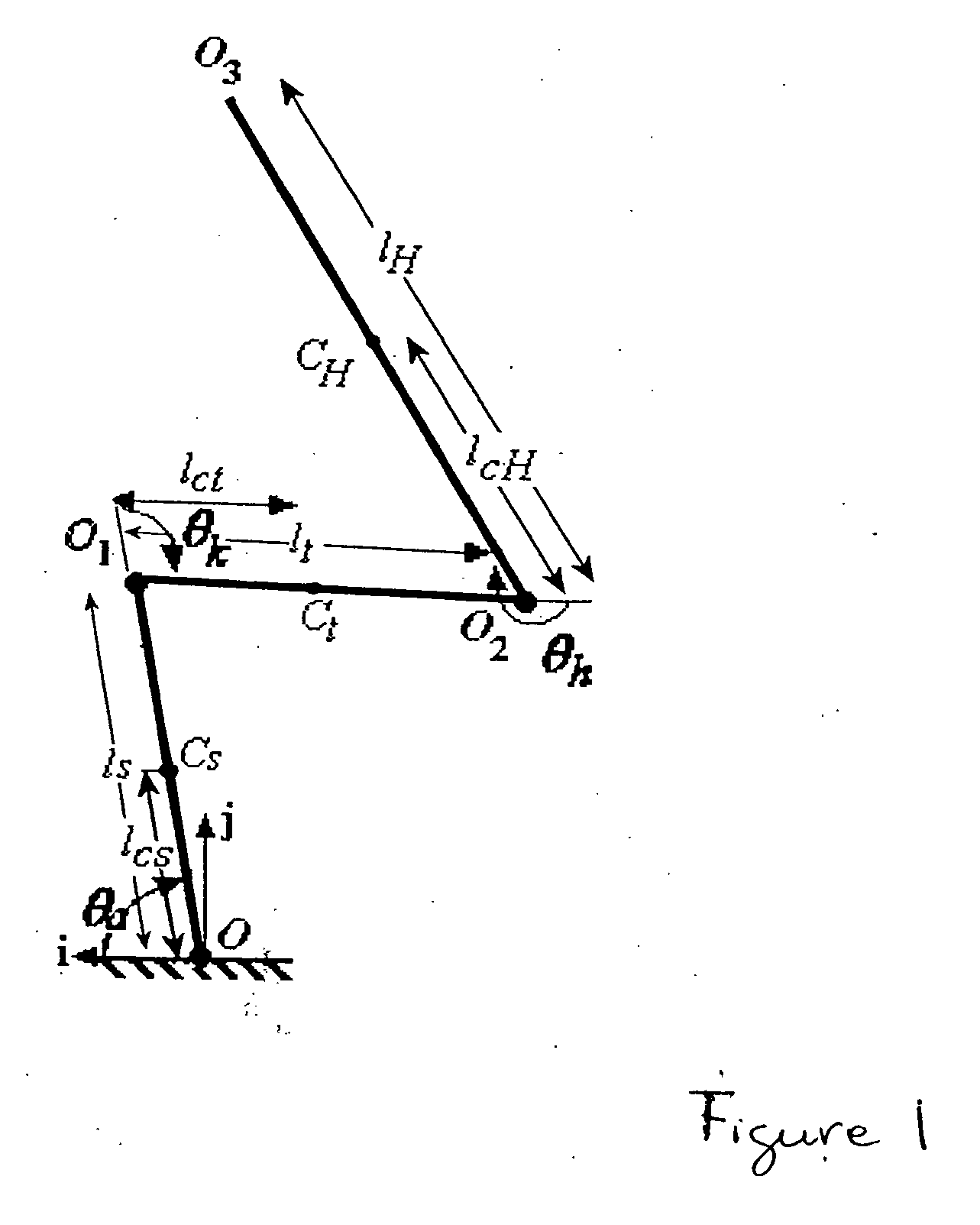
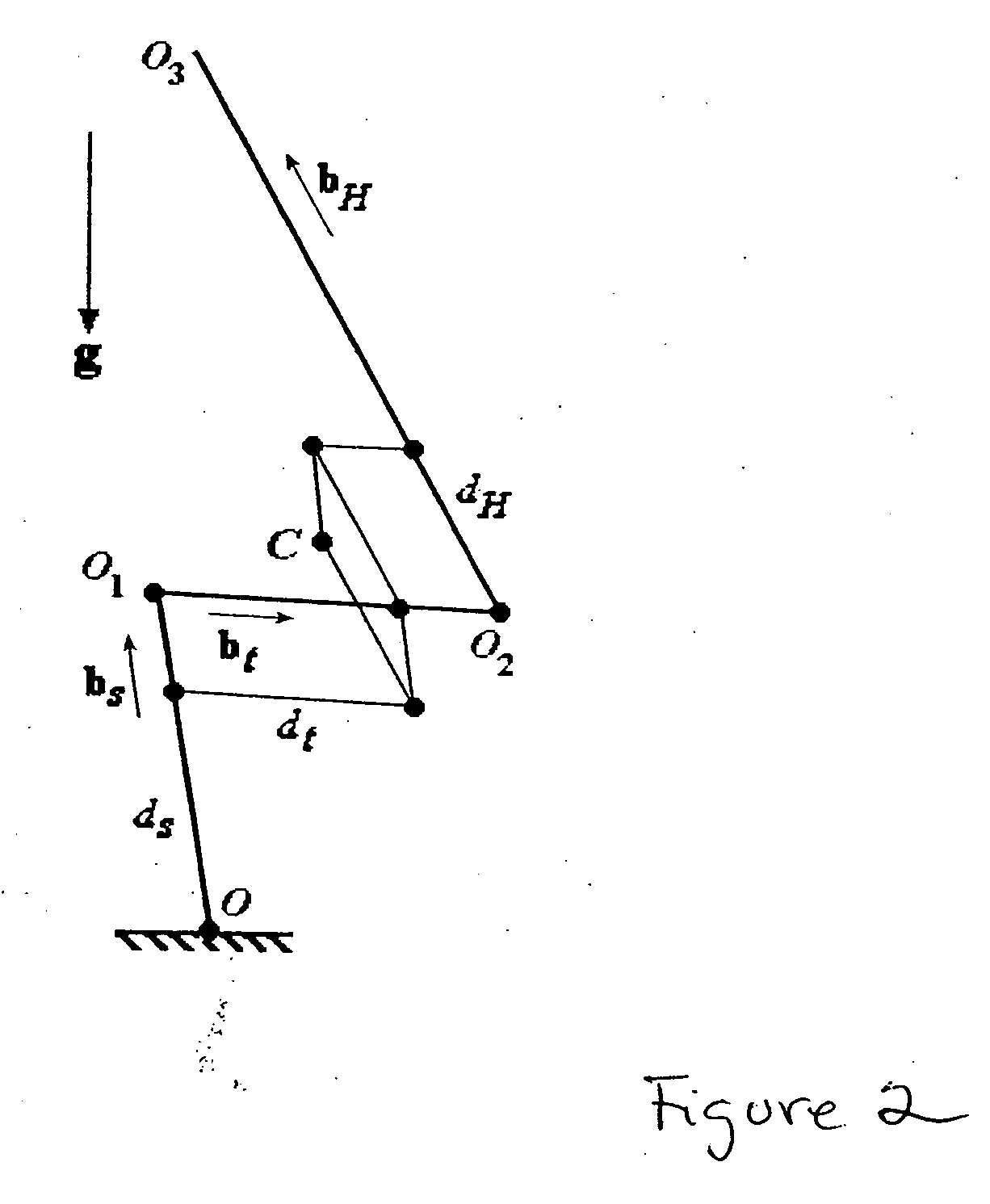
[0038] Having determined the COM of the system, the spring constants are next determined. FIG. 3 illustrates, schematically, a first embodiment, of a STS device. The human body and the device is gravity-balanced by attaching four springs to the system, one across each of the three parallelograms and one from the COM to the fixed primary supporting point P as shown in FIG. 3. The total potential energy of the system consists of gravitational (Vg) and elastic (Vs) energies due to the springs. Its expression is given by:
V=Vs+Vg=(½)kx2+(½)k1x12+(½)k2x22+(½)k3x32−Mg∘roc.
Upon substitution of
x2=∥PC∥·∥PC∥,
x12=∥O1S1∥·∥O1S1∥,
x22=∥CS3∥·∥CS3∥ and
x32=∥O2S2∥·∥O2S2∥
and expanding the results thus obtained in terms of joint angles, one obtains:
−Mg∘roc=Mg(dssa+dtsak+dHSakh)
x2=(dsca+dtcak+dHcakh)2+(dssa+dtsak+dHsakh−d)2
x12=dt2+(ls−ds)2−2(ls−ds)dtck
x22=dH2+(ls−ds)2−2dH(ls−ds)ckh
x32=(lt—dt)2+dH2−2dH(lt−dt)ch.
Here, ci, si, cij, sij, cijk and sijk stand for cos θi, sin θi, cos (θi+θj), sin (...
second embodiment
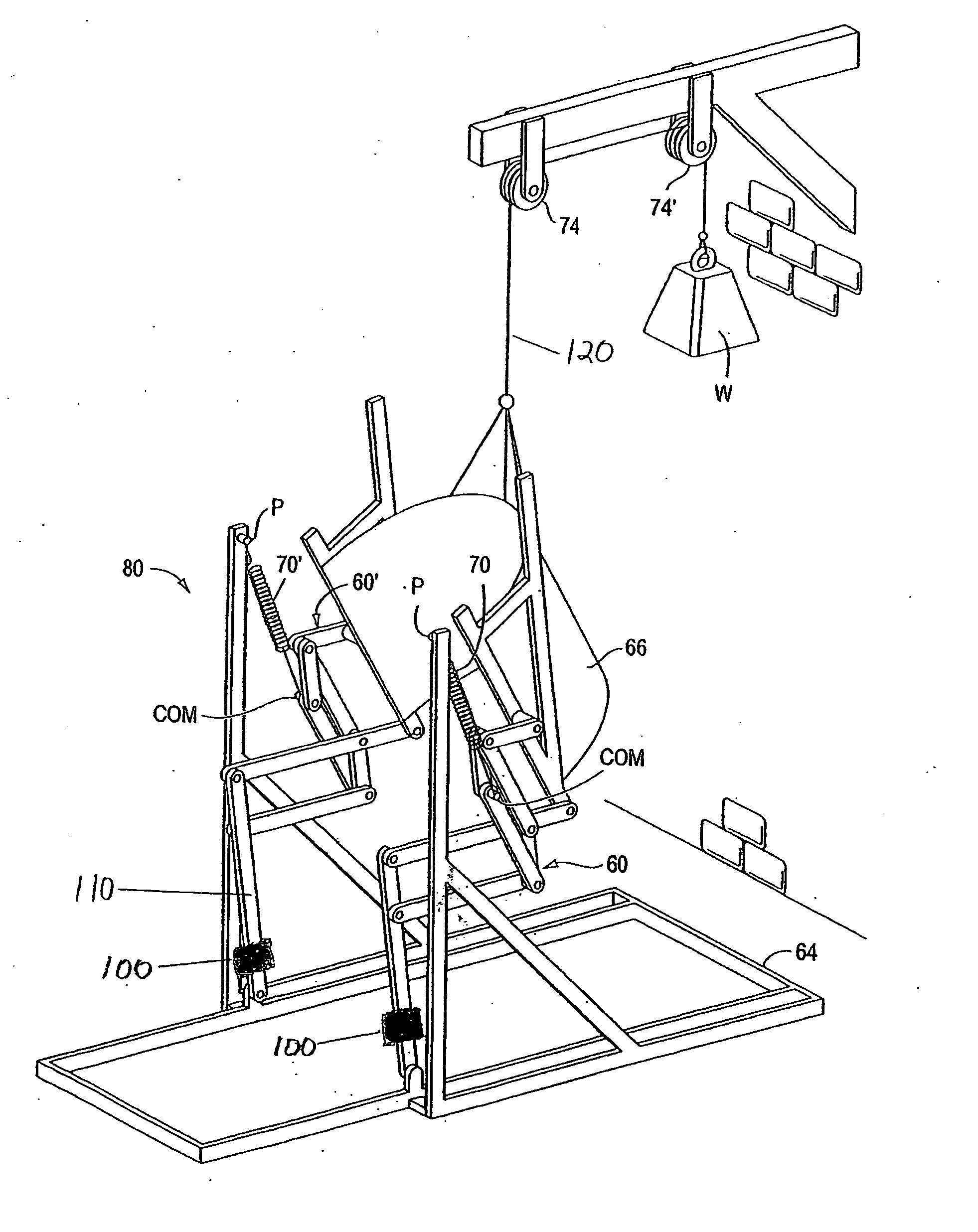
[0040]FIG. 4 shows a schematic representation of an apparatus (80) according to this invention, which allows the use of springs with smaller stiffness constants The apparatus comprises two sets of articulated members 60 and 60′, each set forming three parallelograms on the left and right sides, corresponding to the three parallelograms in FIG. 3. The system of articulated support members serves as an exoskeleton and is mounted on a frame 64. The frame and the members may be fabricated out of a material with relatively low density and high intrinsic stiffness in order to reduce the weight of the device and provide for its easy adjustment. Exemplary materials include extruded aluminum, titanium, carbon reinforced fibers, Kevlar reinforced fibers, and reinforced glass fibers.
[0041] The length of each articulated member may be adjusted and optimized for the user, using, for example, telescoping members. The primary springs 70 and 70′ connect the centers of mass COM to the frame at the f...
the structure of the environmentally friendly knitted fabric provided by the present invention; figure 2 Flow chart of the yarn wrapping machine for environmentally friendly knitted fabrics and storage devices; image 3 Is the parameter map of the yarn covering machine
Login to View More
PUM
Login to View More
Abstract
A passive gravity balancing assist device for human sit-to-stand motion is provided. The design combines the use of auxiliary parallelograms with springs to produce an orthotic device wherein the total potential energy of the system is constant during standing and sitting motion.
Description
RELATED APPLICATIONS [0001] This application is a continuation-in-part of U.S. Ser. No. 11 / 113,729 and claims benefit of priority from U.S. Ser. No. 11 / 113,729, filed Apr. 25, 2005, and U.S. 60 / 748,429, filed Dec. 8, 2005, the contents of which are incorporated herein by reference.STATEMENT REGARDING FEDERALLY SPONSORED RESEARCH [0002] The work leading to this invention was financed in part by the National Institute of Health (NIH) under a grant NO. 1 RO1 HD38582-01A2.FIELD OF THE INVENTION [0003] This invention relates to rehabilitative assistive devices. More specifically, this invention provides a method and associated passive gravity-balanced apparatus for facilitating movement by persons suffering from muscleweakness or impaired motor control. BACKGROUND OF THE INVENTION [0004] A vast number of people are affected by conditions that result in profound muscleweakness or impaired motor control. For example, people with severe muscleweakness from neurological injury, such as he...
Claims
the structure of the environmentally friendly knitted fabric provided by the present invention; figure 2 Flow chart of the yarn wrapping machine for environmentally friendly knitted fabrics and storage devices; image 3 Is the parameter map of the yarn covering machine
Login to View More
Application Information
Patent Timeline
Application Date:The date an application was filed.
Publication Date:The date a patent or application was officially published.
First Publication Date:The earliest publication date of a patent with the same application number.
Issue Date:Publication date of the patent grant document.
PCT Entry Date:The Entry date of PCT National Phase.
Estimated Expiry Date:The statutory expiry date of a patent right according to the Patent Law, and it is the longest term of protection that the patent right can achieve without the termination of the patent right due to other reasons(Term extension factor has been taken into account ).
Invalid Date:Actual expiry date is based on effective date or publication date of legal transaction data of invalid patent.


 Login to View More
  Login to View More