Identifying sources of memory retention

a memory and source technology, applied in the field of computer systems, can solve the problems of memory waste, undesired retention of limited resources, and memory waste, and achieve the effect of low overhead

a memory and source technology, applied in the field of computer systems, can solve the problems of memory waste, undesired retention of limited resources, and memory waste, and achieve the effect of low overhead

US20070067758A1Active Publication Date: 2007-03-22HEWLETT-PACKARD ENTERPRISE DEV LP +1

Image

Smart Image Click on the blue labels to locate them in the text.
Viewing Examples
Smart Image
  • Identifying sources of memory retention
  • Identifying sources of memory retention
  • Identifying sources of memory retention

Examples

Experimental program
Comparison scheme
Effect test

example implementation

[0055] Example Implementation

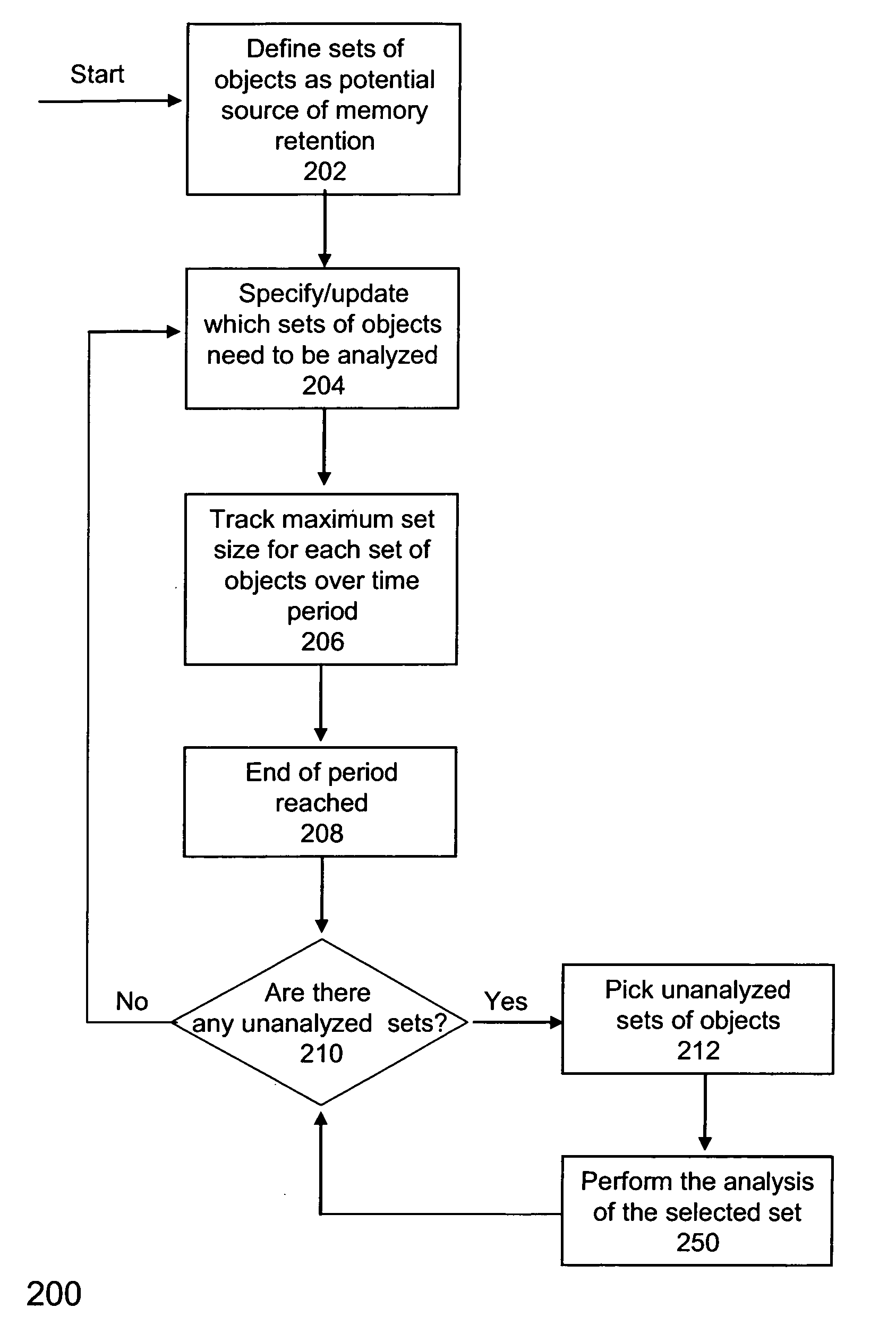
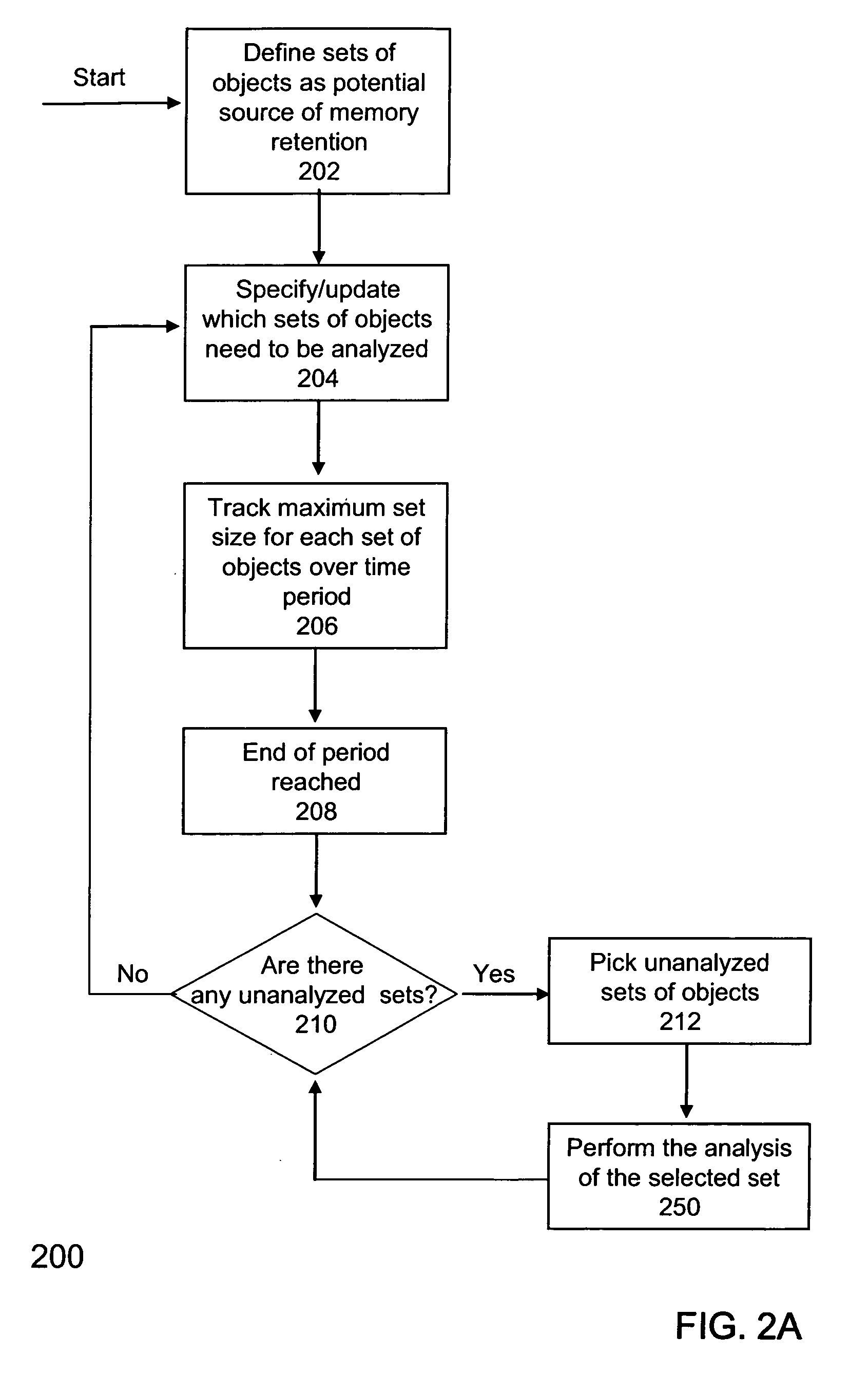
[0056] An example implementation of the methods 200 and 250 in FIGS. 2A and 2B is now described in accordance with an embodiment of the invention. In this example, the sets of objects to be tracked for memory leak purposes are determined by the objects belonging to standard Java collection classes. For each such object, the set of objects to be analyzed by method 200 is defined as the objects referenced (or “contained”) by the collection object. Therefore, the set of objects to be analyzed may be considered identical with the objects belonging to the Java collection classes. For each collection class, a “wrapper” class may be used which is a subclass of the original class. When the application classes are loaded for execution, or dynamically as the application is executing, each creation of the collection object in the Java bytecodes is replaced with the creation of the corresponding wrapper (or suitably modified) collection object.

[0057] For example, i...

the structure of the environmentally friendly knitted fabric provided by the present invention; figure 2 Flow chart of the yarn wrapping machine for environmentally friendly knitted fabrics and storage devices; image 3 Is the parameter map of the yarn covering machine
Login to View More

PUM

No PUM Login to View More

Abstract

One embodiment relates to a method for identifying sources of memory retention in an executing application. A size of a set of objects is tracked over multiple periods. A period is determined to be a growth period if the size for the set of objects increases above a previous maximum size, and the number of growth periods is counted. The set of objects is flagged as having potential undesired object retention (a memory leak) if the number of growth periods is greater than a threshold number. Other embodiments are also disclosed.

Description

BACKGROUND OF THE INVENTION [0001] 1. Field of the Invention [0002] The present invention relates generally to computer systems. [0003] 2. Description of the Background Art [0004] Undesired Retention of Limited Resources [0005] One of the issues involved in information processing on computer systems is the undesired retention of limited resources by computer programs, such as applications or operating systems. Typically, a computer system is comprised of limited resources, regardless of whether the resources are physical, virtual, or abstract. Examples of such resources are CPU cycles, memory, disk space, file descriptors, socket port numbers, database connections or other entities that are manipulated by computer programs. [0006] A computer program may dynamically allocate resources for its exclusive use during its execution. When a resource is no longer needed, it may be released by the program. Releasing the resource can be done by an explicit action performed by the program, or ...

Claims

the structure of the environmentally friendly knitted fabric provided by the present invention; figure 2 Flow chart of the yarn wrapping machine for environmentally friendly knitted fabrics and storage devices; image 3 Is the parameter map of the yarn covering machine
Login to View More

Application Information

Patent Timeline
22 Mar 2007
Publication
US20070067758A1
IPC
G06F9/45
CPC
G06F12/0253; G06F11/076
Inventors
FINDEISEN, PIOTR; LI, YANHUA