
Method and system for controlling contextual information push services
a technology of contextual information and push services, applied in the direction of broadcast service distribution, digital transmission, instruments, etc., can solve the problem of unavoidable system complexity
- Summary
- Abstract
- Description
- Claims
- Application Information
AI Technical Summary
Benefits of technology
Problems solved by technology
Method used
Image

Examples
Embodiment Construction
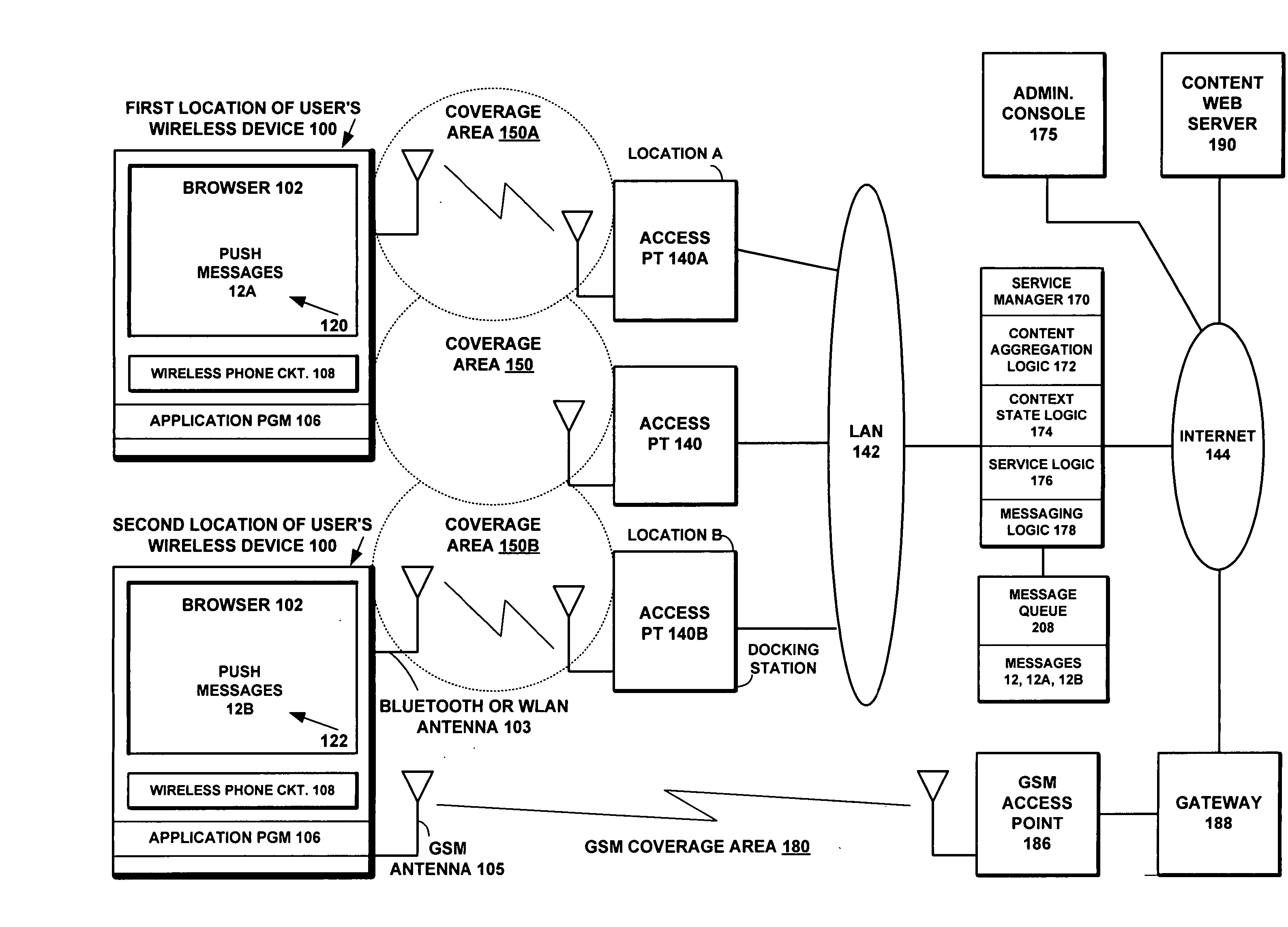
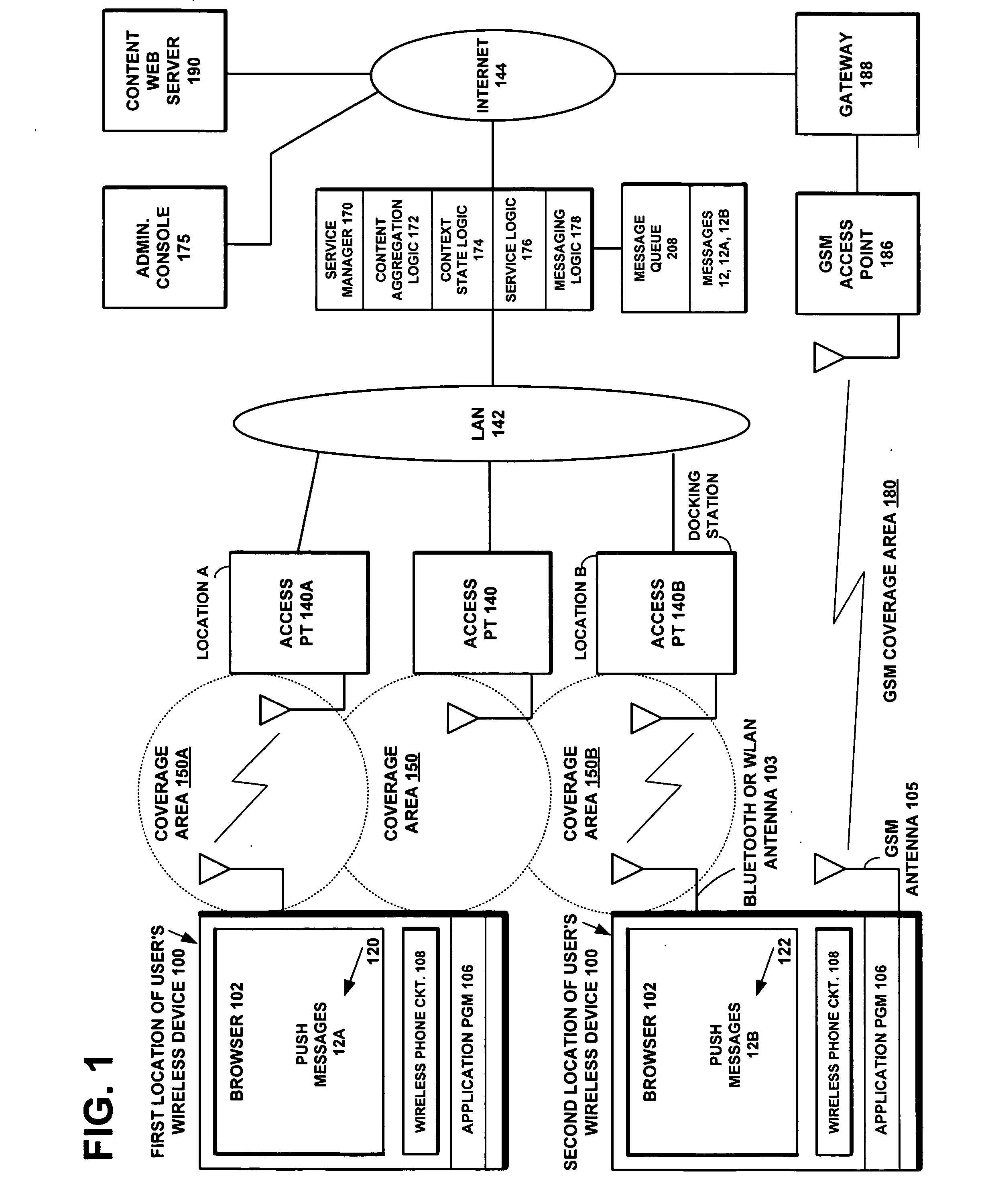
[0017]FIG. 1 is a network diagram according to an embodiment of the present invention, showing a plurality of short-range wireless access points 140, 140A, and 140B connected to the local area network (LAN) 142. Each respective access point 140, 140A, and 140B has a corresponding coverage area 150, 150A, and 150B, respectively. The short-range wireless access points can be, for example, Bluetooth wireless devices, IEEE 802.11 Wireless LAN devices, HIPERLAN Wireless LAN devices, Ultra Wideband (UWB) radio Wireless LAN devices, or IrDA devices. Bluetooth wireless devices have a typical coverage area of a radius of 10 meters. IEEE 802.11 Wireless LAN devices and HIPERLAN Wireless LAN devices have a typical coverage area with a radius of 100 meters.
[0018] The LAN 142 of FIG. 1 interconnects the access points with the Service Manager 170, which in turn is connected to the Internet 144. The Internet 144 is connected to the telephone network gateway 188, which in turn is connected to a wi...
PUM
 Login to View More
 Abstract
Description
Claims
Application Information
 Login to View More