Multiple step identification of recordings

US20100161656A1Inactive Publication Date: 2010-06-24GRACENOTE
38 Cites 5 Cited by

Patent Information

Authority / Receiving Office
US · United States
Current Assignee / Owner
Publication Date
2010-06-24
Estimated Expiration
Not applicable · inactive patent

Smart Images

  • Figure 1
    Figure 1
  • Figure 2
    Figure 2
  • Figure 3
    Figure 3
Patent Text Reader

Abstract

Multiple information is extracted from an unknown recording and information associated therewith. Associated information includes the filename, if the recording is a computer file in, e.g., MP3 format, or table of contents (TOC) data, if the recording is on a removable medium, such as a compact disc. At least one and preferably several algorithmically determined fingerprints are extracted from the recording using one or more fingerprint extraction methods. The information extracted is compared with corresponding information in a database maintained for reference recordings. Identification starts with the most accurate and efficient method available, e.g., using a hash ID, a unique ID or text. Fingerprint matching is used to confirm other matches and validation is performed by comparing the duration of the unknown and a possibly matching reference recording.
Need to check novelty before this filing date? Find Prior Art

Description

CROSS-REFERENCE TO RELATED APPLICATION(S)

[0001] This application is a Divisional of U.S. application Ser. No. 10 / 208,189, filed on Jul. 31, 2002, which claims priority to U.S. Provisional Application No. 60 / 308,594, filed Jul. 31, 2001, and which applications are incorporated by reference herein in their entirety.BACKGROUND OF THE INVENTION

[0002] 1. Field of the Invention

[0003] The present invention is directed to recognition of recordings from their content, and, more particularly to combining fingerprint recognition with other information about a recording to increase reliability of recognition and to accomplish reliable recognition efficiently by using the least expensive forms of recognition first and layering on more complex forms as needed.

[0004] 2. Description of the Related Art

[0005] There are many uses for recognition of audio (and video) recordings. Many of the uses relate to compensation or control by the rights holders for reproduction and performance of the works recorded. T...

Examples

Embodiment Construction

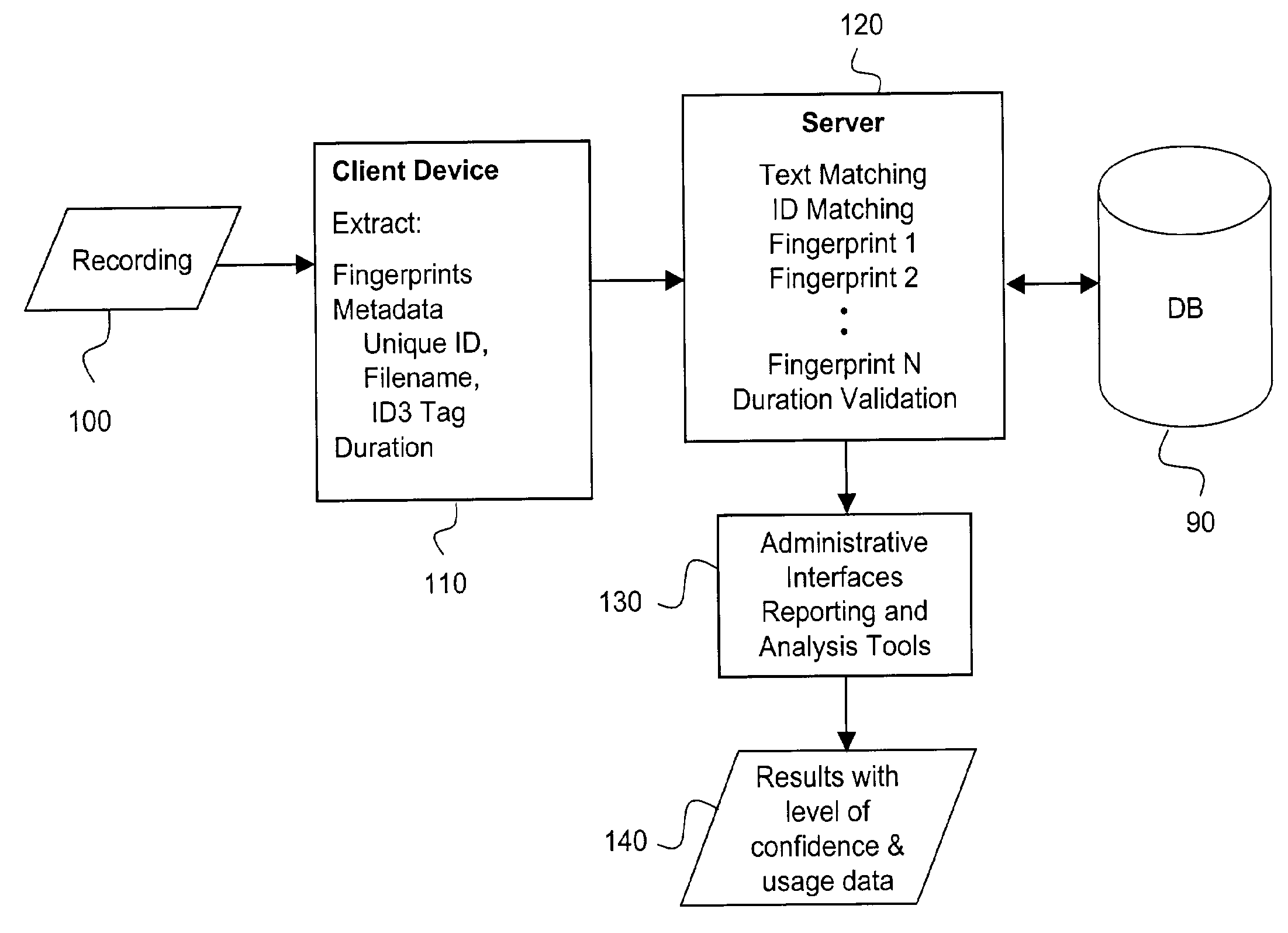
[0033]According to the present invention, a suite of identification components are provided in a system like that illustrated in FIG. 1 to facilitate analysis and identification of audio (and video) files utilizing multiple methods. Preferably, an existing database 90 containing recording identifiers and text data is combined with text-based digital audio and audio fingerprinting identification methods. Preferably, the text data in database 90 is obtained from user submissions and includes user-submitted spelling variants. One such database is available as the CDDB Music Recognition Service from Gracenote, Inc.

[0034]As illustrated in FIG. 1, a recording 100 is accessed by client device 110 via any conventional method, such as reading a digital audio file from a hard drive or a compact disc. Information is extracted from recording 100 and associated information (metadata). Fingerprints are extracted from recording 100, as described in more detail below. The information that is extrac...