Flip top cap with contamination protection

a top cap and contamination protection technology, applied in the field of flip top caps, can solve the problem of reducing the possibility of contact with the open top of the vessel, and achieve the effect of easy opening

US20120199585A1Active Publication Date: 2012-08-09CORNING INC
8 Cites 1 Cited by

Patent Information

Authority / Receiving Office
US · United States
Patent Type
Applications(United States)
Current Assignee / Owner
Publication Date
2012-08-09

Smart Images

  • Figure 1
    Figure 1
  • Figure 2
    Figure 2
  • Figure 3
    Figure 3
Patent Text Reader

Abstract

A cap is provided for a laboratory vessel. The cap includes a lid that can be rotated relative to the laboratory vessel from a closed position to an open position. The lid includes at least one tab dimensioned and disposed for receiving manual digital pressure for opening and / or closing the lid. The tab is in an offset position to prevent a thumb or forefinger from passing over and in contact with the opening to the vessel. Additionally, the lid includes a shield inwardly from the tab for further preventing contact between a finger and the open top of the vessel.
Need to check novelty before this filing date? Find Prior Art

Description

CROSS-REFERENCE TO RELATED APPLICATIONS

[0001] This Application is a continuation of U.S. application Ser. No. 11 / 177,728, filed Jul. 8, 2005, now allowed, which claims priority to U.S. Provisional Application No. 60 / 587,459, filed Jul. 13, 2004, the entire contents of which are incorporated by reference herein.BACKGROUND OF THE INVENTION

[0002] 1. Field of the Invention

[0003] The invention relates to a flip top cap for use with laboratory vessels, such as tubes.

[0004] 2. Description of the Related Art

[0005] Many laboratory procedures require tissue cultures or cell cultures to be stored and / or cultivated in a vessel, such as a tube or a flask. The typical tube includes a cylindrical side wall, a closed bottom and an open top. The closed bottom often is conically generated. The size of the tube varies from one laboratory procedure to another, and tubes typically will define volumes from 15 mL to 50 mL. Flasks also have a side wall, a closed bottom and an open top. For simplicity, the follo...

Examples

Embodiment Construction

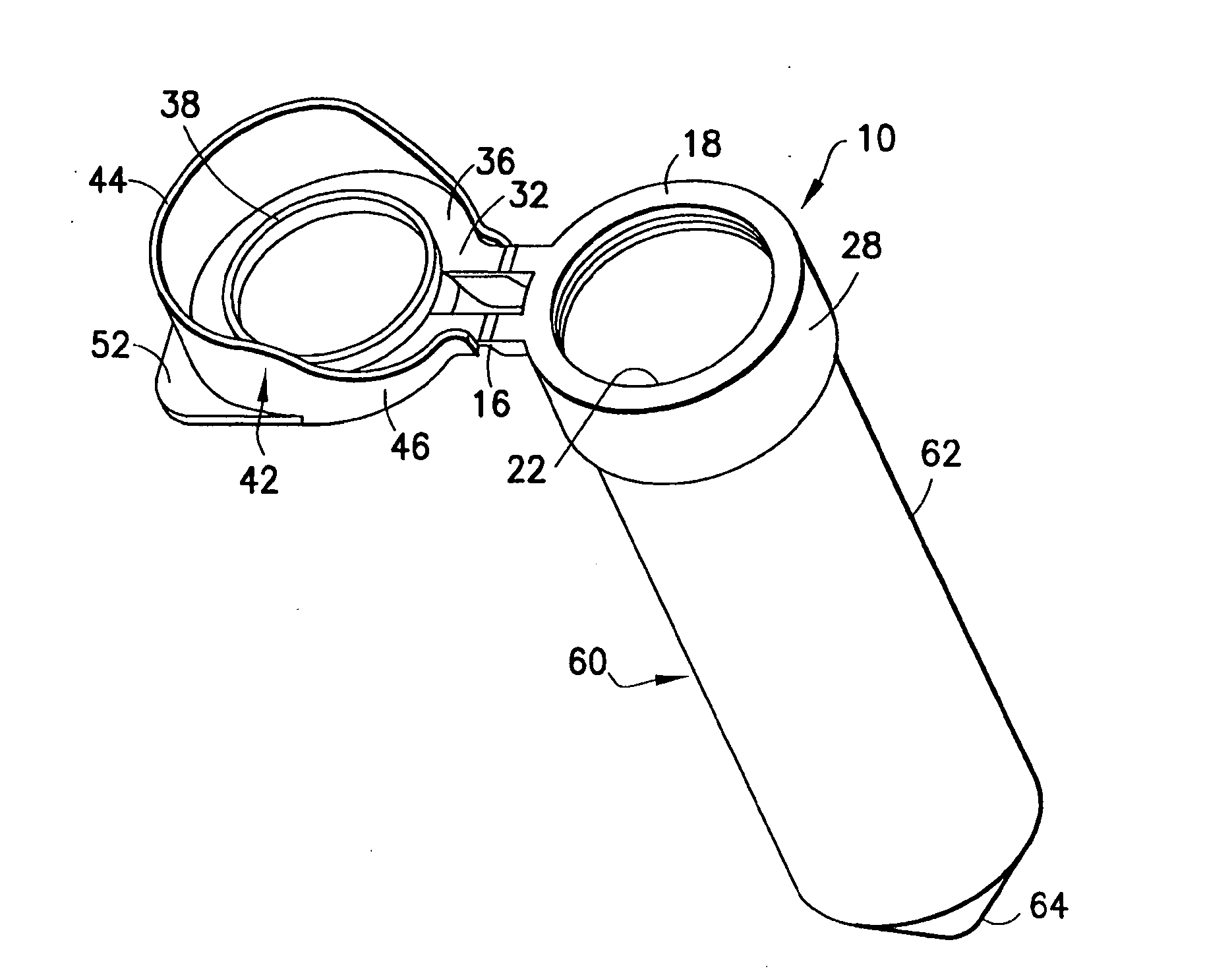
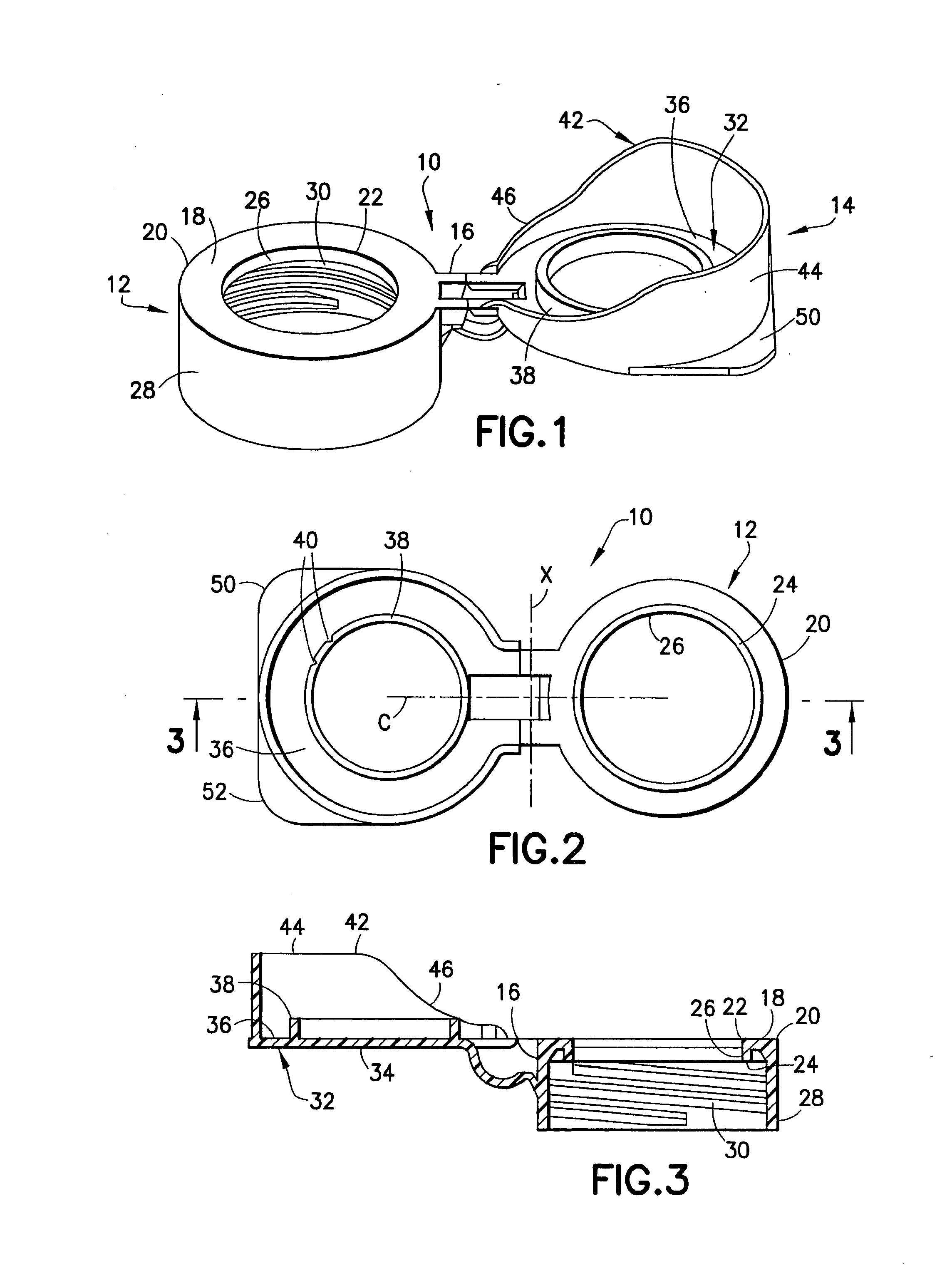
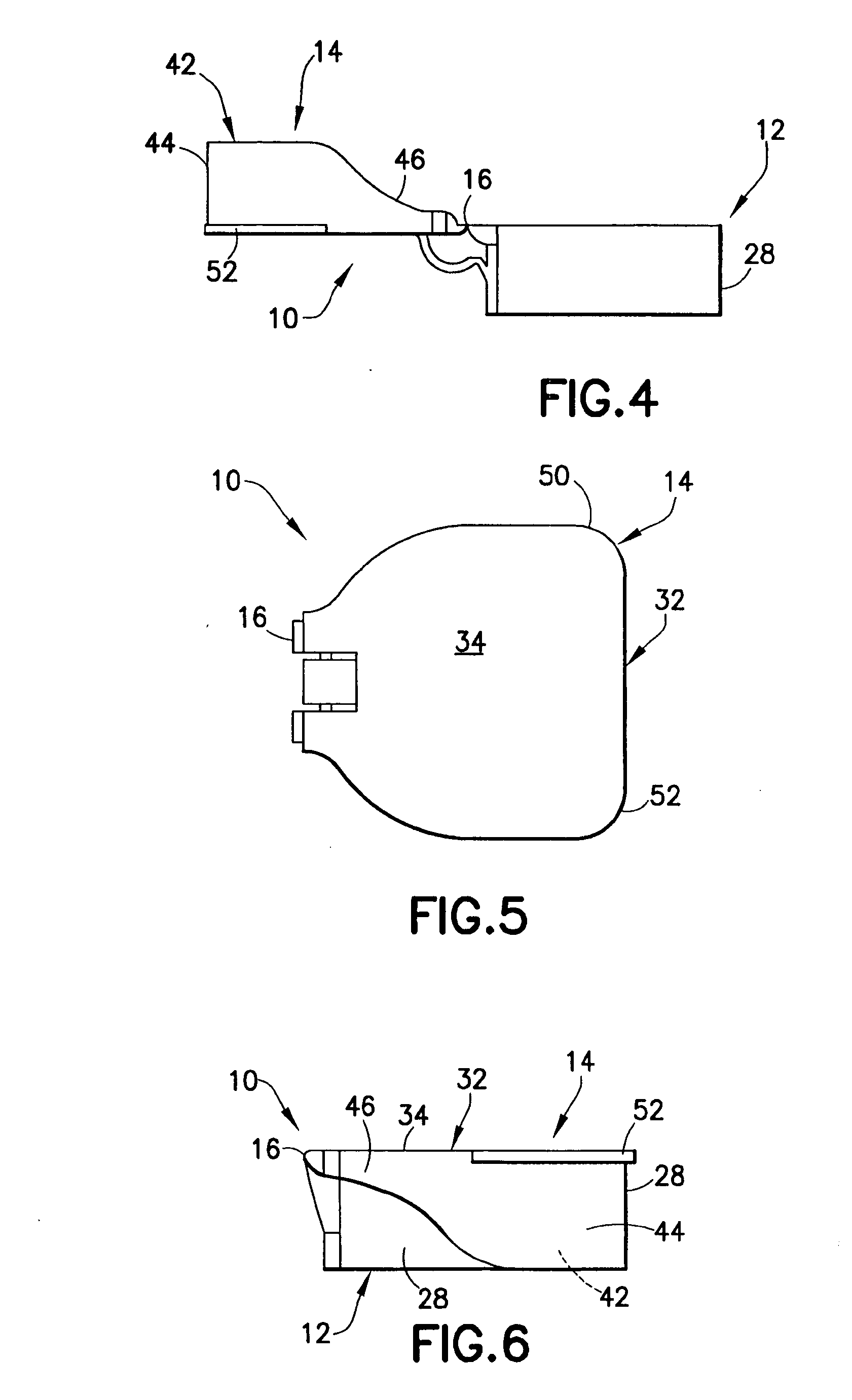
[0026]A cap in accordance with the invention is identified generally by the numeral 10 in FIGS. 1-10. Cap 10 is molded unitarily from resin and includes a body 12 and a lid 14 that are joined unitarily by a living hinge 16. Hinge 16 enables lid 14 to be rotated approximately 180° between a fully open position, as shown in FIGS. 1-4, and a fully closed position, as shown in FIGS. 5 and 6. Additionally, hinge 16 has an over-center design configured to bias lid 14 through the final stages of rotation towards the open position of FIGS. 1-4 and towards the final stages of rotation towards the closed open position of FIGS. 5 and 6.

[0027]Body 12 includes a generally planar top wall 18 with a circular outer periphery 20 and a circular opening 22 concentric with outer periphery 20. A short cylindrical inner wall 24 extends down from top wall 18 concentrically with circular opening 22 in top wall 22. Thus, circular opening 22 and inner wall 24 define a short cylindrical sealing surface 26 fac...