
E-pdcch mapping, and method and apparatus for transmission and reception in wireless communication system
a wireless communication system and mapping technology, applied in the direction of wireless communication, wireless communication, transmission path sub-channel allocation, etc., can solve the problem that control information may not be quickly utilized, reduce the complexity of blind detection of user equipment, reduce the decoding delay of e-pdcch, and improve the efficiency of transmission of e-pdcch
- Summary
- Abstract
- Description
- Claims
- Application Information
AI Technical Summary
Benefits of technology
Problems solved by technology
Method used
Image

Examples
first embodiment
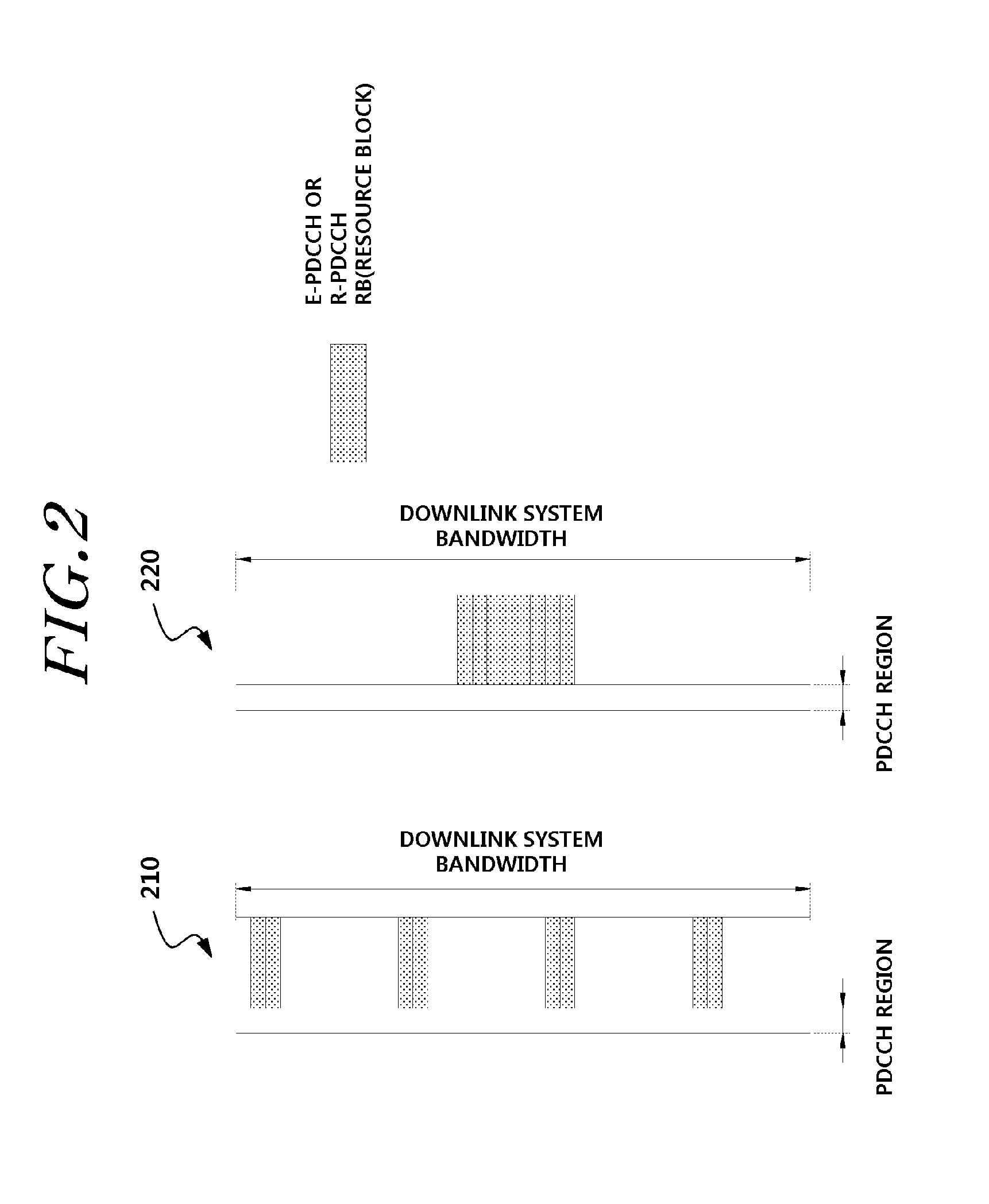
[0093]According to a detailed example of the first embodiment, an E-PDCCH may have various aggregation levels (aggregation level, AL) in the UE specific region and the common region, and an E-PDCCH aggregation level that each UE may have may be limited so as to reduce the complexity (blind detection complexity) of blind detection executed by the UE. Also, an E-PDCCH region in each UE executes reception may be limited to a common or UE specific region, through a high layer signaling. For example, the UE0 may be limited to receive only an E-PDCCH of AL 4 in only the common region. The limitation may be a UE specific or cell specific limitation, or may limit the entire system. As another example, an eNB may inform each UE of E-PDCCH resource limitation information for each resource.
[0094]The signaling scheme will be described in more detail as follows. When each UE desires to receive an E-PDCCH without a separate high layer signaling transferred through a PDSCH, E-PDCCH resource alloca...
second embodiment
[0098]According to the present invention, a blind detection complexity of a user equipment may be reduced by modifying or changing an E-PDCCH mapping scheme based on an aggregation level.
[0099]When the first embodiment of the present invention is applied, an E-PDCCH region allocated to each UE may be divided into a frequency selective scheduling region (UE specific region) and a frequency diversity region (common region) and thus, an E-PDCCH region that provides a scheduling gain may be reduced. This may be a factor that reduces utilization of the E-PDCCH region.
[0100]According to the second embodiment, an E-PDCCH region is set for each UE, and an E-PDCCH transmission scheme is determined in each region, based on an E-PDCCH aggregation level. As described above, in the case in which an E-PDCCH region is set through distributed resource allocation, when an aggregation level becomes high, this may be construed to be a wideband E-PDCCH transmission as opposed to narrow band E-PDCCH tra...
PUM
 Login to View More
 Abstract
Description
Claims
Application Information
 Login to View More