Tongue and seat belt device using same

a technology of tongue and seat belt, which is applied in the direction of vehicle safety belts, braces, vehicle components, etc., can solve the problems of difficult effective restraint of the occupant by the seat belt, and achieve the effect of reducing the width reducing the space, and reducing the thickness of the gripping portion of the tongu

US20150173461A1Active Publication Date: 2015-06-25JOYSON SAFETY SYST JAPAN GK
9 Cites 15 Cited by

Patent Information

Authority / Receiving Office
US · United States
Patent Type
Applications(United States)
Current Assignee / Owner
Publication Date
2015-06-25

Smart Images

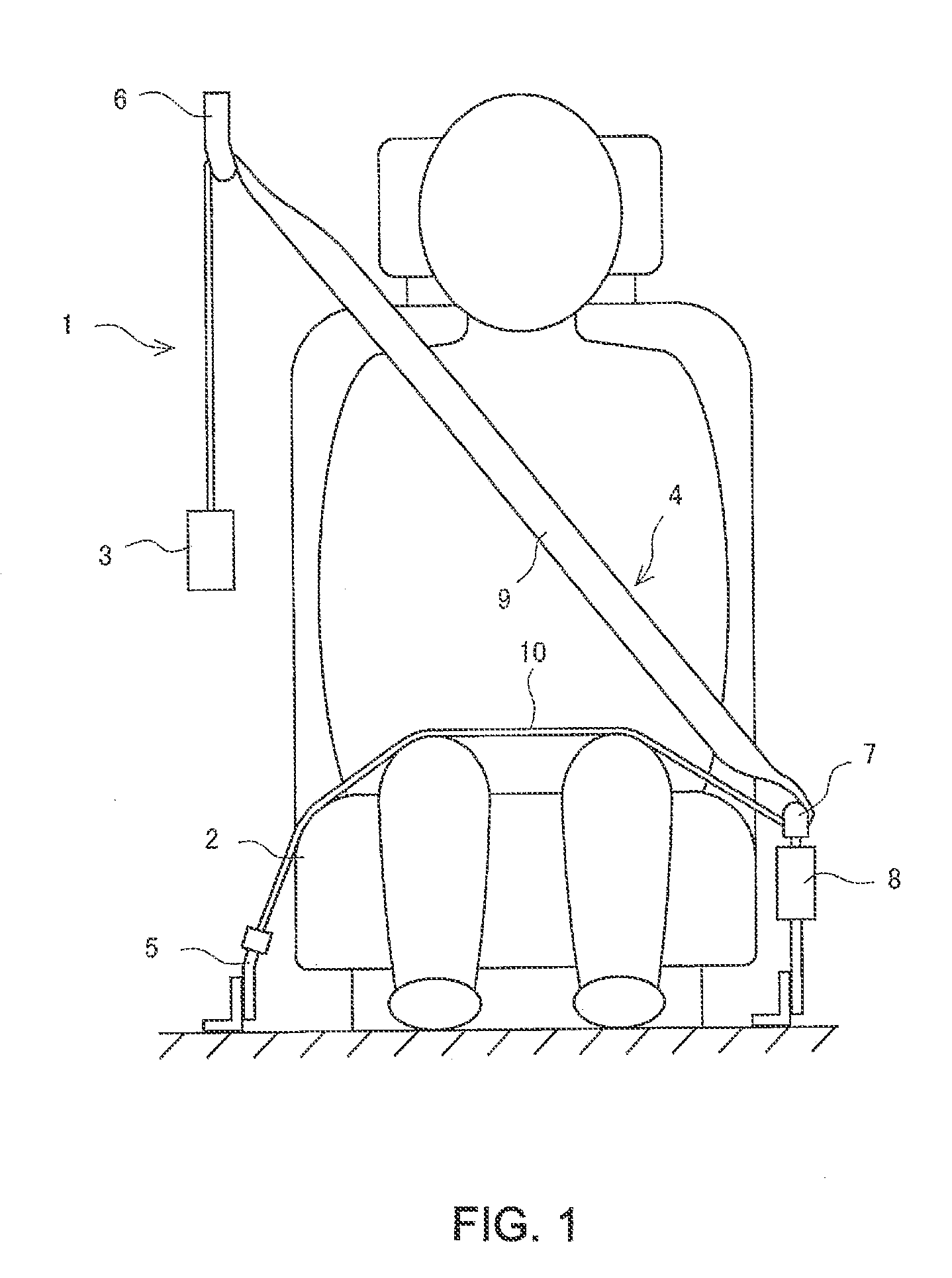
  • Figure 1
    Figure 1
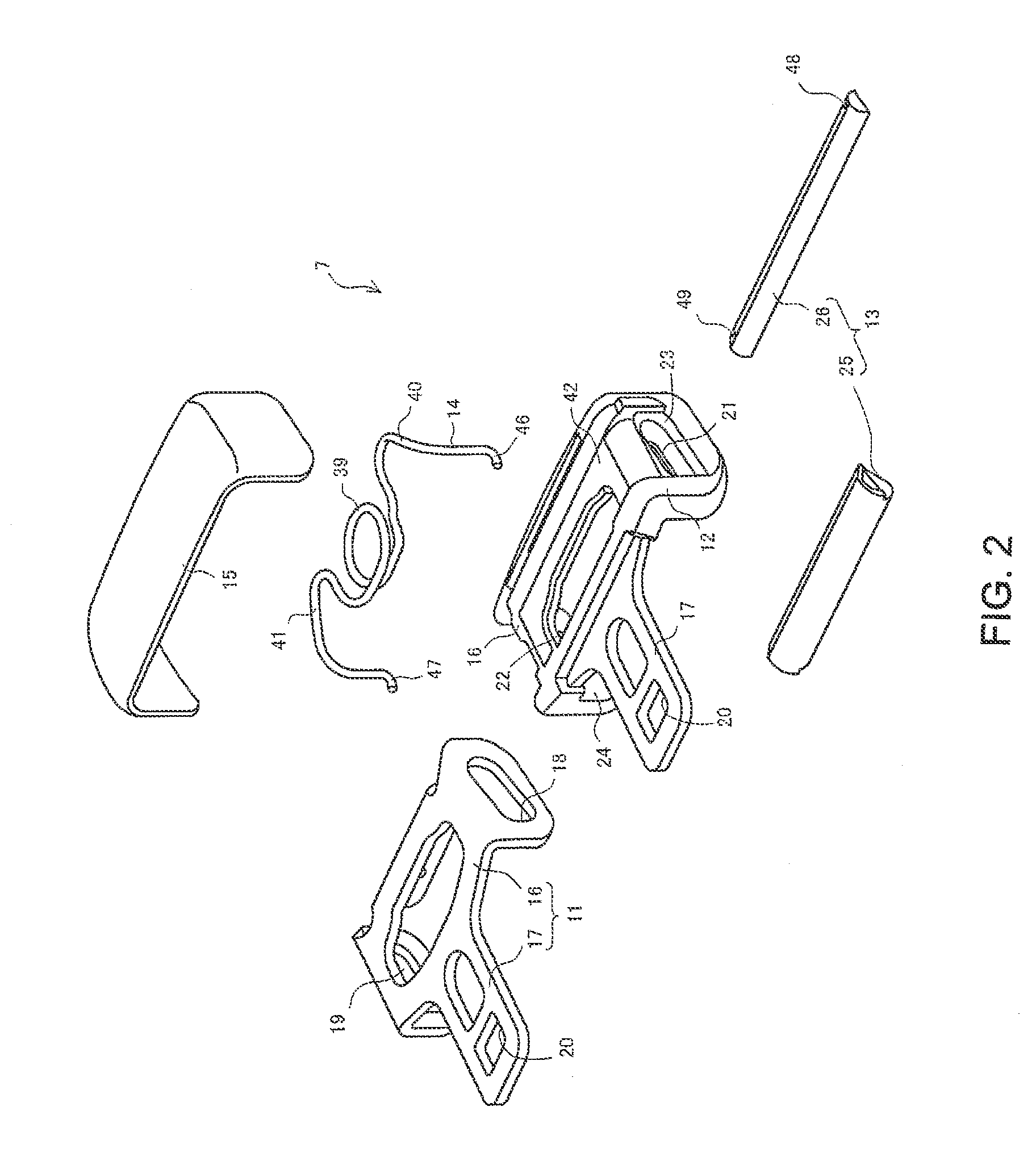
  • Figure 2
    Figure 2
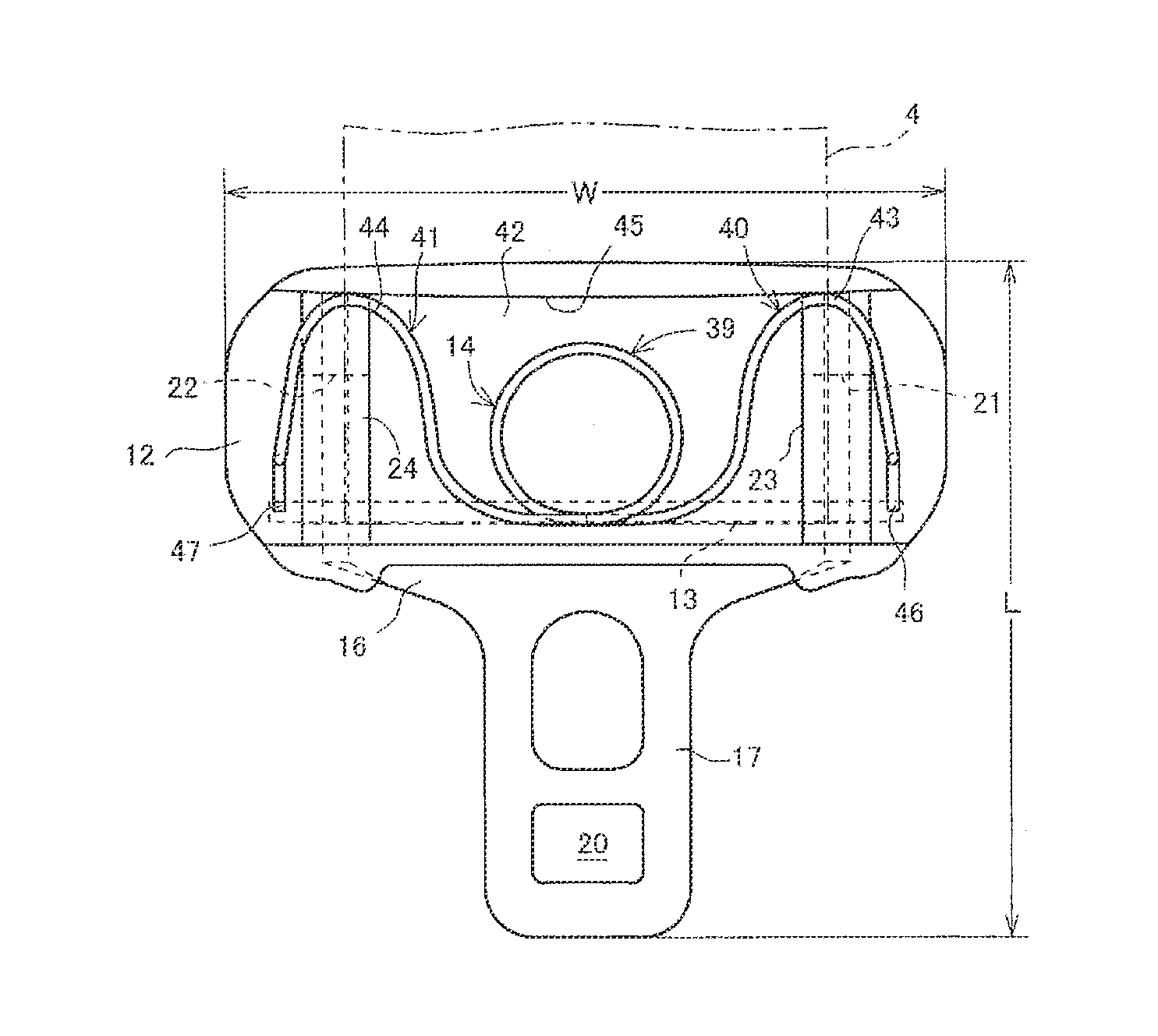
  • Figure 3
    Figure 3
Patent Text Reader

Abstract

[Object] To enable a tongue to be more compact in size even when a seat-belt locking member is disposed and to achieve satisfactory mountability.[Solution] A tongue 7 includes a resin mold portion 12 having seat belt lock guide holes 21 and 22. The resin mold portion 12 is provided with a seat belt lock 13 such that it is movable between an unlocking position where it does not lock a seat belt 4 and a locking position where it locks the seat belt 4 while being guided by the seat belt lock guide holes 21 and 22, and the seat belt lock 13 is set in the unlocking position under normal conditions and is set in the locking position in emergency. The seat belt lock 13 is continuously urged toward the unlocking position by a torsion spring 14. In emergency, the seat belt lock 13 is set in the locking position by a pressing force from the seat belt 4 against the urging force of the torsion spring 14.
Need to check novelty before this filing date? Find Prior Art

Description

TECHNICAL FIELD

[0001] The present invention relates to the technical field of a tongue used in a seat belt device, slidably supported on a seat belt, and engageable in a buckle fixed on a vehicle body or the like and of a seat belt device using the same.BACKGROUND ART

[0002] A traditional seat belt device installed on a vehicle seat in an automobile or the like restrains an occupant using the seat belt in an emergency condition where deceleration acts on the vehicle, such as in a collision, (hereinafter referred to simply as in emergency). One typical example of the seat belt device of this type is a three-point seat belt device, which is widely known and frequently used. In such a typical known three-point seat belt device, a seat belt with its leading end fixed on a vehicle body withdrawn from a seat belt retractor is guided toward an occupant by a belt guide. A tongue is slidably supported on the guided seat belt. In this case, the seat belt penetrates through an elongated seat belt...

Examples

Embodiment Construction

[0035]Embodiments for carrying out the present invention are described below with reference to the drawings.

[0036]FIG. 1 schematically illustrates one example of an embodiment of a seat belt device according to the present invention.

[0037]As illustrated in FIG. 1, the seat belt device in this example is basically the same as a publicly known three-point seat belt device. Referring to FIG. 1, numeral 1 indicates the seat belt device, numeral 2 indicates a vehicle seat, numeral 3 indicates a seat belt retractor arranged in the vehicle body adjacent to the vehicle seat 2, numeral 4 indicates a seat belt retractable by the seat belt retractor 3 in a withdrawable manner and including a belt anchor 5 at the leading end fixed on the floor of the vehicle body or the vehicle seat 2, numeral 6 indicates a belt guide anchor configured to guide the seat belt 4 withdrawn from the seat belt retractor 3 toward the shoulder of an occupant, numeral 7 indicates a tongue slidably supported on the seat...