When students are not engaged. they may not learn the material needed to be successful in a course and ultimately in practice of their chosen profession.
Professionals in these fields are often under extreme pressure, limiting the amount of time, and the availability of hours, they can devote to traveling to seminars and the like or to
traditional classroom studies and courses.
An additional challenge in these fields is that a number of different health, and medical professionals often need to work with each, across professions in an inter-professional manner, other to provide good health and
medical care to patients to improve outcomes.
Yet despite this rising expectation, education far the
individual health and medical professions tends to be somewhat isolated.
Even where the differing schools are on the same campus, they can be very isolated from each other, severely limiting inter-professional educational opportunities.
In addition, students, learners and faculty are often away from campus for various reasons and sometimes not even in the same country.
However, little progress has been made in creating educational experiences a id scenarios that allow students within differing professional training programs to work and learn in an inter-professional way, wherein each student enhances skills needed for their own
specialty while learning to collaborate and integrate with other students inter-professionally.
One obstacle to creating such a
simulation or educational opportunity has been the question of assessment.
When students are not trained together in the health care industry, yet are routinely expected to work together, the education and training fails to match real-world parameters, This can result in a breakdown in the understanding of roles of other professionals and breakdowns in communication, leading to reduced quality care and increased patient safety issues.
Students who do not have the opportunity to interact in a team environment during their education may, when they enter the workplace or practice, not able to meet the needs of employers or effectively function as a team member.
Also, it is difficult for students who do not receive feedback about performing in collaborative and inter-professional settings to improve, let alone, master, working in such settings.
Students who do not receive feedback about interacting in team situations may not understand best way of communication within a team, the role of the other professional, their own role, or team dynamics.
It is not difficult to see how this can lead to errors that affect quality or safety of a product or practice environment, or creates an
unsafe environment for the patient needing care.
Immediate feedback to the student may or may be included, but stealth assessment, benchmarking and feedback to faculty is typically not a part of these games, greatly limiting their usefulness for formal education.
However, scheduling between different types of exercises, not to mention setting up separate and running multiple-profession scenarios, is cumbersome and cost prohibitive for some educational systems.
The simulations are usually limited by time and place and budgets, and can be a large drain on resources.
Further, learning about other professions and their expectations and challenges, even within these training scenarios, is typically not given priority due to all of the other curricular requirements.
Feedback and assessment in programs tends to still be used on each student's knowledge of their own
specialty, giving them little incentive to focus on team or inter-professional competencies.
However, such
simulation laboratories and
simulation mannequins are often cost prohibitive for many schools.
The size of the lab and the type of mannequin an advanced simulation requires, laboratories equipped for use by multiple students particularly for inter-professional education involving multiple types of students and scenarios, can cost millions of dollars to build and even more to provide the human capital to operate the lab and equipment.
Overall, these labs are cumbersome and expensive to equip, and learning opportunities are not consistent or easily scheduled.
They are usually not available to a large number of those obtaining a health professions education, and rarely, if ever, to undergraduate students.
These types of simulations are also typically not available in education outside a college or university program, such as K-12 environments or in professional working environments
Neither classroom nor laboratory simulations nor scenarios, despite their high cost and time involvement, fully meet the need of enabling all students in professions to practice inter-professionally and to learn about different roles or real team interactions because of the limitation of time and space.
Accordingly, little has been done towards providing an educational experience that will provide adequate inter-professional interactive opportunities with sufficient and appropriate feedback for student understanding and improvement.
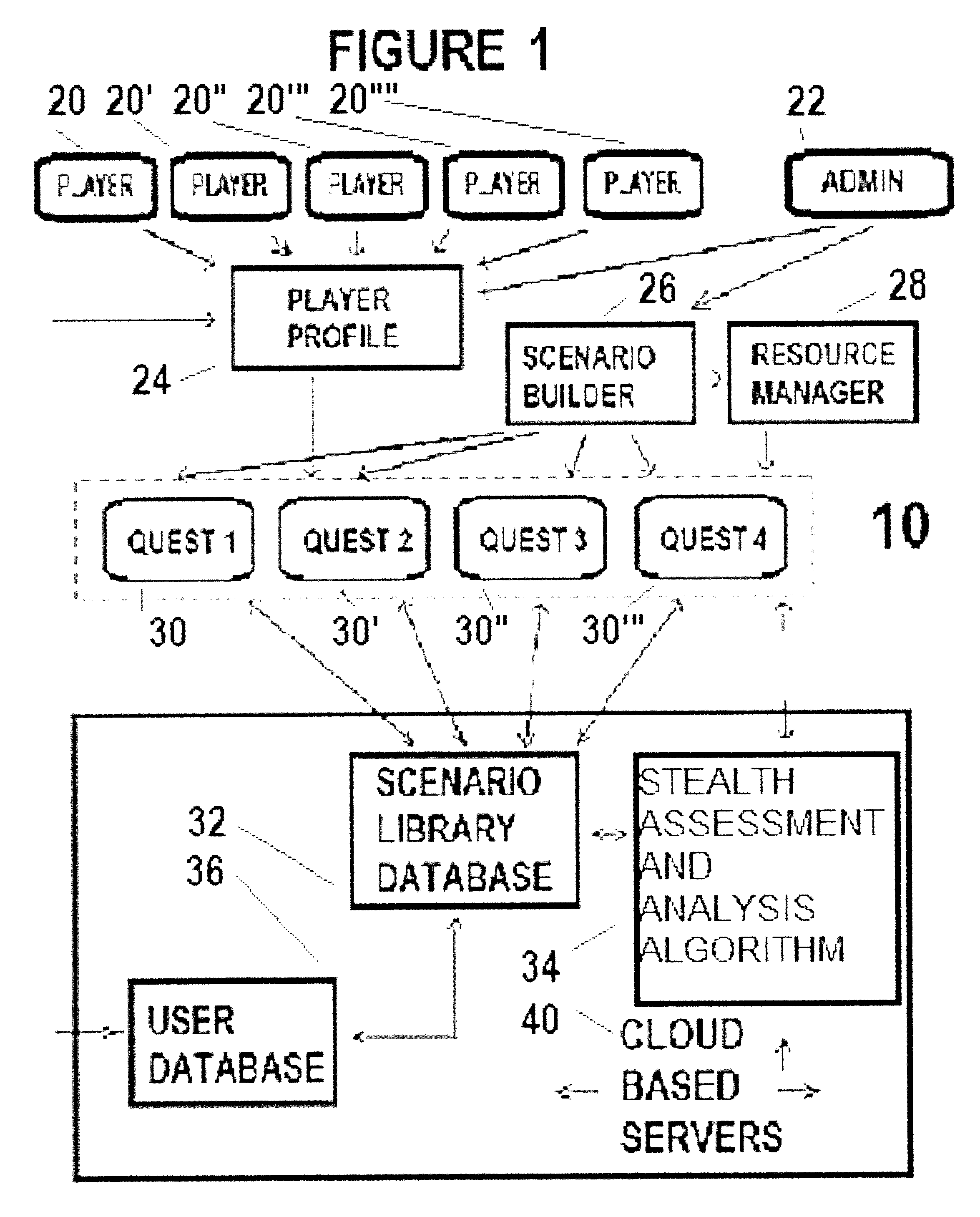
Players who do not engage in good team work, or who seek
advantage by maneuvering or outright
cheating will be provided with
negative feedback to the stealth assessment and analysis interface and rather than profit from this lack of teamwork and / or ethics, will face reduced resources and a concurrently lowered assessment.


 Login to View More
  Login to View More