Method for identifying optimal regions for cardioversion therapy (variants)

a cardioversion therapy and optimal region technology, applied in the field of physiotherapy, can solve the problems of not providing for the search of significant differences in measured values, and significant dependence of the parameters of free oscillation, so as to increase the objectivity and accuracy, reduce the influence, and increase the reliability of identification and accuracy of localizing optimal electropulse therapy zones.

US20190143107A1Inactive Publication Date: 2019-05-16ZAKRYTOE AKTSIONERNOE OBSHCHESTVO OKB RITM
2 Cites 0 Cited by

Patent Information

Authority / Receiving Office
US · United States
Patent Type
Applications(United States)
Current Assignee / Owner
Publication Date
2019-05-16
Estimated Expiration
Not applicable · inactive patent

Smart Images

  • Figure 1
    Figure 1
  • Figure 2
    Figure 2
  • Figure 3
    Figure 3
Patent Text Reader

Abstract

The group of inventions relates to medicine (physiotherapy). Electric stimuli which are generated by the following ringing circuit: active electrode-inductive storage unit-passive electrode-interelectrode tissues-active electrode, contain oscillations which are used as a test signal. In one variant of the method the electrodes are successively applied (in another variant—moved uniformly) across the skin area. Every time the electrodes-to-skin contact is detected, the oscillation parameters are recorded after a delay. Moreover, the values of parameters can be averaged. The group of invention provides the use of both combined and disjointed (separated) electrodes. An optimal zone for electropulse therapy is identified by minimal or maximal value of one or more parameters of the aforementioned oscillations and the use of the principle of “small asymmetry”. The group of inventions provides an increase in the accuracy with which zones optimal for electropulse therapy are identified and localized.
Need to check novelty before this filing date? Find Prior Art

Description

CROSS REFERENCE TO RELATED APPLICATIONS

[0001] The present patent application is a National stage patent application from PCT application PCT / RU2017 / 000080 filed Feb. 17, 2018 which claims priority to Russian patent application RU2016107880 filed Mar. 3, 2016.TECHNICAL FIELD

[0002] The group of inventions refers to physiotherapy, in particular, the means of electropulse stimulation of the human skin by SCENAR devices and similar to those, in which the inductive energy storage unit is used for generating stimuli, and can be used in diagnostic, therapeutic, rehabilitation and preventive purposes.BACKGROUND OF THE INVENTION

[0003] Currently, the stimulators using this principle are manufactured in Russia (SCENAR, DENAS, TINER, etc.) as well as in other countries (Interx, Avazzia, Physiokey, etc.).

[0004] An important aspect of the use of such stimulators is the search for the zones optimal for electric stimulation.

[0005] The use of inductive energy storage unit for stimuli generation allows to ...

Examples

Embodiment Construction

[0039]The first variant is to search the optimal zones for electropulse therapy by the successive placement of the electrodes.

[0040]It is known that when the electrodes contact the skin surface, which is generally a complex mixture of aqueous solutions, a number of processes occur at the “metal-solution” boundary.

[0041]This is, above all, the formation of the difference of potentials (double electric layer) called electrode potential (Grechin, V. (1997), “Neurophysiology techniques,” Nauka, p. 7-9).

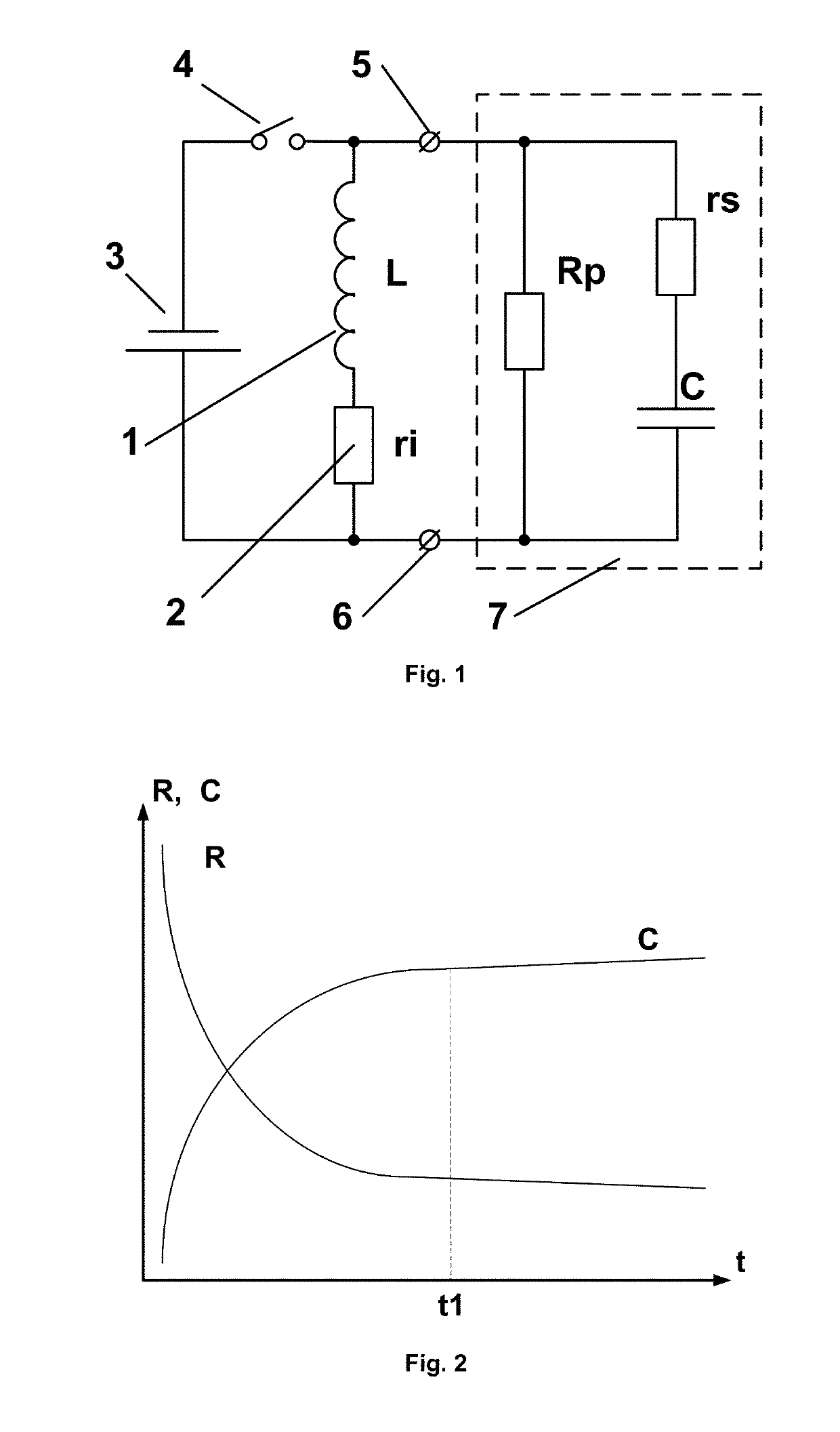
[0042]The functional diagram of the output stage of the device, that influences by the stimuli generated with the inductive storage unit, is shown in the FIG. 1.

[0043]The output stage includes inductive energy storage unit 1 with internal active resistance 2, connected to the power source 3 through switch 4 and to electrodes 5 and 6, which are placed on the tissue of the biological object, the electric equivalent of which is presented by the RC circuit 7 (see Popechitelev, E. P. and M. Ko...