Depth-aware method for mirror segmentation

Pending Publication Date: 2022-07-21
DALIAN UNIV OF TECH
View PDF0 Cites 0 Cited by
  • Summary
  • Abstract
  • Description
  • Claims
  • Application Information

AI Technical Summary

Benefits of technology

The present invention is the first method to use both RGB and depth information to segment mirrors in computer vision tasks. This method uses the depth perception of the scene, the discontinuity of RGB and depth, and the correlation between the inside and outside of the mirror to accurately segment the mirror area. The method is effective in eliminating the interference of the mirror with the visual system and can successfully segment the mirror area from the image, even in complex environments. The method is applicable to various types of mirrors and has been tested on images with small-sized, large-sized, and multiple mirrors. The technical effect of the invention is the reliable and accurate segmentation of mirrors in computer vision tasks.

Problems solved by technology

But there are some special objects cannot be ignored in most scenes, such as mirrors.
Such objects will greatly affect the understanding of the scene and then affect the accuracy of various computer vision tasks and applications.
It is essentially different from other objects, so segmenting mirror in the scene is a very challenging task.
Yet, mirrors confuse many vision systems as they are unable to distinguish real from reflected scenes.
However, treating mirrors as an additional semantic category fails to produce satisfactory results as the visible mirror content is further semantically classified.
Therefore, the existing SOD method cannot solve the mirror segmentation.

Method used

the structure of the environmentally friendly knitted fabric provided by the present invention; figure 2 Flow chart of the yarn wrapping machine for environmentally friendly knitted fabrics and storage devices; image 3 Is the parameter map of the yarn covering machine
View more

Image

Smart Image Click on the blue labels to locate them in the text.
Viewing Examples
Smart Image
  • Depth-aware method for mirror segmentation
  • Depth-aware method for mirror segmentation

Examples

Experimental program
Comparison scheme
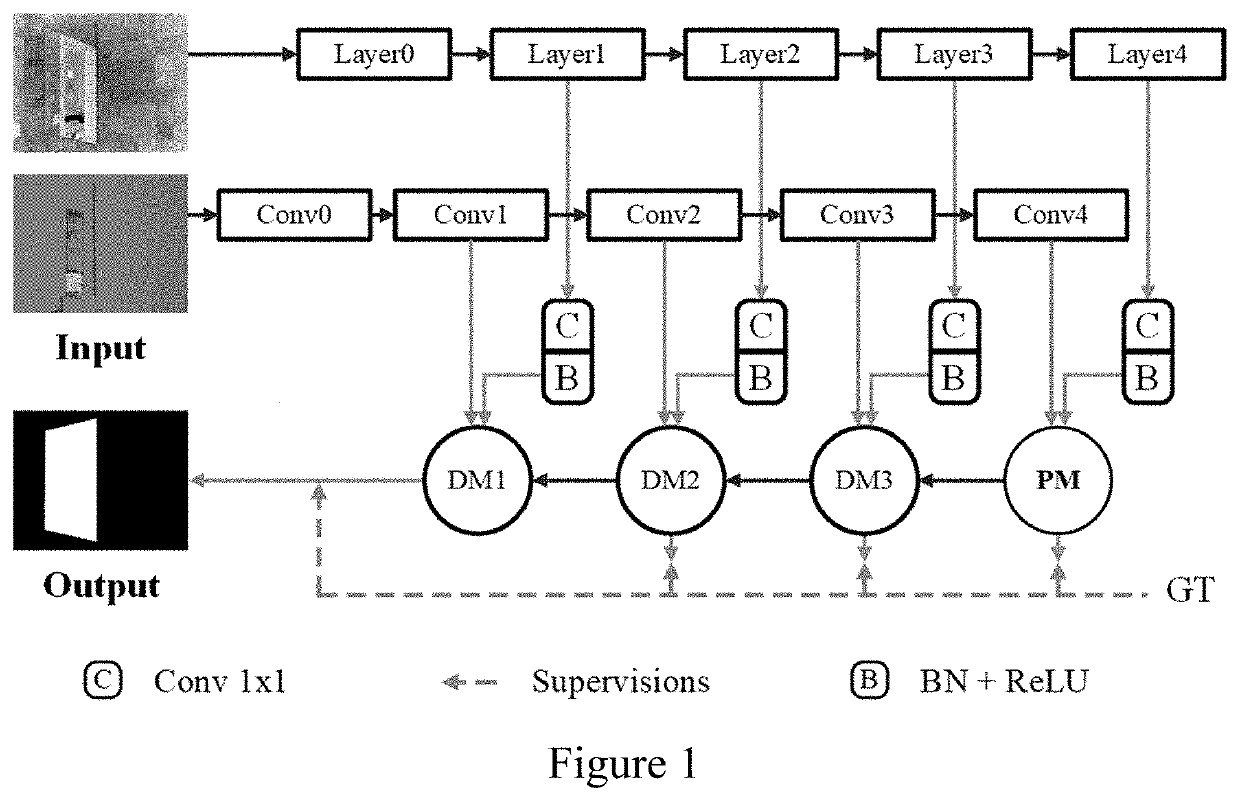
Effect test

Embodiment Construction

[0029]The specific embodiments of the present invention will be further described below in conjunction with the drawings.

[0030]The mirror dataset RGBD-Mirror with depth information used in this embodiment contains 3049 groups of pictures, each group of pictures has an RGB mirror image, and a corresponding depth image and a manually annotated mask image. The dataset is randomly divided into a training set composed of 2000 groups of images and a test set composed of 1049 groups of images. The images with multiple sizes in the dataset will be uniformly scaled to 416×416 during training, and the output segmentation result images will be readjusted to the original size of the input image. The parameters of the feature extraction network are initialized by the pre-trained ResNet-50 network, and other parameters are initialized randomly.

[0031]In PDNet, the RGB and depth images are respectively passed through two multi-level feature extractors to obtain RGB and depth features, and the extra...

the structure of the environmentally friendly knitted fabric provided by the present invention; figure 2 Flow chart of the yarn wrapping machine for environmentally friendly knitted fabrics and storage devices; image 3 Is the parameter map of the yarn covering machine
Login to View More

PUM

No PUM Login to View More

Abstract

The invention belongs to scene segmentation's field in computer vision and is a depth-aware method for mirror segmentation. PDNet successively includes a multi-layer feature extractor, a positioning module, and a delineating module. The multi-layer feature extractor uses a traditional feature extraction network to obtain contextual features; the positioning module combines RGB feature information with depth feature information to initially determine the position of the mirror in the image; the delineating module is based on the image RGB feature information, combined with depth information to adjust and determine the boundary of the mirror. This method is the first method that uses both RGB image and depth image to achieve mirror segmentation in an image. The present invention has also been further tested. For mirrors with a large area in a complex environment, the PDNet segmentation results are still excellent, and the results at the boundary of the mirrors are also satisfactory.

Description

TECHNICAL FIELD[0001]The invention belongs to the scene segmentation methods in the computer vision field, and the specific realization result is the segmentation of image content, and particularly relates to a mirror segmentation method in real scenes.BACKGROUND[0002]Two-dimensional image segmentation refers to distinguishing the pixels belonging to different objects in the scene image and determining their size, shape, and position. It is a key step from image processing to image analysis and has great application value. But there are some special objects cannot be ignored in most scenes, such as mirrors. Such objects will greatly affect the understanding of the scene and then affect the accuracy of various computer vision tasks and applications. The characteristics of the mirror make the mirror area present the content of the scene in front of it. Diversity of the scene, diversity of objects in the scene, and diversity of direction and tilt angle of the mirror determine the varie...

Claims

the structure of the environmentally friendly knitted fabric provided by the present invention; figure 2 Flow chart of the yarn wrapping machine for environmentally friendly knitted fabrics and storage devices; image 3 Is the parameter map of the yarn covering machine
Login to View More

Application Information

Patent Timeline
no application Login to View More
IPC IPC(8): G06T7/11G06T7/174G06T7/73G06N3/08
CPCG06T7/11G06T7/174G06T7/74G06N3/08G06T2207/20221G06T2207/10028G06T2207/20081G06T2207/20084G06T2207/10024G06N3/04G06V10/454G06V10/82G06V10/26G06V20/64G06V10/255G06N3/048
InventorDONG, WENYANG, XINMEI, HAIYANGWEI, XIAOPENGZHANG, QIANG
OwnerDALIAN UNIV OF TECH