
Three dimensional measurement, evaluation and grading system for fabric/textile structure/garment appearance
a three-dimensional measurement and fabric technology, applied in the direction of static indicating devices, instruments, image enhancement, etc., can solve the problems of too slow and too expensive industrial applications, the degree of permanent in-plane and out-of-plane deformation, and the limited application of the method, so as to achieve the effect of obtaining 3-d surface information more quickly and easily
- Summary
- Abstract
- Description
- Claims
- Application Information
AI Technical Summary
Benefits of technology
Problems solved by technology
Method used
Image

Examples
Embodiment Construction
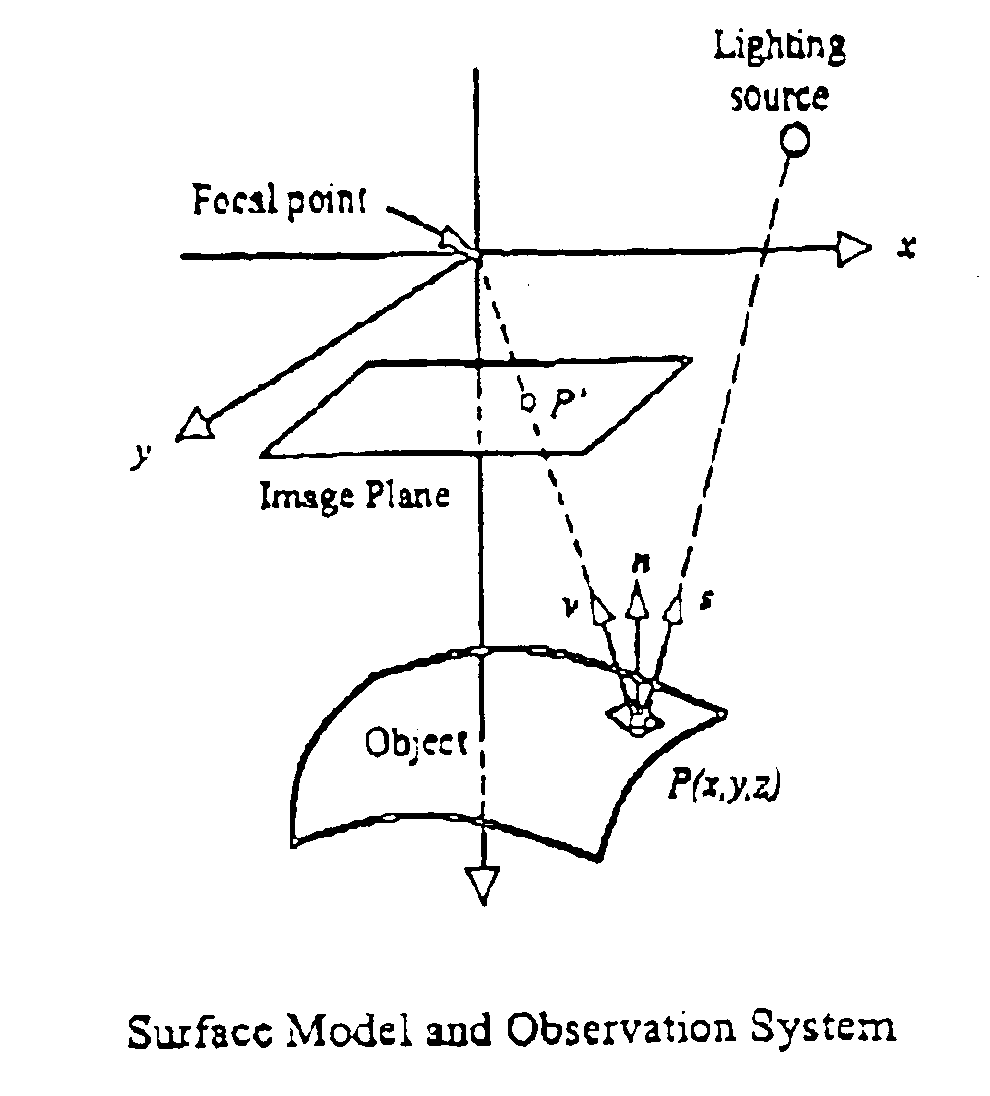
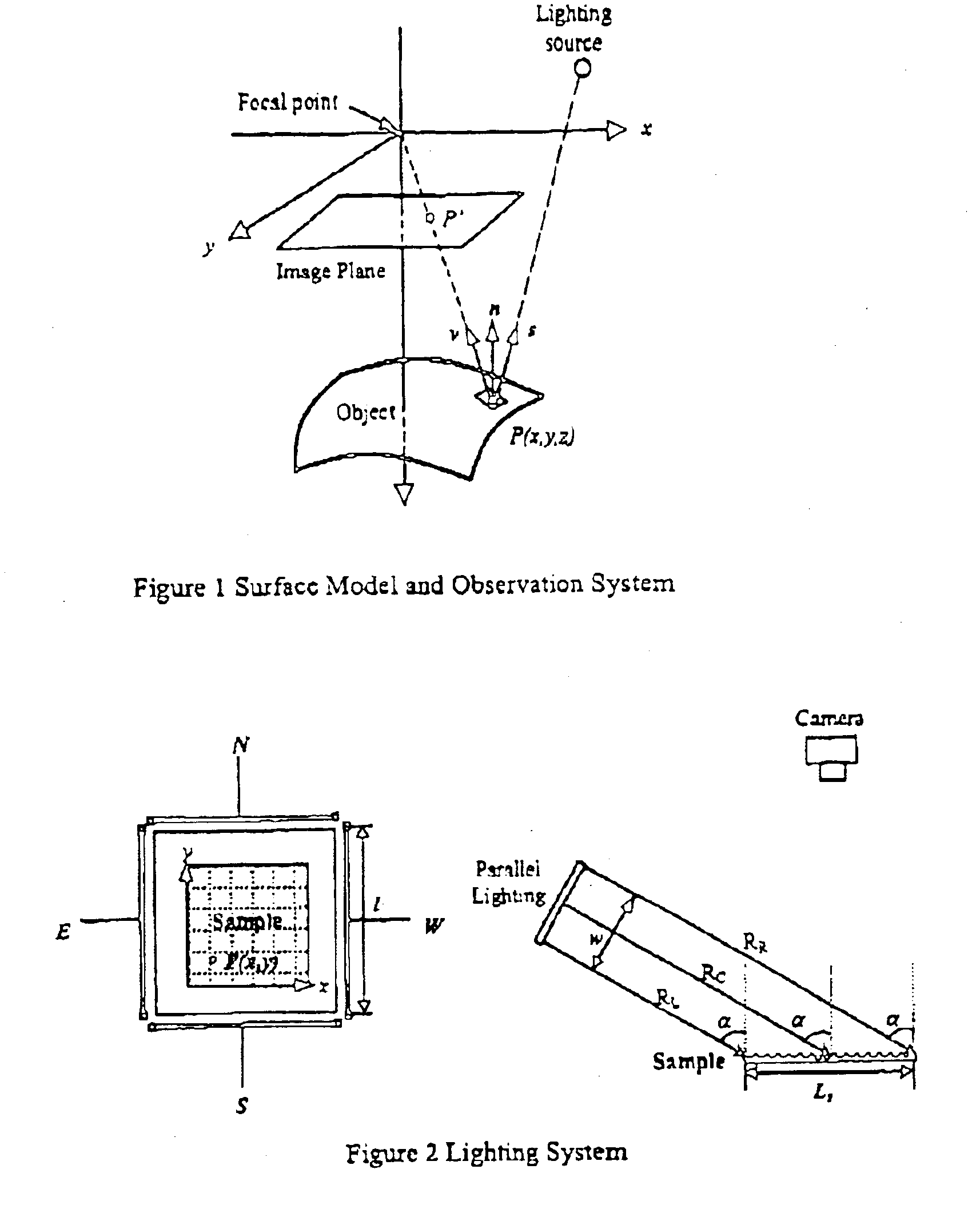
Referring to the drawings, the method relies on shining four parallel light sources on to a surface of a fabric specimen. When a ray of light strikes the surface of fabric, specular and diffuse reflections take place. These reflection characteristics depend on the surface of the material, surface microstructure, incident wavelength, and the direction of incidence of the light. However, it is acceptable to visualize most fabric surfaces as Lambertian surfaces, which scatter incident light equally in all directions and appear equally bright from all directions (see FIG. 1).
According to Lambert's cosine law, the intensity of an image element P′ corresponding to a Lambertian reflecting surface is given by the relationship
I(x,y)=c(x,y)cos θ (1)
Where c(x,y) is the reflective parameter of corresponding surface element P, and θ is the incident angle at this element. As shown in FIG. 1, P,n,s,v are respectively a surface element of an object, normal vector of P, vector of P, incident vector...
PUM
| Property | Measurement | Unit |
|---|---|---|
| surface normal gradients | aaaaa | aaaaa |
| tg | aaaaa | aaaaa |
| imaging technology | aaaaa | aaaaa |
Abstract
Description
Claims
Application Information
 Login to View More