
Apparatus and method for the estimation of flow -independent parameters which characterize the relevant features of nitric oxide production and exchange in the human lungs
a flow-dependent parameter and nitric oxide technology, applied in the field of methods and apparatus for determining physiological parameters indicative of lung condition, can solve the problem that the constant flow rate maneuver cannot provide information regarding the origin of endogenous no production, inconsistent absolute concentrations, and conclusions
- Summary
- Abstract
- Description
- Claims
- Application Information
AI Technical Summary
Benefits of technology
Problems solved by technology
Method used
Image

Examples
case ii
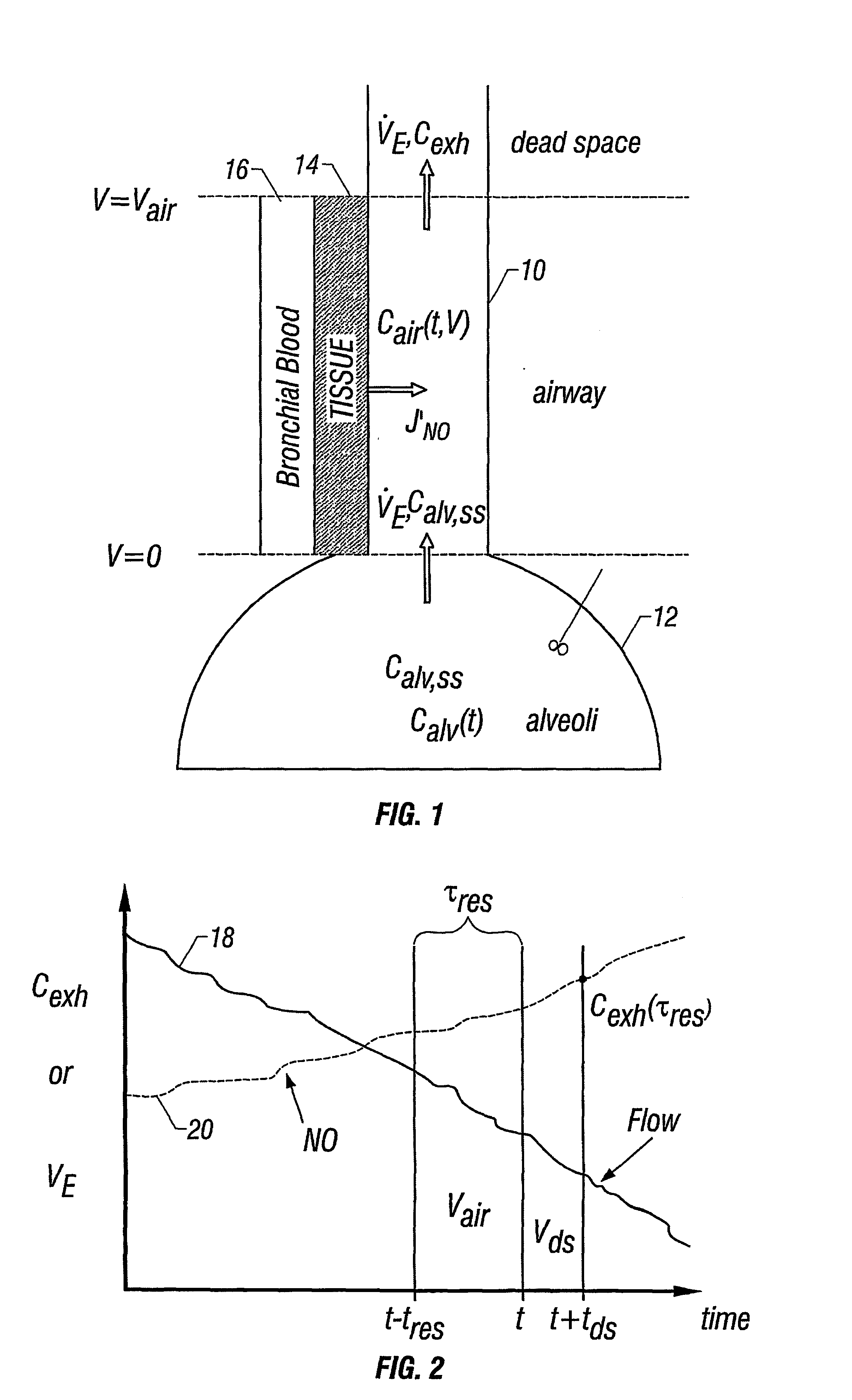
represents the emptying of the gas in Phase III of the exhalation profile, or the alveolar plateau. Phase II is not described by the model as axial diffusion is neglected to preserve an analytical solution; the compensation for this simplification is described in Parameter Estimation. During Phase III, the expired air originates primarily from the alveolar compartment 12. Thus, Cin is equivalent to Calv,ss, and Tres(t) is calculated from Eq. 5. In this case, the flow signal is provided entirely by the expiratory flow rate.
FIG. 2 is a graph which depicts the method used for analyzing the experimental data (Eq. 3-5) and demonstrating the “backward” integration of the flow signal to convert exhalation time to residence time of each exhaled bolus of gas. The concentration of a gas bolus is determined at time t+tds. By using the flow rate history of the bolus, one can integrate the flow rate signal backward until the volume of the deadspace and the airway volume has been traversed. In do...
PUM
 Login to View More
 Abstract
Description
Claims
Application Information
 Login to View More