Multi-carrier transmission/reception apparatus

a transmission/receiving apparatus and multi-carrier technology, applied in the direction of orthogonal multiplex, multiplex communication, assess restriction, etc., can solve the problems of delay wave due to multipath propagation, degrade transmission characteristics, and similarly take time, so as to suppress interference and radio resources

US7386055B2Inactive Publication Date: 2008-06-10PANASONIC INTELLECTUAL PROPERTY CORP OF AMERICA
5 Cites 72 Cited by

Patent Information

Authority / Receiving Office
US · United States
Current Assignee / Owner
Publication Date
2008-06-10
Estimated Expiration
Not applicable · inactive patent

Smart Images

  • Figure 1
    Figure 1
  • Figure 2
    Figure 2
  • Figure 3
    Figure 3
Patent Text Reader

Abstract

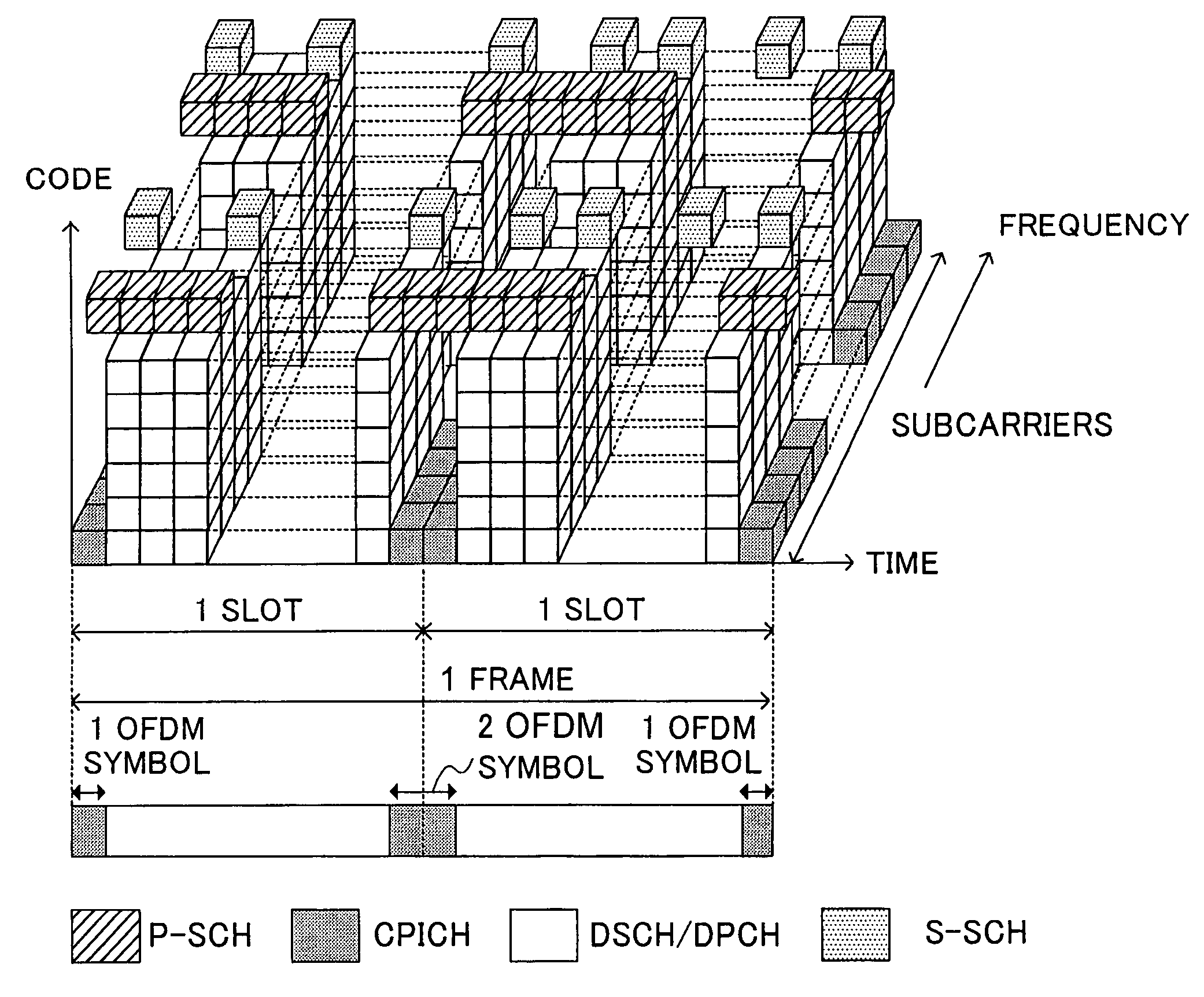
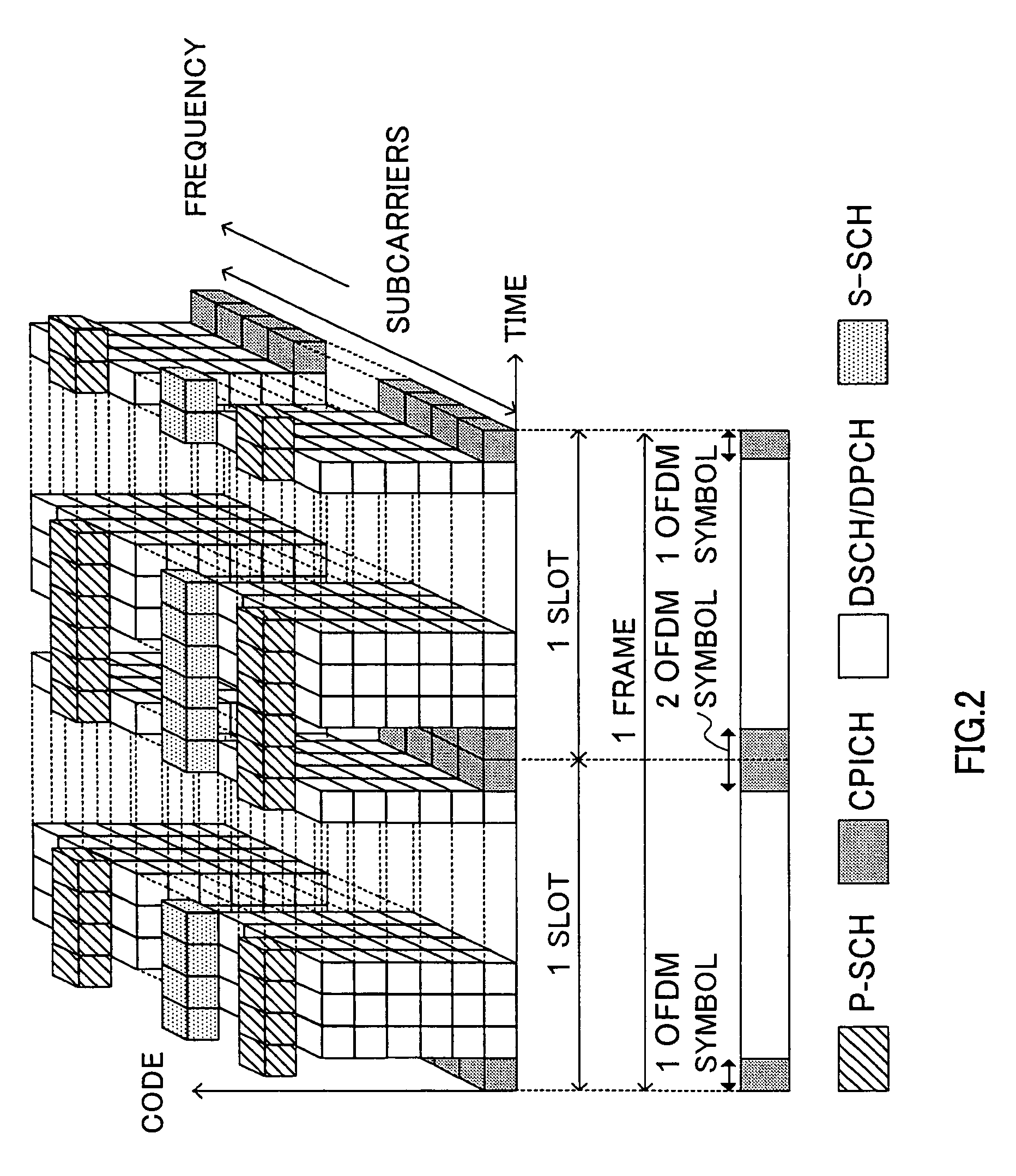
A multicarrier radio communication technology that enables radio resources to be used effectively, interference-to be suppressed, and a cell search to be performed at high speed, in a multicarrier CDMA system. In this technology, a secondary synchronization code (S-SCH signal) for identifying the group of scrambling codes divided into groups beforehand is frequency multiplexed in a plurality of subcarriers. A secondary synchronization code is coded in the time direction. Subcarriers in which a secondary synchronization code is multiplexed are mutually separated and equally spaced. The number of subcarriers in which a secondary synchronization code is multiplexed can be set to a small value with respect to the total number of subcarriers. A secondary synchronization code is an orthogonal code. On the receiving side, a cell search is carried out using such a frequency multiplexed type S-SCH.
Need to check novelty before this filing date? Find Prior Art

Description

TECHNICAL FIELD

[0001] The present invention relates to a multicarrier transmitting / receiving apparatus, multicarrier radio communication method, and multicarrier radio communication program.BACKGROUND ART

[0002] Nowadays, in radio communications, and especially in mobile communications, various kinds of information such as images and data are transmitted as well as voice. Henceforth, demand for the transmission of various kinds of content is expected to continue to grow, further increasing the necessity of highly reliable, high-speed, large-volume transmission. However, when high-speed transmission is carried out in mobile communications, the effect of delayed waves due to multipath propagation cannot be ignored, and transmission characteristics degrade due to frequency selective fading.

[0003] Multicarrier modulation methods such as OFDM (Orthogonal Frequency Division Multiplexing) are attracting attention as one kind of technology for coping with frequency selective fading. A multicarr...

Examples

Embodiment Construction

[0027]With reference now to the accompanying drawings, an embodiment of the present invention will be explained in detail below. In the embodiment described below, it is assumed that, for example, the Secondary Synchronization Code (SSC) or Secondary Synchronization Channel (S-SCH) in the “cell search procedure” disclosed in 3GPP standard “TS25.214 Physical Layer Procedures (FDD)” is used as a scrambling code group identification code.

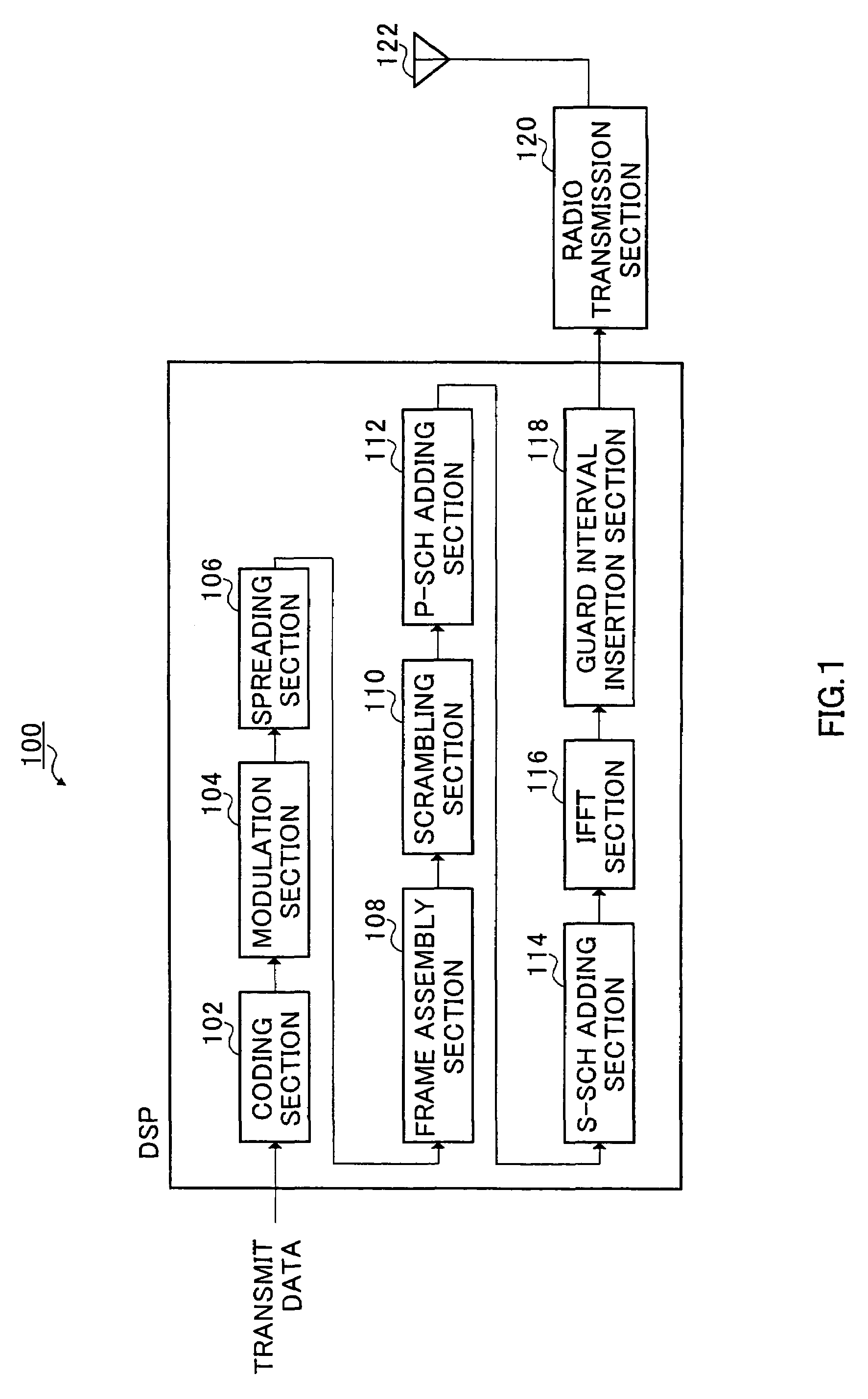
[0028]FIG. 1 is a block diagram showing the configuration of a multicarrier transmitting apparatus according to one embodiment of the present invention.

[0029]Multicarrier transmitting apparatus (hereinafter referred to simply as “transmitting apparatus”) 100 shown in FIG. 1 uses multicarrier CDMA, and has a coding section 102, modulation section 104, spreading section 106, frame assembly section 108, scrambling section 110, Primary Synchronization Channel (P-SCH) adding section 112, Secondary Synchronization Channel (S-SCH) adding section114, Inverse F...