Borosilicate glass compositions and uses thereof

a technology of borosilicate glass and compositions, applied in the field of glass compositions, can solve the problems of cracks, reduced glass properties, and reduced mechanical strength of sintered glass products

Inactive Publication Date: 2009-10-06
CORNING INC
View PDF9 Cites 0 Cited by
  • Summary
  • Abstract
  • Description
  • Claims
  • Application Information

AI Technical Summary

Benefits of technology

The borosilicate glass composition effectively resists devitrification and maintains mechanical strength and chemical durability, preventing thermal shock and chemical reagent resistance while maintaining low softening points and compatible thermal expansion with other device components.

Problems solved by technology

However, powdered borosilicate glass (borosilicate glass frit) undergoes devitrification (i.e., formation of cristobalite, tridymite, and / or quartz crystals that lead to a decrease in glass properties) during sintering at between about 700-800° C. Crystal formation with high CTE lowers the mechanical strength of the sintered glass product.
Thus, when powdered borosilicate glass is used to make frit layers on a substrate having a low CTE, devitrification increases global CTE of the frit layer and thereby causes cracks to form.
The addition of alumina, however, causes the sintering ability of the frit glass to decrease.
Thus, a heretofore unaddressed need exists in the industry to form a glass frit that addresses the aforementioned deficiencies and / or inadequacies.

Method used

the structure of the environmentally friendly knitted fabric provided by the present invention; figure 2 Flow chart of the yarn wrapping machine for environmentally friendly knitted fabrics and storage devices; image 3 Is the parameter map of the yarn covering machine
View more

Image

Smart Image Click on the blue labels to locate them in the text.
Viewing Examples
Smart Image
  • Borosilicate glass compositions and uses thereof

Examples

Experimental program
Comparison scheme
Effect test

Embodiment Construction

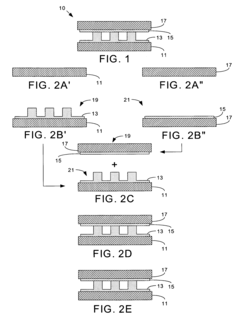
[0016]Embodiments of the present invention provide for borosilicate glass compositions, methods of preparation thereof, and structures incorporating borosilicate glass formed from the borosilicate glass compositions. Embodiments of the present invention overcome at least some of the aforementioned deficiencies and inadequacies described above by providing borosilicate glass compositions that self-inhibit the formation of detrimental crystals. As discussed above, formation of one or more of these crystals may likely cause an increase in the coefficient of thermal expansion (CTE). Consequently, the glass product loses mechanical strength due, at least in part, to the volume change associated with crystal formation.

[0017]In addition, the borosilicate glass compositions may be formulated to resist thermal shock, be chemically resistant to acidic and alkaline chemical reagents, and have low softening points, while not devitrifying and causing crystals.

[0018]In particular, a glass formed ...

the structure of the environmentally friendly knitted fabric provided by the present invention; figure 2 Flow chart of the yarn wrapping machine for environmentally friendly knitted fabrics and storage devices; image 3 Is the parameter map of the yarn covering machine
Login to View More

PUM

PropertyMeasurementUnit
softening pointaaaaaaaaaa
weight percentaaaaaaaaaa
Login to View More

Abstract

Glass, glass compositions, methods of preparing the glass compositions, microfluidic devices that include the glass composition, and methods of fabricating microfluidic devices that include the glass composition are disclosed. The borosilicate glass composition includes silicon dioxide (SiO2) in a range from about 60% to 74% by total composition weight; boric oxide (B2O3) in a range from about 9% to 25% by total composition weight; aluminum oxide (Al2O3) in a range from about 7% to 17% by total composition weight; and at least one alkali oxide in a range from about 2% to 7% by total composition weight. In addition, the borosilicate glass has a coefficient of thermal expansion (CTE) that is in a range between about 30×10−7 / ° C. and 55×10−7 / ° C. Furthermore, the borosilicate glass composition resists devitrification upon sintering without the addition of an inhibitor oxide.

Description

[0001]This application claims the benefit of priority under 35 U.S.C. § 119 of European Patent Application Serial No. 02 292 981.4 filed on Dec. 3, 2002. This application further claims the benefit of priority under 35 U.S.C. § 120 of U.S. patent application Ser. No. 10 / 728,523 filed on Dec. 2, 2003.CROSS-REFERENCE TO RELATED APPLICATION[0002]This application is related to U.S. utility patent application entitled “A Microfluidic Device and Manufacture Thereof” filed on 12 May 2004 and accorded Ser. No. 10 / 843,949, now issued as U.S. Pat. No. 7,007,709, which is a continuation of Ser. No. 10 / 454,985, filed 4 Jun. 2003 and now issued as U.S. Pat. No. 6,769,444, which is a continuation of Ser. No. 10 / 163,215, filed 4 Jun. 2002 and now issued as U.S. Pat. No. 6,595,232, which is entirely incorporated herein by reference.TECHNICAL FIELD[0003]The present invention is generally related to glass compositions and, more particularly, is related to borosilicate glass compositions and uses ther...

Claims

the structure of the environmentally friendly knitted fabric provided by the present invention; figure 2 Flow chart of the yarn wrapping machine for environmentally friendly knitted fabrics and storage devices; image 3 Is the parameter map of the yarn covering machine
Login to View More

Application Information

Patent Timeline
no application Login to View More
Patent Type & AuthorityPatents(United States)
IPC IPC(8): C03B19/00C03B19/01C03B32/00C03B5/00C03C3/089C03C3/091C03C3/093B81B1/00B81C1/00G01N1/00
CPCC03C3/093C03C3/091B81C1/00119B01J2219/00783B01J2219/00831C03B19/06C03B2215/412
InventorMARQUES, PAULO
OwnerCORNING INC