
Digital rights management negotiation for streaming media over a network
a technology of streaming media and rights management, applied in the direction of selective content distribution, television system, instruments, etc., can solve the problems of affecting the widespread adoption of digital media distribution using drm technology, affecting the rights of artists and copyright owners, and affecting the effect of drm technology
- Summary
- Abstract
- Description
- Claims
- Application Information
AI Technical Summary
Benefits of technology
Problems solved by technology
Method used
Image

Examples
Embodiment Construction
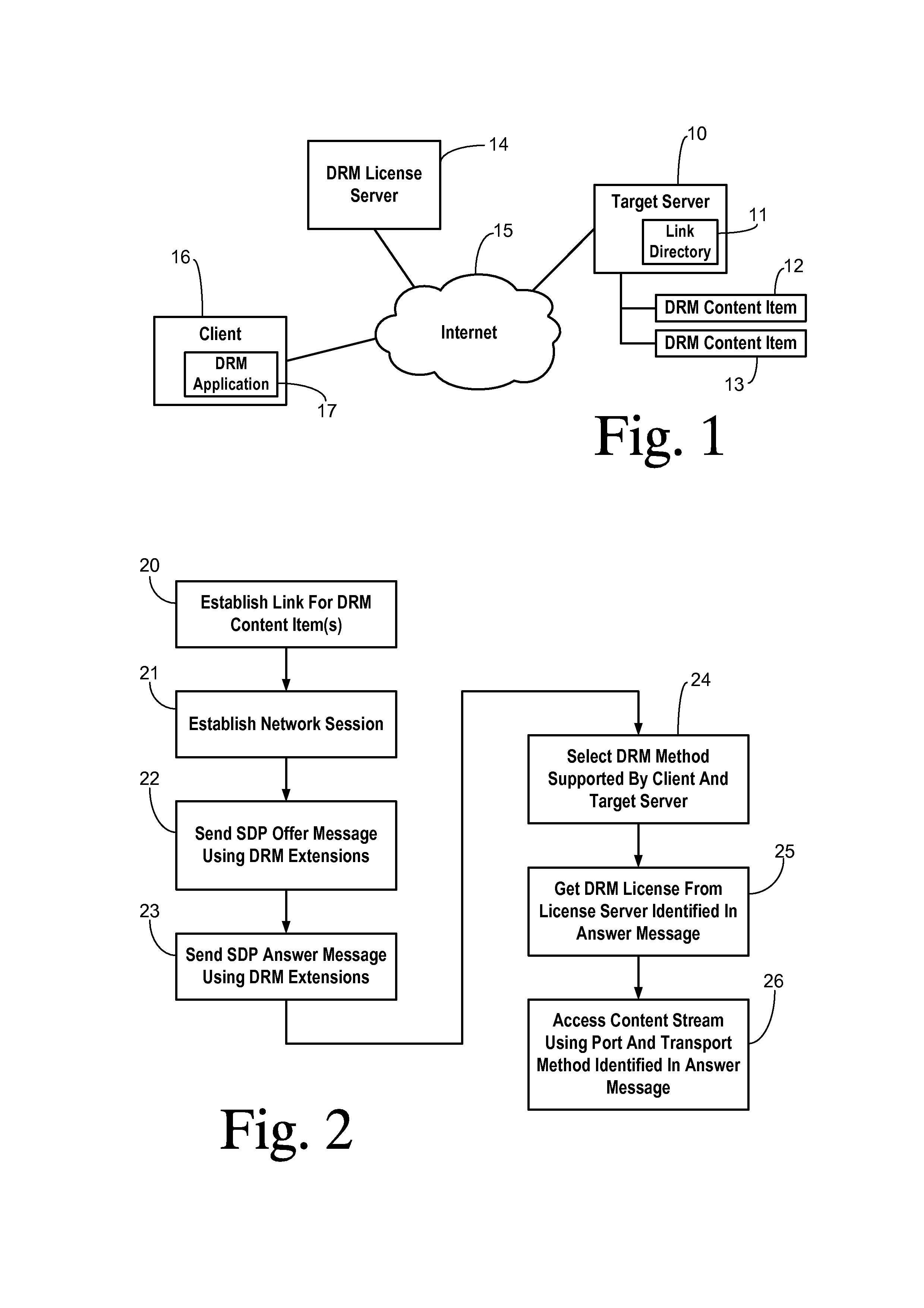
[0019]Referring to FIG. 1, a target server 10 includes a link directory 11 for pointing to a plurality of DRM encoded content items, including items 12 and 13. The content items may include digital music files in a music distribution system or digital video files in a video distribution system, for example. The content items may also be comprised of recorded voice mail messages in an IP telephony system as will be described later. Target server 10 preferably supports a plurality of DRM methods. Consequently, the content items may include multiple files containing the same media content that are encoded differently according to separate DRM methods.
[0020]Target server 10 is coupled to a DRM license server 14 via Internet 15 so that licensing information (e.g., decryption key, license rules, and license qualifications) can be transferred to DRM license server 14 when content items are added to target server 10. A client 16 (e.g., a user's personal computer) is connected to Internet 15...
PUM
 Login to View More
 Abstract
Description
Claims
Application Information
 Login to View More