Lenticular product

a technology of lenticular products and lenticular tubes, which is applied in the field of lenticular products, can solve the problems of deterring simple tasks by arrays, and achieve the effects of low viscosity, high viscosity, and substantial optical flatness

US8310761B1Active Publication Date: 2012-11-13TRACER IMAGING
15 Cites 6 Cited by

Patent Information

Authority / Receiving Office
US · United States
Patent Type
Patents(United States)
Current Assignee / Owner
Publication Date
2012-11-13

Smart Images

  • Figure 1
    Figure 1
  • Figure 2
    Figure 2
  • Figure 3
    Figure 3
Patent Text Reader

Abstract

A lenticular product having a see-through window or lens is made by depositing a clear coating on a lenticular sheet. The lenticular product permits scanning a bar code or reading textual data that is printed on an image viewable through the lenticular product for animated, morphing, or stereographic effect. The window or lens of the lenticular product can also provide optical effects (e.g., magnification) in addition to the effects provided by the lenticular sheet. The lenticular product can be made by depositing fluid or resin in a one- or two-step process.
Need to check novelty before this filing date? Find Prior Art

Description

CROSS REFERENCE TO RELATED APPLICATIONS

[0001] The present application claims priority to, and hereby incorporates herein by reference in its entirety, U.S. Provisional Application 60 / 945,657, filed Jun. 22, 2007.FIELD OF THE INVENTION

[0002] The present invention relates to lenticular products and, more particularly, to local surface modification of the patterned relief of a lenticular sheet for improving the rendering, readability, and detection of graphics such as (but not limited to) printed imagery, fonts, symbols, fine text, or bar codes.BACKGROUND OF THE INVENTION

[0003] In the interest of a better understanding of the invention, certain conventions and practices within the trade may be appreciated.

[0004] Lenticular lenses, or lenticules, are typically cylindrical bodies having longitudinal axes and arranged in a parallel-axis array on a lenticulated face of a lenticular sheet. The face opposite the lenticulated face typically is substantially planar. Seen in cross-section, each len...

Examples

Embodiment Construction

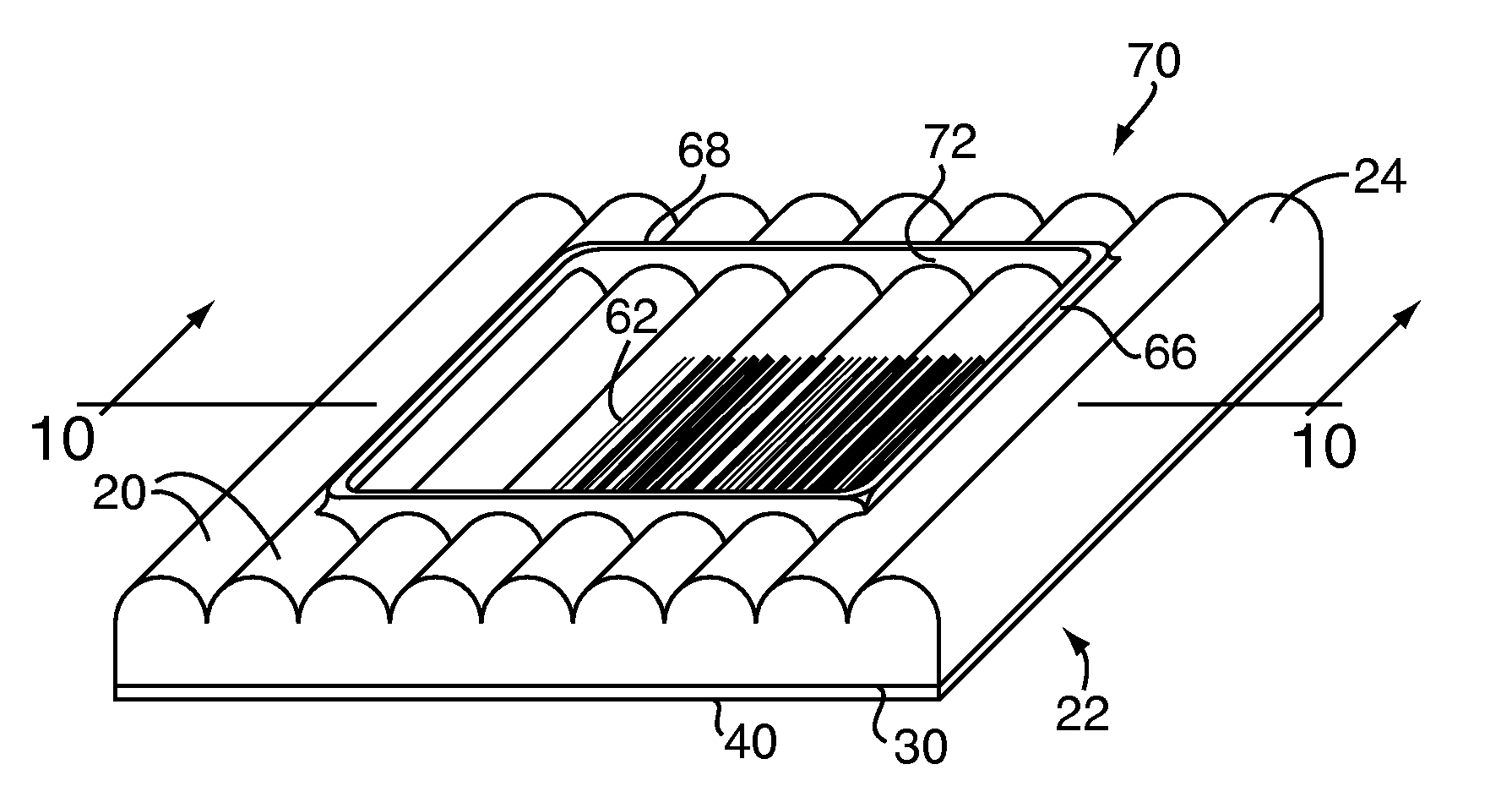
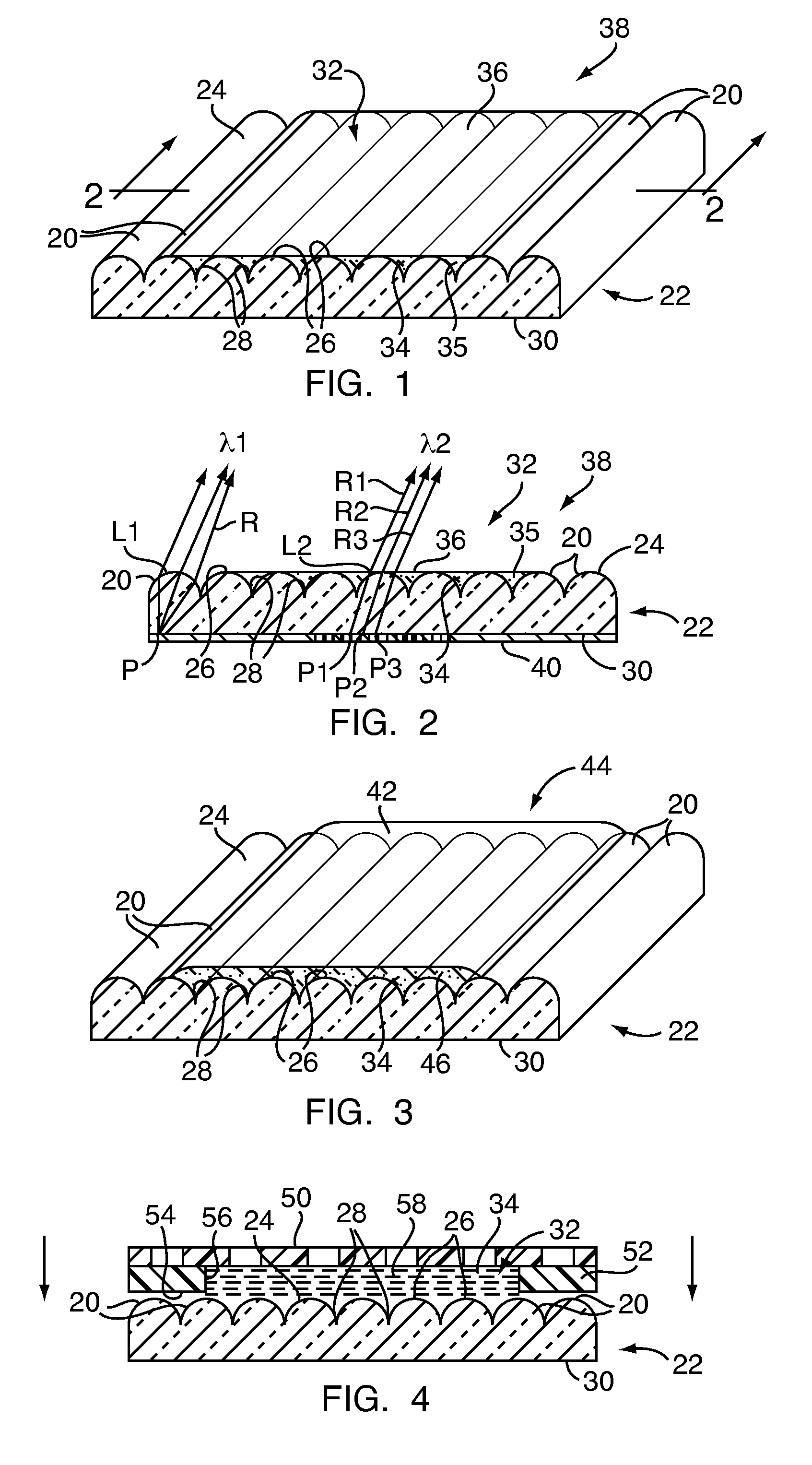
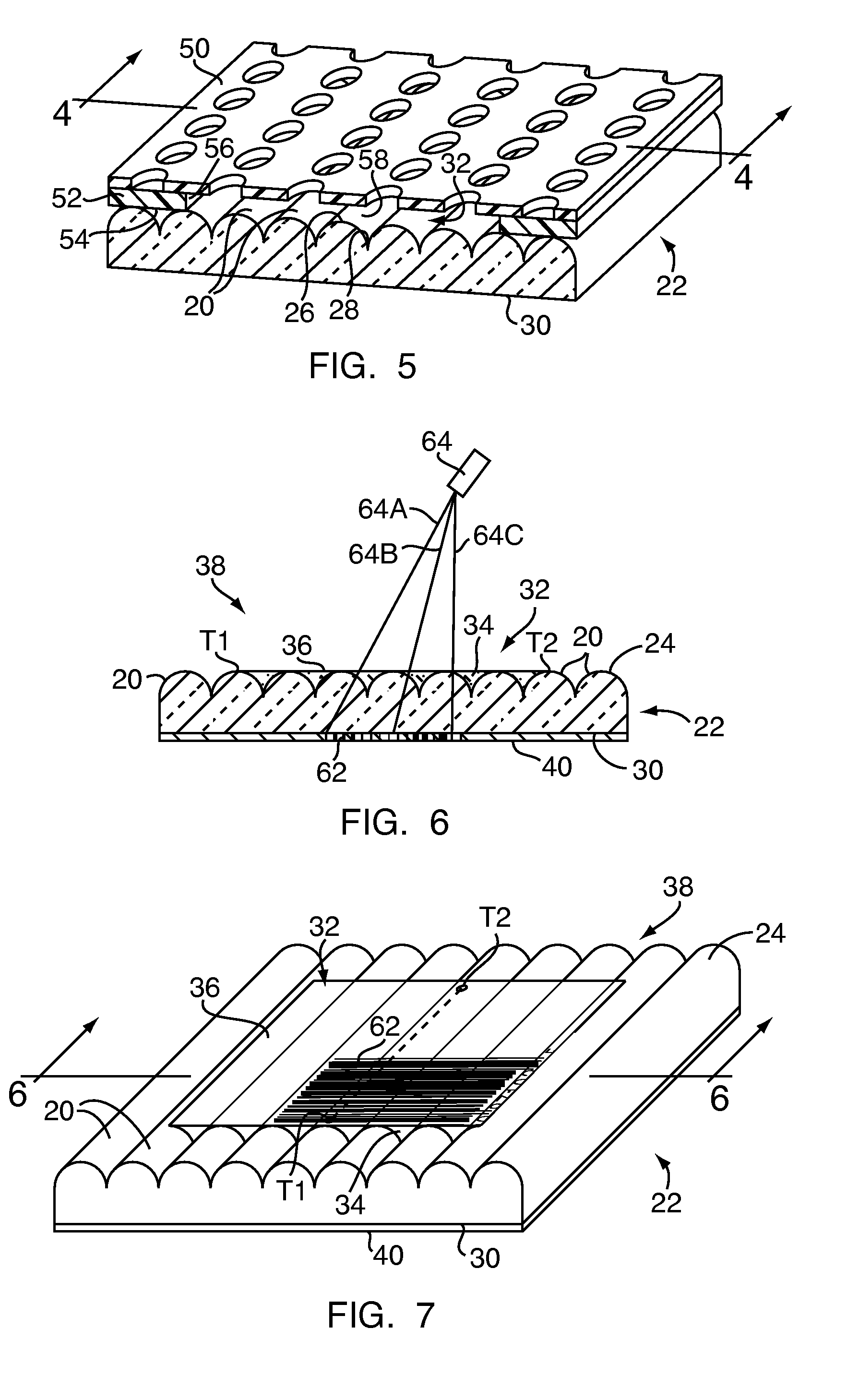
[0040]In view of the foregoing discussion of the art and the summary of the invention, and referring now to the drawings and the specifics particular to the present invention, FIG. 1 shows a plurality of lenticules 20 formed on a transparent lenticular sheet 22. The plurality of lenticules 20 are arrayed in parallel to form a lenticulated surface 24 having vertices 26 and valleys 28. The lens sheet also includes an unpatterned surface 30. The unpatterned surface 30 is most typically planar, but may also be curved around one or more axes if the transparent lenticular sheet 22 itself is contoured conformally to a cylindrical, conical, or other achievable geometrical shape.

[0041]In FIG. 1, a portion 32 of the lenticulated surface 24 has been modified by depositing an amount of a substantially clear coating 34 sufficient to fill the valleys 28, thereby forming a filled region 35 having a surface 36 that is substantially tangent to the vertices 26 of the lenticules 20.

[0042]If the coatin...