
Fire log
a fire log and log stack technology, applied in the field of fire logs, can solve the problems of inconvenient tinder spherical fire, inability to consistently reliable fire tinder, and inability to stack log arrays according to some theoretical design, so as to achieve the effect of increasing or decreasing flame intensity, easy ignitability
- Summary
- Abstract
- Description
- Claims
- Application Information
AI Technical Summary
Benefits of technology
Problems solved by technology
Method used
Image

Examples
Embodiment Construction
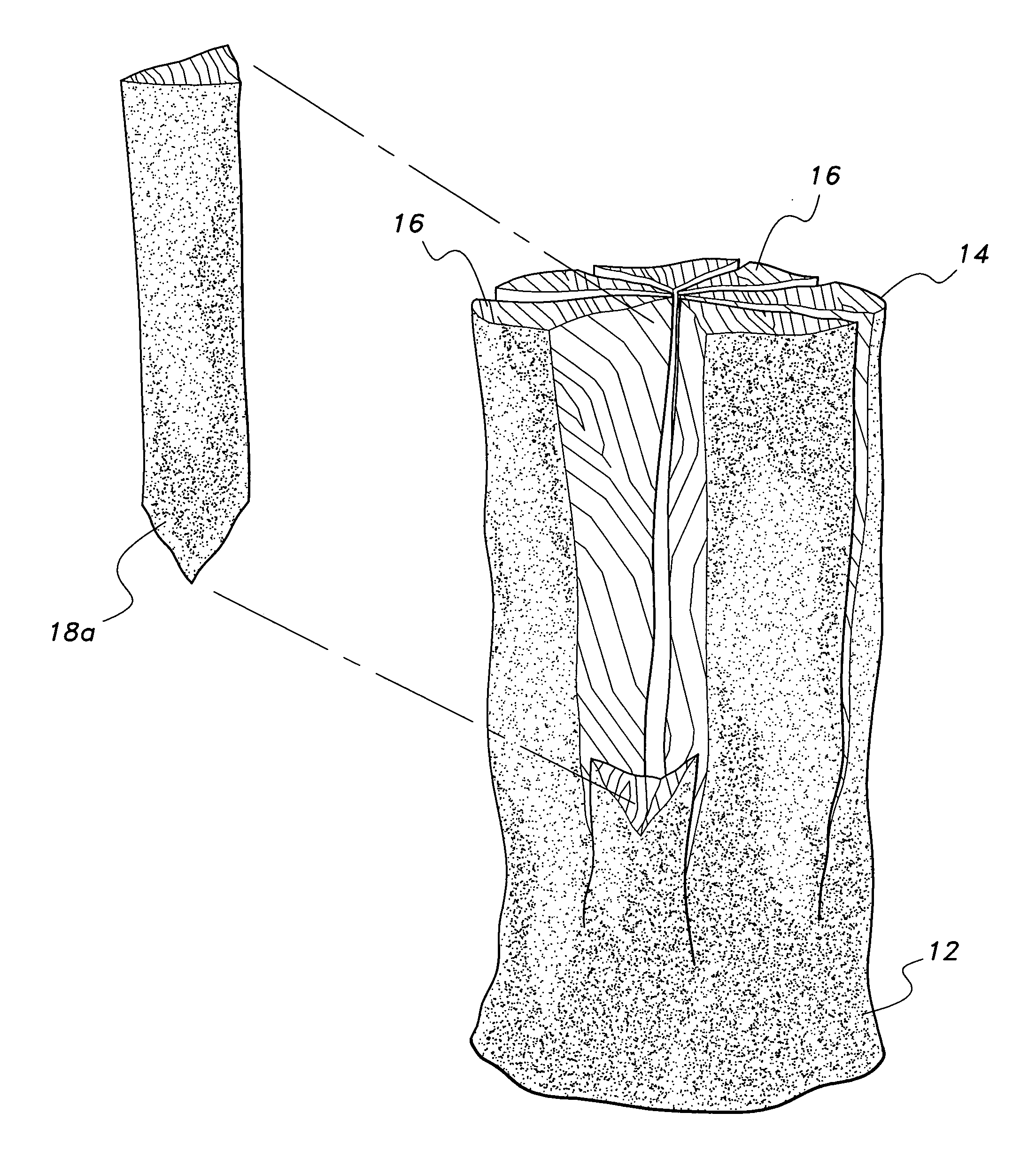
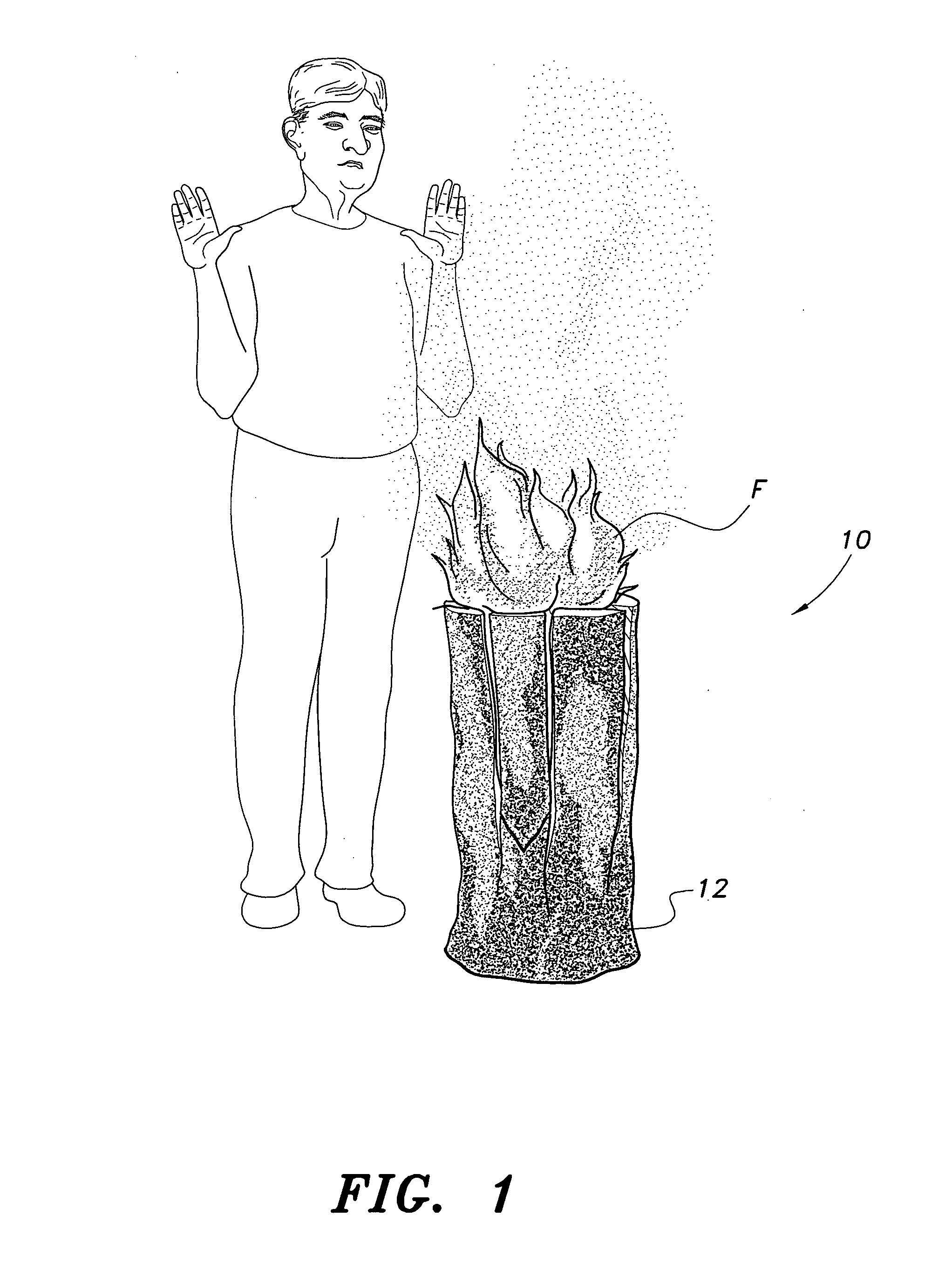
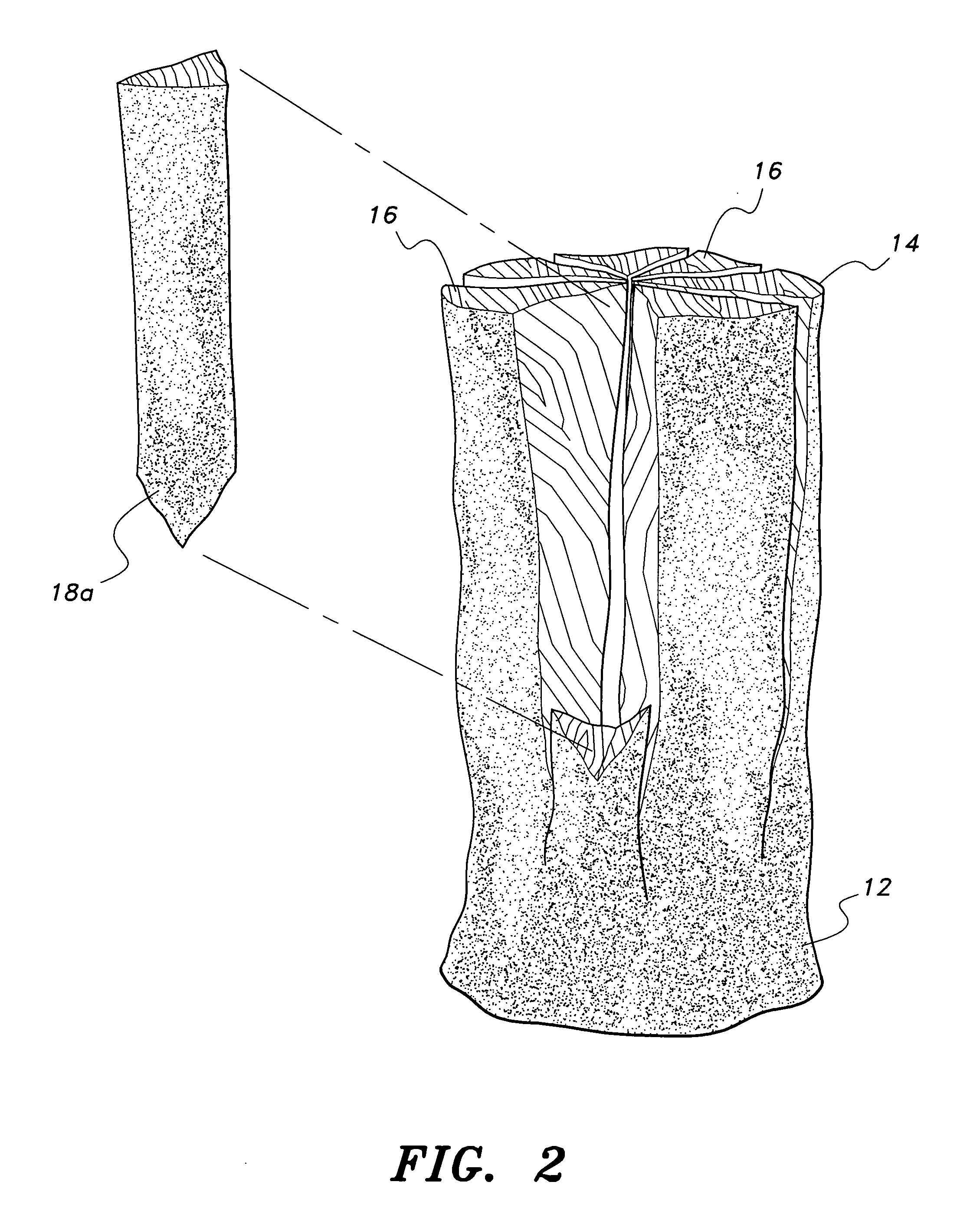
[0012]Attention is directed to FIGS. 1-3 wherein the fire log is indicated generally at 10. Fire log 10 comprises a single log having a base 12 and an upper surface 14. As indicated above, the height of log 10 can range from twenty-four to seventy-two inches. Logs in this height range produce the most satisfying flame / user positioning. Diametrical cuts 16 are made across upper surface 14 of log 10. Cuts 16 extend downward toward base 12 and terminate at a point whereby approximately 25% of the logs length remains uncut, which uncut portion forms the base 12. For logs having small and medium diameters, it has been determined that four diametrical cuts 16 are needed. The four diametrical cuts will create eight pie-shaped segments 18. One of the segments 18a is cut horizontally at its lower end toward the center of the log so that this segment can be removed and replaced as desired. As indicated above, larger diameter logs may require more than four cuts to insure effectiveness.
[0013]I...
PUM
| Property | Measurement | Unit |
|---|---|---|
| length | aaaaa | aaaaa |
| length | aaaaa | aaaaa |
| diameter | aaaaa | aaaaa |
Abstract
Description
Claims
Application Information
 Login to View More