
Thiourea compounds
A compound, thiourea technology, applied in the preparation of organic compounds, active ingredients of heterocyclic compounds, organic chemistry, etc., can solve problems such as low success rate, high price, and low patient acceptance
Patent Information
- Authority / Receiving Office
- CN · China
- Patent Type
- Applications(China)
- Current Assignee / Owner
- Publication Date
- 2009-09-02
- Estimated Expiration
- Not applicable · inactive patent
Smart Images
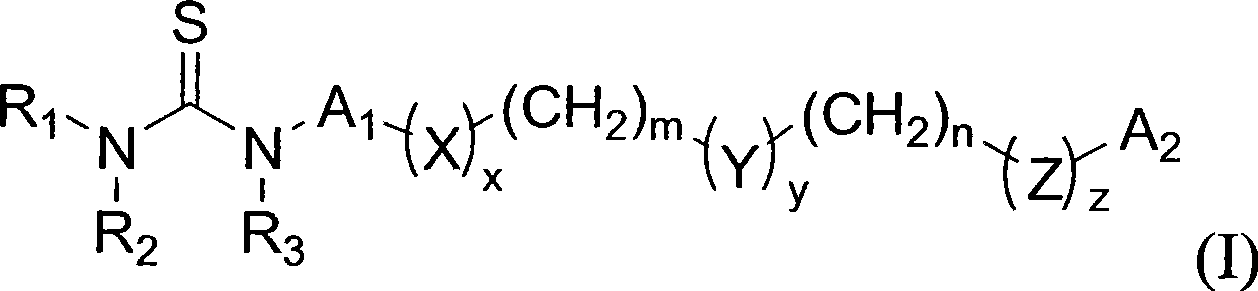
Figure 1 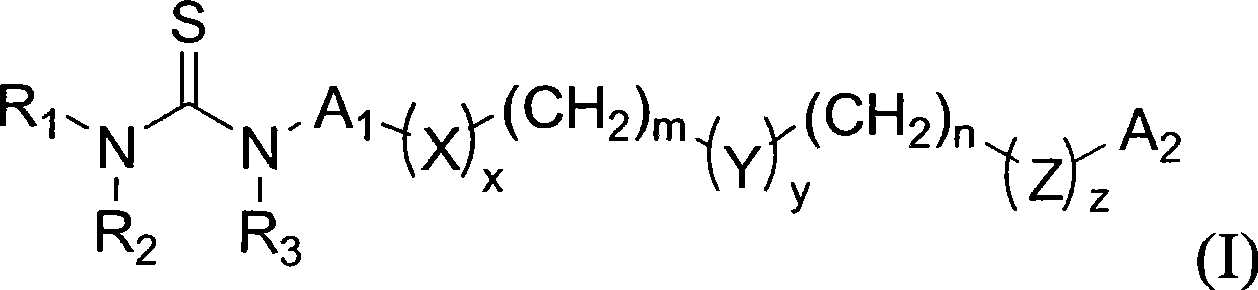
Figure 2 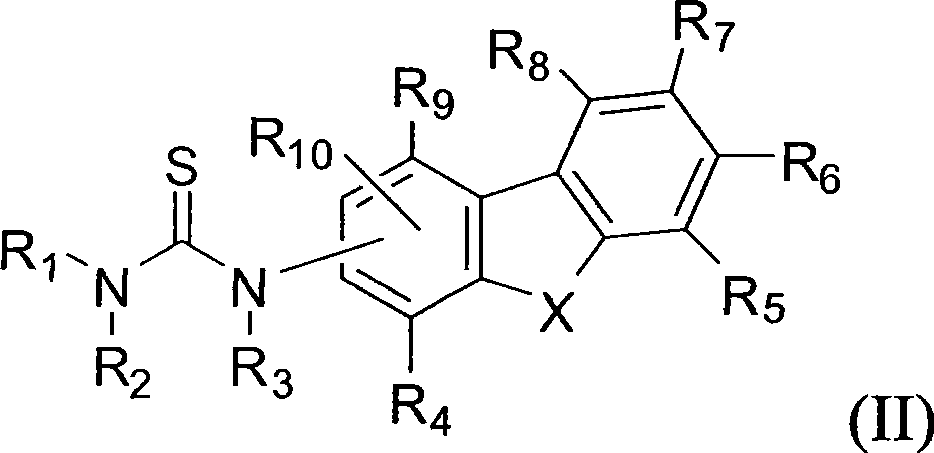
Figure 3
Abstract
Description
[0001] cross reference
[0002] Pursuant to 35 U.S.C. §119(e), this application claims priority to US Provisional Application 60 / 837,782, filed August 15, 2006. The content of this provisional application is hereby incorporated by reference. Background technique
[0003] Hepatitis C virus (HCV) infection is estimated to affect 170 million people worldwide. The disease is mainly spread through contaminated blood products. Although the spread of the disease has slowed due to advances in blood screening mechanisms in many countries, HCV infection remains the leading cause of death from liver-related disease worldwide. For example, approximately 10,000 people die each year from hepatitis C virus infection in the United States alone. Due to the lack of effective treatment, this mortality rate is projected to more than triple in the ensuing two decades.
[0004] At present, the success rate of treatment with interferon alpha is not high, especially for genotype-I infections that...
Examples
Embodiment 1
[0083] Example 1, preparation of compound 1: 1-(3-(5-phenylpentyloxy)phenyl)thiourea (1-(3-(5-phenylpentyloxy)phenyl)thiourea)
[0084]
[0085] First, 1.2 g of potassium carbonate (8.7 mmol) was added to a stirred mixture consisting of 0.8 g of 3-nitrophenol (5.8 mmol), 1.32 g of (5-bromo-pentyl)-benzene (5.8 mmol), 0.96 g of potassium iodide (5.8 mmol) and 15 ml of N-methylpyrrolidone in a suspension. The above mixture was stirred at 90°C for 4 hours. After the reaction mixture was cooled to room temperature, 30 mL of water was added to terminate the reaction, and then extracted with ethyl acetate (30 mL×3). The combined organic phases were washed with brine and concentrated under vacuum. After the obtained residue was subjected to silica gel column chromatography, 1.4 g of 1-nitro-3-(5-phenylpentyloxy)benzene (4.93 mmol, yield 85%) was obtained as a colorless oil.
[0086] 5.57 g of tin(II) chloride (24.7 mmol) was added to a solution consisting of 1.4 g of 1-nitro-3-...
Embodiment 2
[0088] Example 2, preparation of compound 2: 1-(3-(4-phenylbutoxy)phenyl)thiourea (1-(3-(4-phenylbutoxy)phenyl)thiourea)
[0089] Its preparation method is similar to Example 1. EI-MS (M+1): 301
Embodiment 3
[0090] Example 3, preparation of compound 3: 1-(3-(3-phenylpropoxy)phenyl)thiourea (1-(3-(3-phenylpropoxy)phenyl)thiourea)
[0091] Its preparation method is similar to Example 1. EI-MS (M+1): 287