
Method for preparing sustained-release microspheres containing micronized recombinant human vascular endothelial inhibin
A technology of vascular endothelium and slow-release microspheres, which is applied in the directions of medical preparations, drug combinations, and pharmaceutical formulations containing active ingredients, can solve the problems of not widely used, large proportion of excipients, large protein particles, etc., and can improve the emulsification efficiency. , Improve the encapsulation efficiency and reduce the loss of protein activity
Patent Information
- Authority / Receiving Office
- CN · China
- Patent Type
- Patents(China)
- Current Assignee / Owner
- Publication Date
- 2012-07-04
Smart Images
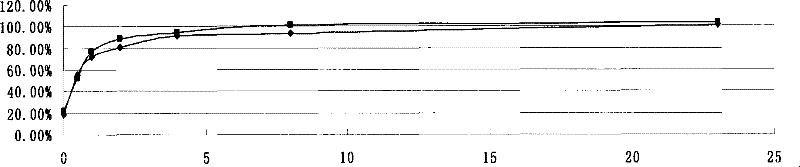
Figure 1 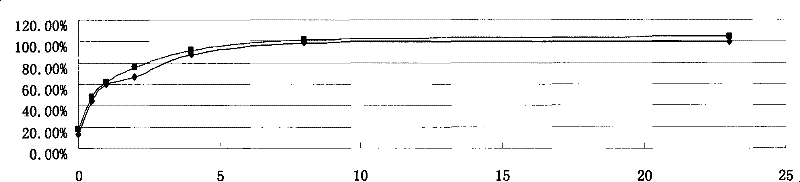
Figure 2 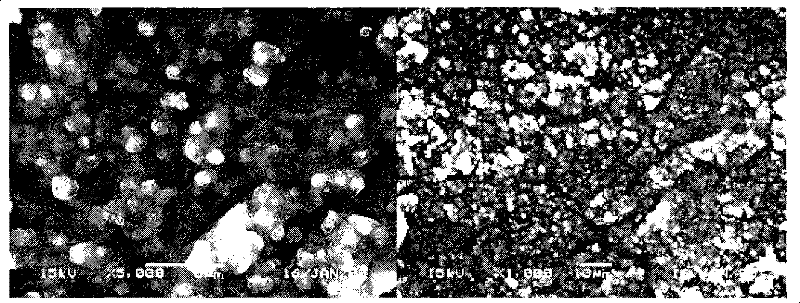
Figure 3
Abstract
Description
technical field
[0001] The invention relates to a preparation method of recombinant human endostatin sustained-release microspheres, in particular to a preparation method of recombinant human endostatin sustained-release microspheres with high encapsulation efficiency. Background technique
[0002] In the 1960s, Dr. Folkman of Harvard Medical School put forward the hypothesis that "tumor growth depends on blood vessel growth", and in 1971 he proposed the theory of "starving tumor therapy". Today, under the impetus of molecular biology technology, the anti-cancer protein-endu has been developed by using genetic engineering technology. Chinese patent CN 1237072C Luo Yongzhang et al. added 9 amino acids to the N-terminal of natural Endostatin, which not only improves the stability of Endostatin, prolongs the half-life, but also increases the biological activity, and the renaturation rate of the protein is also higher than that of the general production method. The drug has bee...
Examples
Embodiment 1
[0049] Accurately weigh 240 mg of recombinant human endostatin Endostar micropowder (containing 200 mg of recombinant human endostatin Endostar), dissolve 400 mg of PLGA (Mw=48000, 50:50) in 10 ml of acetonitrile, add the micropowder into PLGA dichloromethane In the mixed organic solution with acetonitrile, dichloromethane:acetonitrile=1:4 (volume ratio). 4000rpm high-speed dispersion and emulsification to form S / O colostrum. Pour the above S / O colostrum into soybean oil containing 0.3% lecithin and 0.1% sucrose ester, mechanically stir the volatile solvent (1000rpm) for 4 hours, use a 0.8 μm organic microporous membrane to filter to obtain microspheres, and use petroleum Washed three times with ether, and finally freeze-dried to obtain the finished microspheres. The finished microspheres were dissolved in dichloromethane, and the drug was extracted with a PBS solution with pH=7.4. The protein concentration in the extracted solution was determined by HPLC to obtain the drug l...
Embodiment 2
[0052] Accurately weigh 120 mg of recombinant human endostatin Endostar micropowder (containing 100 mg of recombinant human endostatin Endostar), dissolve 400 mg of PLGA (Mw=10000, 50:50) in 10 ml of acetonitrile, and add the micropowder into the acetonitrile solution of PLGA , 4000rpm high-speed dispersion and emulsification to form S / O colostrum. Pour the above S / O colostrum into the medicinal light liquid paraffin containing 0.5% Span 80, mechanically stir the volatile solvent (500rpm) for 4 hours, use a 0.8 μm organic microporous membrane to filter to obtain microspheres, and use petroleum Washed three times with ether, and finally freeze-dried to obtain the finished microspheres. The finished microspheres were dissolved in dichloromethane, and the drug was extracted with a PBS solution with pH=7.4. The protein concentration in the extracted solution was determined by HPLC to obtain the drug loading and encapsulation efficiency of the microspheres. The drug loading is 28....
Embodiment 3
[0055] Accurately weigh the same batch of micronized Endostar protein used in Example 1, redissolve with buffer, and dilute to 1500ng / ml, 1200ng / ml, 1000ng / ml, 800ng / ml, 600ng / ml, 400ng / ml, 200ng / ml, 100ng / ml, 50ng / ml. The immunological activity was measured with a commercially available ELISA (enzyme-linked immunoassay) kit. Method: Make a standard curve of unmicronized protein, and then make a standard curve of reconstituted micronized protein, compare the difference in absorbance value (OD) between the two curves at 100ng / ml-1000ng / ml, and obtain the immunological activity retention Rate. The calculation method of activity retention rate is: activity retention rate=100%-(non-micronized protein OD-micronized protein OD) / (non-micronized protein OD-blank value 0.0392)*100%. Table 1 shows that the protein activity retention rate after micronization is greater than 90%.
[0056] Table 1
[0057]
[0058]