
Application of mutated gene PRPF4 in preparation of hereditary retinal disease diagnosis reagent
A technology for retinal diseases and diagnostic reagents, which is applied in the field of preparation of diagnostic reagents for hereditary retinal diseases, can solve the problems of screening out disease-causing genes, failing to locate disease-causing sites, and difficult to analyze small families and sporadic cases, etc., to achieve The effect of wide screening area and high screening efficiency
Patent Information
- Authority / Receiving Office
- CN · China
- Patent Type
- Applications(China)
- Current Assignee / Owner
- Publication Date
- 2014-08-27
Smart Images
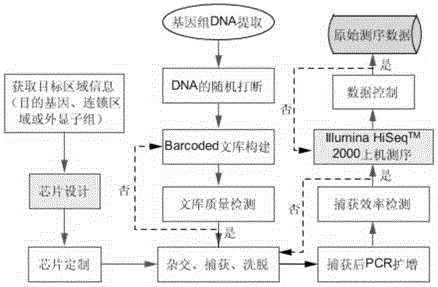
Figure 1 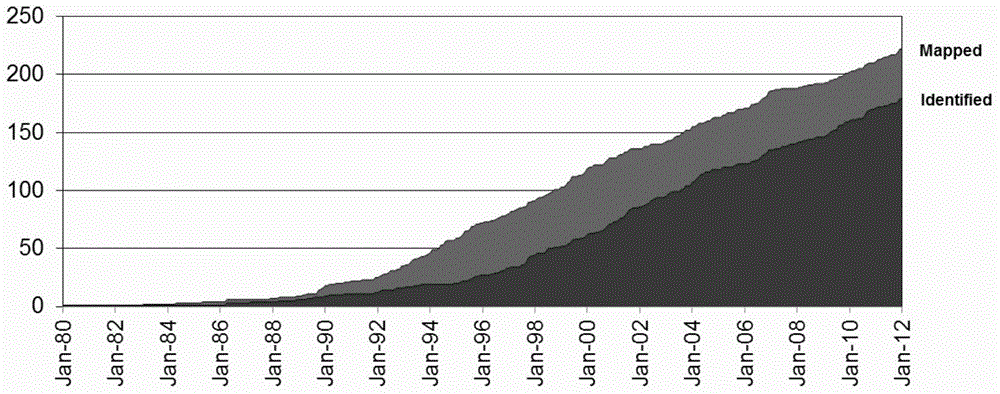
Figure 2 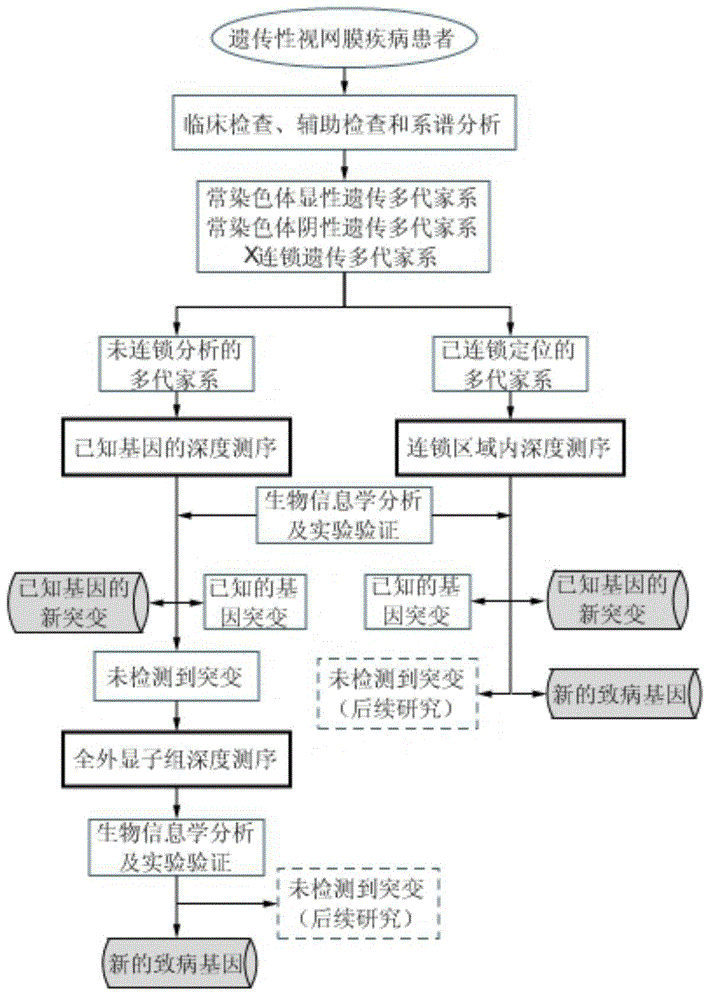
Figure 3
Abstract
Description
[0001] Case Description
[0002] This application is a divisional application of a Chinese invention patent application filed on January 7, 2013 with the application number 2013100052529, titled a method for screening pathogenic mutations in HRDs and related gene chip hybridization probe design methods. technical field
[0003] The invention belongs to the field of biomedicine and relates to the application of mutated gene PRPF4 in the preparation of diagnostic reagents for hereditary retinal diseases. Background technique
[0004] Hereditary retinal diseases (HRDs) are a group of progressive retinal degenerative diseases caused by genetic defects, and are common and serious hereditary blinding diseases in clinical practice. As the number one blindness disease among working-age people worldwide, the incidence of HRDs is about 1 / 3000 in Europe and the United States, and as high as 1 / 1000 in my country. my country is a country with a large number of HRDs genetic resources, bu...
Examples
Embodiment 1
[0048] experimental method:
[0049] 1. Establishment of HRDs genetic resource bank.
[0050] 1.1 Collect the clinical data and blood samples of the following three types of patients:
[0051] 1.1.13 or more generations of autosomal dominant, autosomal recessive, and X-linked recessive families, including RP, Leber congenital amaurosis, congenital static night blindness, and yolk-like macular dystrophy , Stargardt disease.
[0052] 1.1.2 Collect small hereditary families of various HRDs.
[0053] 1.1.3 Collect sporadic cases of various HRDs without family history.
[0054] 1.2 Genomic DNA extraction:
[0055] Using TIANamp Blood DNA Extraction Kit (Tiangen Biotech Co. Ltd, Beijing, China), the patient's genomic DNA was extracted from the collected patient's peripheral blood according to the protocol provided by the manufacturer.
[0056] 2. Mining new pathogenic genes / new mutations of known pathogenic genes in HRDs (see figure 2 ).
[0057] 2.1 Design and customize HRDs...
Embodiment 2
[0092] Functional research was carried out on the pathogenic gene detected in Example 1. Here, the new mutation p.P315L of the above-mentioned PRPF4 gene was taken as an example.
[0093] experimental method:
[0094] 1. Conservative analysis:
[0095] Using NCBI HomoloGene database ( http: / / www.ncbi.nlm.nih.gov / homologene ) Conservative prediction of the screened mutations in multiple species.
[0096] 2. Predict the pathogenicity of mutations based on SIFT and PolyPhen values:
[0097] Using two mainstream online prediction software: PolyPhen-2 (Polymorphism Phenotyping, version2; http: / / genetics.bwh.harvard.edu / pph2 / ) and SIFT Human Protein DB ( http: / / sift.bii.a-star.edu.sg / ), to predict the impact of missense mutations and nonsense mutations on protein levels, thereby predicting the pathogenicity of mutations.
[0098] 3. Research on protein crystal structure changes:
[0099] Since the PRPF4 gene is involved in the formation of the U4 / U6 complex, and the mutat...