
Multiplex RT-PCR Detection Method for Latent Viruses and Viroids in Apple
An apple latent virus, RT-PCR technology, applied in microorganism-based methods, biochemical equipment and methods, and microbial determination/inspection, etc., can solve the problems of high efficiency of multiplex PCR, no simultaneous detection, etc., to improve the results. The effect of discriminating accuracy, reducing non-specific amplification, and improving detection accuracy and sensitivity
Patent Information
- Authority / Receiving Office
- CN · China
- Patent Type
- Patents(China)
- Current Assignee / Owner
- Publication Date
- 2016-06-22
- Estimated Expiration
- Not applicable · inactive patent
Smart Images
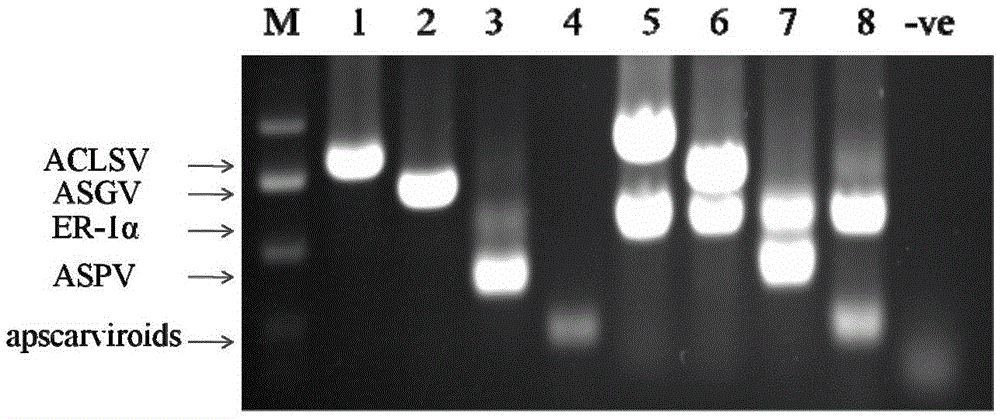
Figure 1 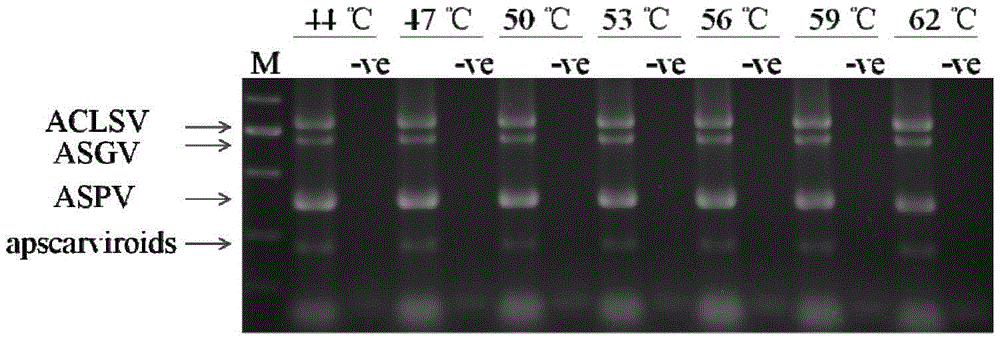
Figure 2 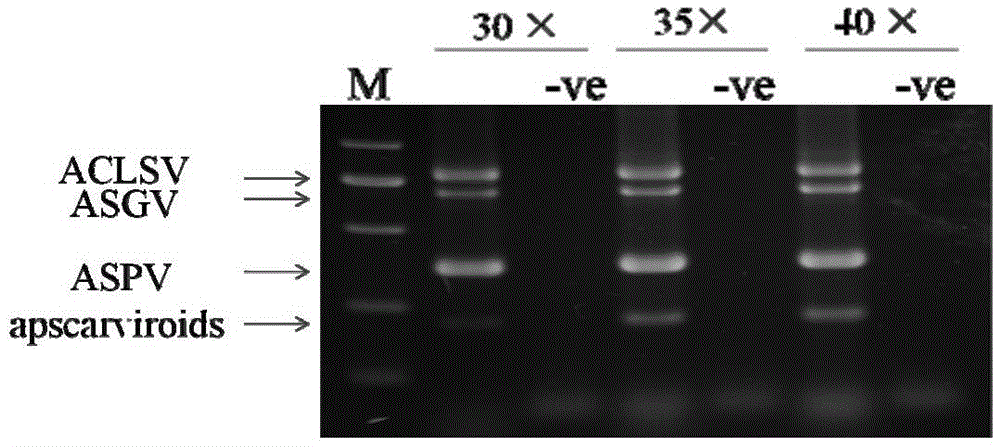
Figure 3
Abstract
Description
technical field
[0001] The invention relates to the field of plant protection and molecular biology detection, in particular to a multiple RT-PCR detection method for apple latent virus and viroid. Background technique
[0002] In the process of apple cultivation and production, virus disease has always been one of the main factors that seriously affect the yield and quality of fruit. After the apple tree is infected by the virus, it will be poisoned for life. The virus proliferates in the tree, interferes and destroys the normal physiological function of the tree, resulting in decreased growth, decreased yield, poor quality, and intolerance to storage, which has caused the production of apples in my country. serious economic losses. At present, the viruses that have been discovered and identified in my country mainly include: apple chloroticleafspot virus (ACLSV), apple stem grooving virus (ASGV), apple stem pox virus (Applestempitting virus, ASPV), apple rust virus (Apples...
Examples
Embodiment 1
[0052] The acquisition of multiple RT-PCR detection primer combination of embodiment 1 apple latent virus and viroid
[0053] Referring to the existing literature and the sequences reported in GenBank, screen and design multiple RT-PCR primers, aiming to make the selected primers applicable to all latent viruses and viroids of apples that have been identified in my country, and can specifically obtain the target fragments, and each target fragment can be clearly distinguished by agarose gel electrophoresis. Finally, four pairs of primers for ACLSV (794bp), ASGV (666bp), ASPV (346bp) and apscarviroids (220bp) in Table 1 were designed and selected. In order to reduce the generation of false positives, the apple genome EF-1α (520bp) was used as the internal standard gene. It was verified by conventional PCR. It can be seen that the selected primers can clearly and specifically obtain the target fragment, the primer dimer is not obvious, and there is no obvious interference betwee...
Embodiment 2
[0056] The establishment and optimization of the multiple RT-PCR system of embodiment 2 apple latent virus and viroid
[0057] 1. Determine the sampling location and sampling method
[0058] In order to make the established multiple RT-PCR technique more widely applicable, according to the distribution characteristics of latent viruses and viroids in apple plants, it was determined that leaves, branches, flowers and fruits could be used as sampling sites. Among them, the leaves and flowers can be used to directly grind and extract the total plant RNA, the branches need to use a blade to peel off the phloem for grinding, and the fruit needs to peel off the pericarp.
[0059] 2. Extract total RNA: extract total RNA by CTAB-phenol method
[0060] Prepare RNA extraction buffer:
[0061]
[0062] Take 0.1g sample, grind it with liquid nitrogen, quickly transfer it to a 1.5ml centrifuge tube, add 500 μL water-saturated phenol, chloroform and isoamyl alcohol mixture (phenol: chl...
Embodiment 3
[0086] Example 3 Detection of orchard apple samples and specificity verification
[0087] Using apple samples collected from an orchard as materials, total RNA was extracted as a template to verify the feasibility of the established multiplex RT-PCR technology.
[0088] Extraction of total RNA, reverse transcription, multiplex PCR reaction system and optimized PCR reaction conditions are the same as those described in Example 2. The results show that the detection results have achieved very good results ( Figure 5 ).
[0089] In order to verify the specificity of virus detection, the bands after electrophoresis were respectively subjected to gel cutting, recovery and purification, cloning and sequence determination. Blastn alignment was performed on the obtained sequences in GenBank, and the results showed that the virus sequence corresponding to each band was consistent with the target virus sequence, indicating that the method was highly specific.