
Method for preparing flame-retardant polymer containing pyridine groups
A technology of flame retardant polymer and pyridine group, which is applied in the field of preparation of flame retardant polymer containing pyridine group, can solve the problems of weak surface adhesion, difficult to mix, limited application scope, etc., and achieves strong surface adhesion and resistance. The effect of good combustion performance and thermodynamic stability, and a wide range of applications
Patent Information
- Authority / Receiving Office
- CN · China
- Current Assignee / Owner
- Publication Date
- 2014-12-03
Smart Images
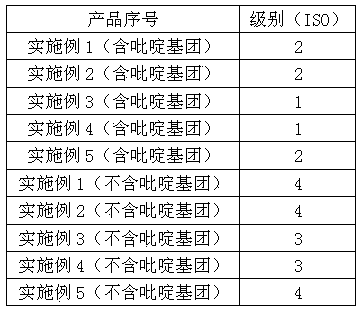
Figure 1 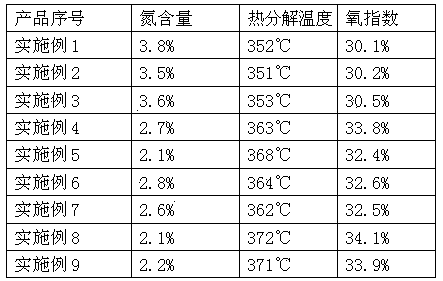
Figure 2
Abstract
Description
technical field
[0001] The invention relates to a preparation method of a pyridine group-containing flame-retardant polymer. Background technique
[0002] Styrene acrylonitrile polymer (also known as SAN or AS), as a kind of engineering plastic with good chemical stability, is widely used in the preparation of various plastic containers, such as lighter casings, cosmetic containers, ballpoint pen holders, etc. In recent years, with the continuous improvement of people's requirements for material performance, the flame retardant performance of engineering plastics has received more and more attention. How to make conventional materials have flame retardant performance is the main research direction of researchers in the field of flame retardant material preparation. Bromine series flame retardants are currently widely used. In order to make styrene acrylonitrile polymers have flame retardant properties, a method currently used is: introduce bromine element on the phenyl group...
Examples
Embodiment 1
[0022] (1) Add 10.6g of styrene, 5.3g of acrylonitrile, 10.6g of 2-vinylpyridine, 10.6g of dibromostyrene, 1.9g of sodium dodecyl sulfate and 111.3g of water into a 500ml four-neck flask, Under the temperature condition of 70°C, stir for 30 minutes to obtain an emulsion;
[0023] (2) Add 0.8g of potassium persulfate and 0.8g of tert-dodecylmercaptan to the above emulsion, raise the temperature to 80-85°C, and react for 5 hours to prepare a reaction mixture;
[0024] (3) Add 0.8g sodium chloride to the above reaction mixture and stir for 10 minutes, then carry out suction filtration, and the solid product obtained after suction filtration is a crude product;
[0025] (4) Wash the above crude product with water first, then with methanol, put it in a vacuum drying oven after washing, and dry it for 2 hours at a pressure of -0.095mpa and a temperature of 30°C-40°C to obtain 35.8g of white particles The product is a flame-retardant polymer containing pyridine groups.
Embodiment 2
[0027] (1) Add 10.6g of styrene, 5.3g of acrylonitrile, 10.6g of 2-vinylpyridine, 13.1g of dibromostyrene, 3.1g of sodium dodecyl sulfate and 160g of water into a 500ml four-necked flask. Under the temperature condition of 70°C, stir for 30 minutes to obtain an emulsion;
[0028] (2) Add 1.1 g of potassium persulfate and 1.9 g of tert-dodecylmercaptan to the above emulsion, raise the temperature to 80-85°C, and react for 5.5 hours to prepare a reaction mixture;
[0029] (3) Add 1.5g sodium chloride to the above reaction mixture and stir for 10 minutes, then carry out suction filtration, and the solid product obtained after suction filtration is a crude product;
[0030] (4) Wash the above crude product with water first, then with methanol, put it in a vacuum drying oven after washing, and dry it for 2 hours at a pressure of -0.095mpa and a temperature of 30°C-40°C to obtain 38.6g of light yellow A granular product, the product is a pyridine group-containing flame-retardant po...
Embodiment 3
[0032] (1) Add 10.6g styrene, 5.3g acrylonitrile, 10.6g 2-vinylpyridine, 13.1g dibromostyrene, 3.1g sodium dodecylbenzenesulfonate, 160g water and 20g methanol into a 500ml four-necked flask , under the temperature condition of 65-70°C, stirring for 30 minutes to obtain an emulsion;
[0033] (2) Add 1.1 g of potassium persulfate and 1.9 g of tert-dodecylmercaptan to the above emulsion, raise the temperature to 80-85°C, and react for 5.5 hours to prepare a reaction mixture;
[0034] (3) Add 1.2g sodium chloride to the above reaction mixture and stir for 10 minutes, then carry out suction filtration, and the solid product obtained after suction filtration is a crude product;
[0035] (4) Wash the above crude product first with water and then with methanol, put it in a vacuum drying oven after washing, and dry it for 2 hours at a pressure of -0.095mpa and a temperature of 30°C-40°C to obtain 38.9g of light yellow A granular product, the product is a pyridine group-containing fla...