
High-stability ultraviolet-light cured water-based ink for glass
A water-based ink, high stability technology, applied in the direction of ink, application, household appliances, etc., to achieve the effect of environmental protection, improve product quality, and broad development prospects
Patent Information
- Authority / Receiving Office
- CN · China
- Patent Type
- Applications(China)
- Current Assignee / Owner
- Publication Date
- 2016-07-06
- Estimated Expiration
- Not applicable · inactive patent
Smart Images
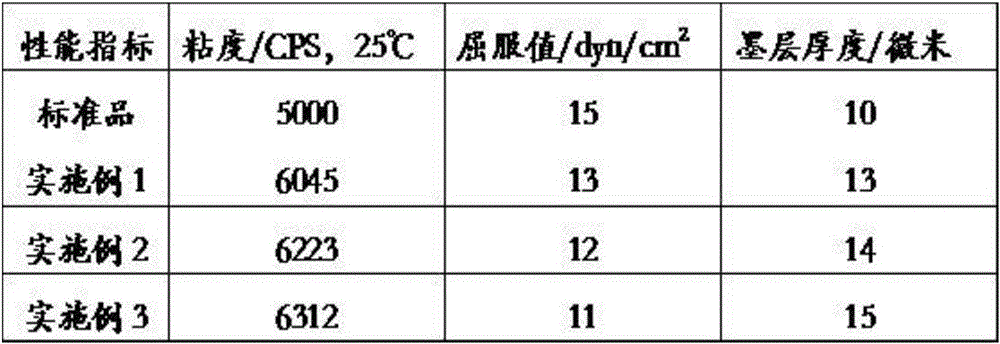
Figure 1
Abstract
Description
technical field
[0001] The invention relates to the technical field of water-based inks, in particular to a high-stability ultraviolet light-curable water-based ink for glass. Background technique
[0002] Ultraviolet light curing (UV curing) means that under the action of ultraviolet light, the photosensitive substance in the system undergoes a chemical reaction to produce active fragments, which triggers the polymerization and crosslinking of active monomers or oligomers in the system, so that the system can be coated from a liquid state. The layer instantly becomes a solid coating. Since the German Bayer company developed the first generation of UV curing coatings in 1967, UV curing technology has developed rapidly around the world and has been rapidly popularized and applied in industries such as electronics, printing, construction, decoration, medicine, machinery, chemicals and automobiles. . Since the commercialization of ultraviolet light curing materials in foreign...
Examples
Embodiment 1
[0016] A high-stability UV-curable water-based ink for glass is composed of the following raw materials in parts by weight:
[0017] 20 parts of unsaturated polyester, 10 parts of polyurethane acrylate, 20 parts of acrylated polypropylene, 10 parts of polyether acrylate, 10 parts of epoxy acrylate, 5 parts of water-based epoxy acrylate, 5 parts of water-based polyurethane acrylate , hydroxyethyl methacrylate, 5 parts of 1,6-hexanediol diacrylate, 20 parts of pentaerythritol tetraacrylate, 20 parts of ethoxylated neopentyl glycol diacrylate, ethoxylated trimethylolpropane triacrylate 10 parts, 5 parts trimethylol propane tetraacrylate, 5 parts ethoxylated phenolic acrylate, 10 parts propoxylated glycerin triacrylate, 5 parts neopentyl glycol diacrylate, dipropylene glycol diacrylate 20 parts, 3 parts of photoinitiator, 2 parts of surfactant.
[0018] According to the above technical scheme, the unsaturated polyester is polyethylene glycol or allyl ether.
[0019] According to...
Embodiment 2
[0023] A high-stability UV-curable water-based ink for glass is composed of the following raw materials in parts by weight:
[0024] 25 parts of unsaturated polyester, 12 parts of polyurethane acrylate, 25 parts of acrylated polypropylene, 12 parts of polyether acrylate, 12 parts of epoxy acrylate, 7 parts of water-based epoxy acrylate, 7 parts of water-based polyurethane acrylate , hydroxyethyl methacrylate, 7 parts of 1,6-hexanediol diacrylate, 25 parts of pentaerythritol tetraacrylate, 25 parts of ethoxylated neopentyl glycol diacrylate, ethoxylated trimethylolpropane triacrylate 12 parts, 7 parts trimethylol propane tetraacrylate, 7 parts ethoxylated phenolic acrylate, 12 parts propoxylated glycerin triacrylate, 7 parts neopentyl glycol diacrylate, dipropylene glycol diacrylate 25 parts, 4 parts of photoinitiator, 3 parts of surfactant.
[0025] According to the above technical scheme, the unsaturated polyester is polyethylene glycol or allyl ether.
[0026] According to...
Embodiment 3
[0030] A high-stability UV-curable water-based ink for glass is composed of the following raw materials in parts by weight:
[0031] 30 parts of unsaturated polyester, 15 parts of polyurethane acrylate, 30 parts of acrylated polypropylene, 15 parts of polyether acrylate, 15 parts of epoxy acrylate, 10 parts of water-based epoxy acrylate, 10 parts of water-based polyurethane acrylate , hydroxyethyl methacrylate, 10 parts of 1,6-hexanediol diacrylate, 30 parts of pentaerythritol tetraacrylate, 30 parts of ethoxylated neopentyl glycol diacrylate, ethoxylated trimethylolpropane triacrylate 15 parts, 10 parts of trimethylolpropane tetraacrylate, 10 parts of ethoxylated phenolic acrylate, 15 parts of propoxylated glycerin triacrylate, 10 parts of neopentyl glycol diacrylate, 10 parts of dipropylene glycol diacrylate 30 parts, 5 parts of photoinitiator, 4 parts of surfactant.
[0032] According to the above technical scheme, the unsaturated polyester is polyethylene glycol or allyl ...