
Application of great burdock root polysaccharide in preparation of drug for treating non-alcoholic fatty liver disease
A non-alcoholic, fatty liver technology, applied in the field of medicine and health food
Patent Information
- Authority / Receiving Office
- CN · China
- Current Assignee / Owner
- Publication Date
- 2020-05-01
Smart Images
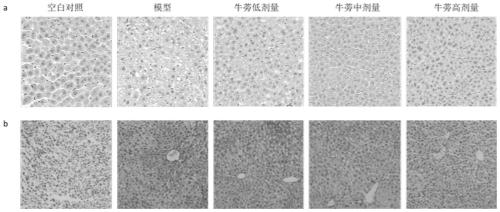
Figure 1 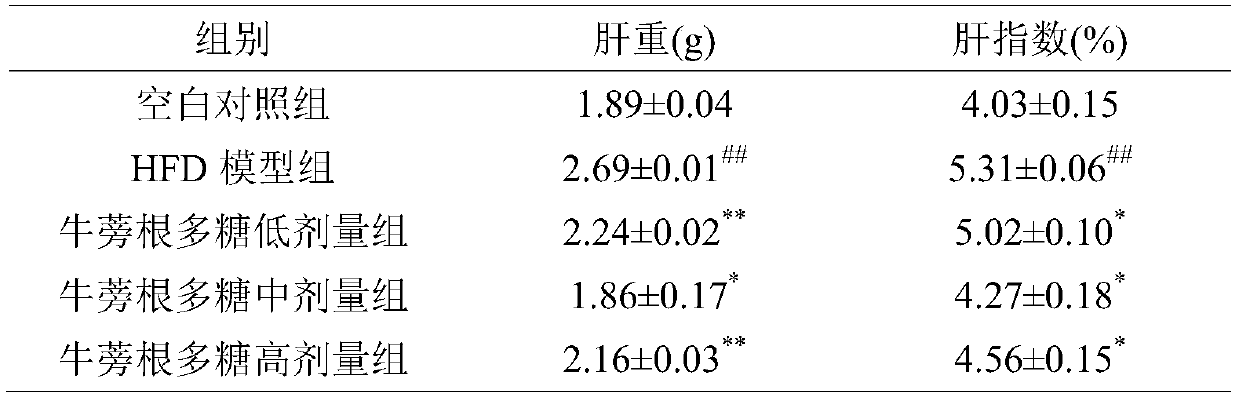
Figure 2 
Figure 3
Abstract
Description
technical field
[0001] The invention relates to the application of burdock root polysaccharide in preparing medicine for treating non-alcoholic fatty liver, and belongs to the technical field of medicine and health food. Background technique
[0002] Nonalcoholic fatty liver disease (NAFLD) refers to a clinicopathological syndrome characterized by fatty degeneration and lipid deposition in hepatic cells, which is not caused by alcohol and other clear liver damage factors, and is often associated with obesity, insulin Resistance (IR), genetic susceptibility, mitochondrial and endoplasmic reticulum oxidative stress, etc. Due to the difference in the degree of steatosis and inflammation in liver tissue, simple fatty liver can develop into non-alcoholic steatohepatitis, and further develop into cirrhosis or even liver cancer.
[0003] With the improvement of people's living standards, the incidence of NAFLD is also increasing year by year. Currently, the incidence rate in deve...
Examples
Embodiment 1
[0029] Embodiment 1: the preparation of burdock root polysaccharide
[0030] The preparation method of burdock root polysaccharide comprises steps as follows:
[0031] (1) Select fresh burdock root, inactivate the enzyme in a boiling water bath for 5-10 minutes, peel the burdock root and cut it into thin slices, add deionized water at a material-to-liquid mass ratio of 1:10, set the extraction conditions to 80°C and 60 minutes, Leach for 3 times, combine the extracts and filter with a double-layer filter cloth, then use a Buchner funnel for suction filtration, centrifuge the filtrate at 7000r / min for 30min, and collect the supernatant;
[0032] (2) Place the supernatant obtained in step (1) in a rotary evaporator at 60°C to evaporate and concentrate to 1 / 2 of the original volume, and collect the concentrate; then add 4 times the volume of 95wt% Precipitate with ethanol overnight, centrifuge at 7000r / min for 30min, and retain the precipitate; dissolve the precipitate in deioni...
Embodiment 2
[0036] Example 2: Effects of burdock root polysaccharides on liver weight and liver index in HFD (high fat) induced non-alcoholic fatty liver (NAFLD) mice
[0037] experimental method:
[0038] Establishment of NAFLD mouse model:
[0039] Male Kunming mice, weighing 18±2g / only, were randomly divided into 5 groups, 10 in each group;
[0040] Blank control group: fed with normal feed and normal drinking water until the end of the experimental period;
[0041] HFD model group: fed with high-fat feed and ordinary drinking water until the end of the experimental period;
[0042] Low-dose burdock root polysaccharide group: fed with high-fat feed and ordinary drinking water, after 20 weeks of modeling, burdock root polysaccharide (100mg / kg / d) was administered orally for 8 weeks;
[0043]Burdock root polysaccharide medium-dose group: fed with high-fat feed and ordinary drinking water, after 20 weeks of modeling, burdock root polysaccharide (400mg / kg / d) was administered orally for 8...
Embodiment 3
[0049] Example 3: Effects of Burdock Root Polysaccharides on Liver Histomorphology in NAFLD Mice
[0050] Experimental method: 5 groups of mice after the experimental period in Example 2 were dissected, and the isolated liver tissue was fixed, dehydrated, transparent, dipped in wax, embedded, sectioned and stained, and the morphology of the liver tissue was observed under a microscope change and judge. The upper, middle, lower, left, and right fields of view were selected for each mouse liver tissue staining section to describe the degree of fatty degeneration and inflammatory response of the liver tissue.
[0051] The specific preparation and staining process is as follows:
[0052] Producer:
[0053] 1) Fixation: Soak the excised fresh liver tissue in paraformaldehyde and fix it for 24 hours;
[0054] 2) Dehydration: soak in 85% ethanol for 60 minutes; soak in 95% ethanol for 30 minutes, soak twice; soak in absolute ethanol for 10 minutes, soak three times;
[0055] 3) T...