

Preparation method of aminobenzonitrile
A technology of aminobenzonitrile and aminobenzamide, which is applied in the field of preparation of aminobenzonitrile, can solve the problems of intractable waste water, low yield, short service life and the like, achieves improved yield and quality, and reduced reaction temperature , the effect of shortened response time
Patent Information
- Authority / Receiving Office
- CN · China
- Patent Type
- Applications(China)
- Current Assignee / Owner
- Publication Date
- 2020-06-12
Smart Images
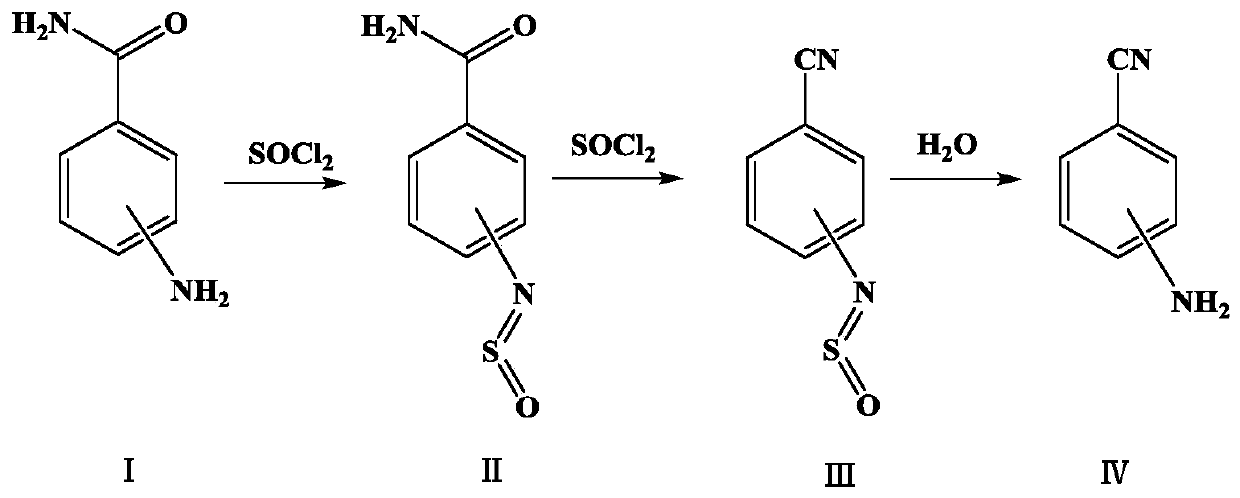
Figure 1
Abstract
Description
technical field
[0001] The invention relates to the technical field of fine chemical synthesis, in particular to a preparation method of aminobenzonitrile. Background technique
[0002] Aminobenzonitrile compounds are important intermediates in organic synthesis and are widely used in the production of medicines, pesticides, dyes, rubber and fine chemicals. For example, the condensation of m-aminobenzonitrile and cyclohexanone can directly synthesize tacrine, an effective drug for treating Alzheimer's disease; p-aminobenzonitrile can be used to synthesize bicalutamide (Zhaohui), etravirine and dabigatol Key intermediates of esters.
[0003] At present, the methods for synthesizing aminobenzonitrile mainly include four methods such as cyanation of haloaniline, amination of halobenzonitrile, reduction of nitrobenzonitrile and dehydration of aminobenzamide. Halogenated aniline cyanation method requires the use of highly toxic cyanide, waste water is difficult to treat, and th...
Examples
Embodiment 1
[0022] Dehydration: Add 510 g of toluene and 102 g (0.75 mol) of 4-aminobenzamide into a 1000 ml reaction flask with a reflux device cooled by brine, raise the temperature to 90-100 ° C, slowly add 205 g (1.72 mol) of thionyl chloride dropwise, A large amount of tail gas is produced (HCl+SO 2 ), after the thionyl chloride has been dripped, continue to keep warm until all the materials are dissolved and no tail gas is emitted. Cool to 50-60°C, that is, dehydration liquid, keep warm for later use.
[0023] Hydrolysis: Add 102g of water into a 1000ml reaction bottle, stir and heat up to 50-60°C, add the above dehydration solution dropwise, at this time tail gas will be produced (SO 2 ), control the dropping speed, after the dropping is finished and stirred until no tail gas is released, adjust the pH of the water layer to 6.5-7.5 with 30% sodium hydroxide solution while hot. After standing for separation, the organic layer was slowly stirred and cooled to 0-5°C, filtered, washe...
Embodiment 2
[0025] Dehydration: Add 510g of toluene and 102g (0.75mol) of 3-aminobenzamide into a 1000ml reaction flask with a reflux device cooled by brine, raise the temperature to 90-100°C, slowly add 205g (1.72mol) of thionyl chloride dropwise, A large amount of tail gas is produced (HCl+SO 2 ), after the thionyl chloride has been dripped, continue to keep warm until all the materials are dissolved and no tail gas is released. Cool to 50-60°C, that is, dehydration liquid, keep warm for later use.
[0026] Hydrolysis: Add 102g of water into a 1000ml reaction bottle, stir and heat up to 50-60°C, add the above dehydration solution dropwise, at this time tail gas will be produced (SO 2 ), control the dropping speed, after the dropping is finished and stirred until no tail gas is released, adjust the pH of the water layer to 6.5-7.5 with 30% sodium hydroxide solution while hot. After static separation, the organic layer was slowly stirred and cooled to 0-5°C, filtered, washed with an app...
Embodiment 3
[0028] Dehydration: Add 510g of toluene and 102g (0.75mol) of 2-aminobenzamide into a 1000ml reaction flask with a reflux device cooled by brine, raise the temperature to 90-100°C, slowly add 205g (1.72mol) of thionyl chloride dropwise, A large amount of tail gas is produced (HCl+SO 2 ), after the thionyl chloride has been dripped, continue to keep warm until all the materials are dissolved and no tail gas is released. Cool to 50-60°C, that is, dehydration liquid, keep warm for later use.
[0029] Hydrolysis: Add 102g of water into a 1000ml reaction bottle, stir and heat up to 50-60°C, add the above dehydration solution dropwise, at this time tail gas will be produced (SO 2 ), control the dropping speed, after the dropping is finished and stirred until no tail gas is released, adjust the pH of the water layer to 6.5-7.5 with 30% sodium hydroxide solution while hot. After standing for separation, the organic layer was slowly stirred and cooled to 0-5°C, filtered, washed with ...