
Ultralow-static polyolefin porous membrane, raw material formula, preparation method and battery
A polyolefin and porous membrane technology, applied in non-aqueous electrolyte storage batteries, lithium storage batteries, battery pack components, etc., can solve the problems of loss of electronic insulation, the content of antistatic additives cannot be too high, and the electronic conductivity of diaphragms is low. To achieve the effect of reducing the generation of static electricity
Patent Information
- Authority / Receiving Office
- CN · China
- Patent Type
- Applications(China)
- Current Assignee / Owner
- Publication Date
- 2020-12-29
- Estimated Expiration
- Not applicable · inactive patent
Smart Images
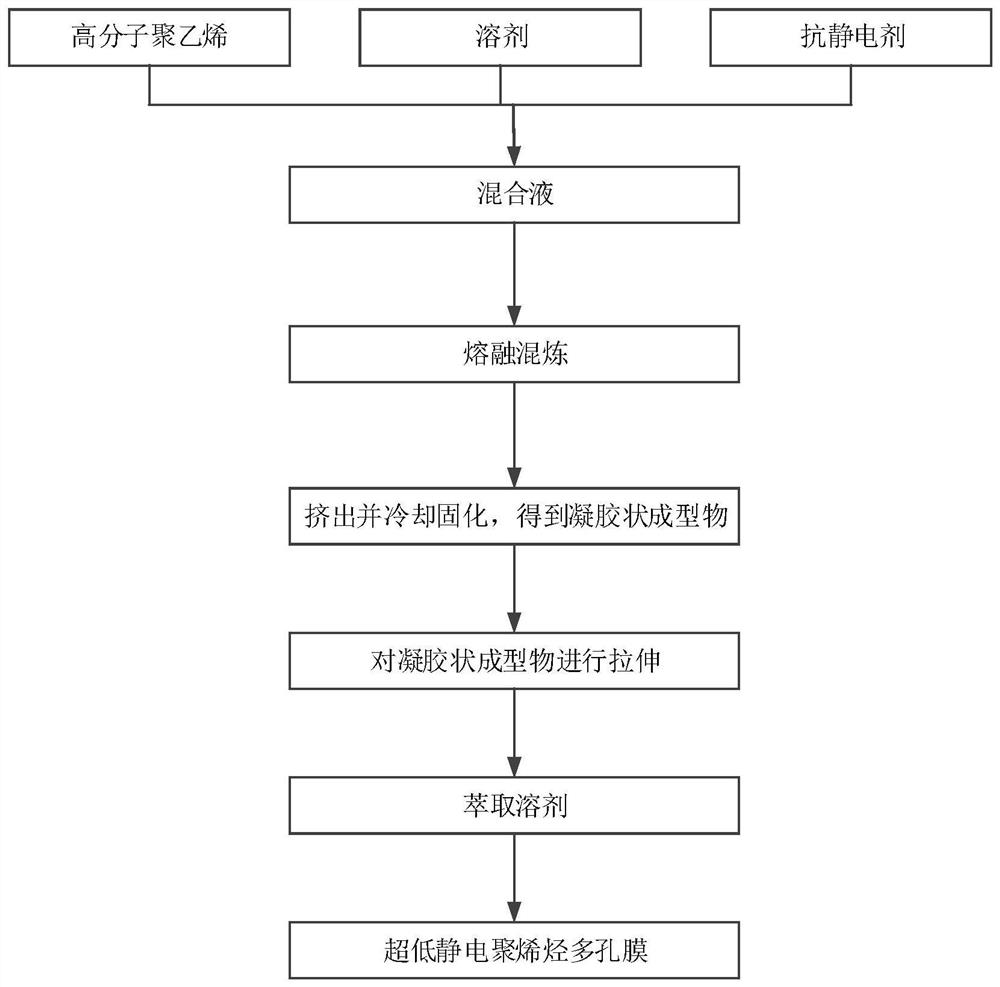
Figure 1 
Figure 2
Abstract
Description
technical field
[0001] The invention belongs to the technical field of lithium battery diaphragms, and in particular relates to an ultra-low static polyolefin porous film, a raw material formula, a preparation method and a battery. Background technique
[0002] In the production process of the porous membrane of the secondary battery, after casting, stretching and other processes, the friction between the pellets, the friction between the melt and the die, and the friction between the guide roller and the film forming and winding, the secondary battery is porous. The surface of the membrane generates more static electricity, and the existence of static electricity will seriously affect the application of the porous membrane of the secondary battery in the secondary battery; in addition, the surface of the porous membrane of the secondary battery has more static electricity and will also absorb a lot of dust. After the separator is assembled into the battery, it will cause a ...
Examples
preparation example Construction
[0019] further, see figure 1 , the invention provides a method for preparing a polyolefin porous film, comprising: preparing a mixed liquid, that is, mixing a solvent with a polyolefin composition and an antistatic agent; melting and kneading the mixed liquid; extruding and cooling to solidify to obtain a gel shape molding; stretching the gel molding; extracting the solvent to obtain an ultra-low static polyolefin porous membrane.
[0020] Concrete preparation steps are as follows:
[0021] (1) Mix polyolefin composition, antistatic agent and white oil to form a mixed liquid. From the viewpoint of the uniformity of the crystallinity of the separator, the content ratio of the solvent is preferably 80-98%. From the point of view of controlling the filling rate of the resin compound into the polyolefin micropolyolefin porous film substrate, it is preferable to make the mass concentration of the polyolefin composition 10 to 35%, and it is more preferable to make the mass concent...
Embodiment 1
[0036] (1) Preparation of polyethylene solution
[0037] A polyethylene solution was prepared by mixing 15 parts by mass of high molecular weight polyethylene with a mass average molecular weight of 500,000, 85 parts by mass of white oil, and 2 parts by mass of stearyl trimethyl quaternary ammonium hydrochloride.
[0038] (2) Making a gel-like sheet
[0039] The polyethylene solution was extruded from a die into a sheet at a temperature of 160° C., and then cast onto a cooled metal roll to produce a gel-like sheet (also referred to as a base tape).
[0040] (3) Stretching and heat setting
[0041] At a temperature of 100°C, the base tape is stretched along the length direction with a magnification of 5.5 times, then at a temperature of 115°C, the base tape is stretched along the width direction with a magnification of 14 times, and finally heat-treated at 134°C ( heat fix).
[0042] (4) Extraction and washing
[0043] The polyolefin porous membrane was continuously immerse...
Embodiment 2
[0045] (1) Preparation of polyethylene solution
[0046] A polyethylene solution was prepared by mixing 10 parts by mass of high molecular weight polyethylene having a mass average molecular weight of 500,000, 100 parts by mass of white oil, and 0.3 parts by mass of stearyl trimethyl quaternary ammonium hydrochloride.
[0047] (2) Making a gel-like sheet
[0048] The polyethylene solution was extruded from a die into a sheet at a temperature of 160° C., and then cast onto a cooled metal roll to produce a gel-like sheet (also referred to as a base tape).
[0049] (3) Stretching and heat setting
[0050] At a temperature of 100°C, the base tape is stretched along the length direction with a magnification of 5.5 times, then at a temperature of 115°C, the base tape is stretched along the width direction with a magnification of 14 times, and finally heat-treated at 134°C ( heat fix).
[0051] (4) Extraction and washing
[0052] The polyolefin porous membrane was continuously im...