
A kind of preparation method of (s)-2-(adamantan-1-yl)-2-aminoacetic acid hydrochloride
A technology of glycine hydrochloride and adamantane is applied in the preparation of organic compounds, the preparation of cyanide reactions, chemical instruments and methods, etc., and can solve problems such as being unsuitable for industrial production, unsafe, etc., and achieves convenient operation, The effect of short route and easy response
Patent Information
- Authority / Receiving Office
- CN · China
- Patent Type
- Patents(China)
- Current Assignee / Owner
- Publication Date
- 2022-07-15
Smart Images
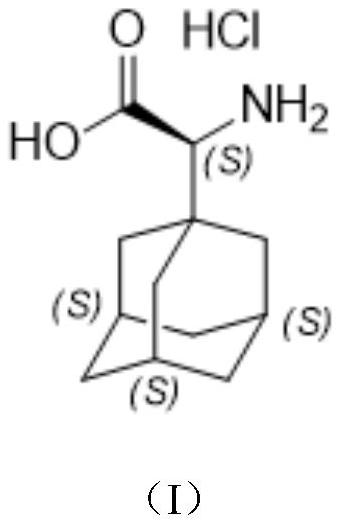
Figure 1 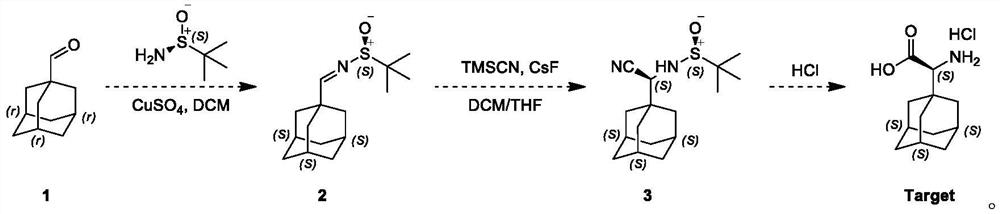
Figure 2 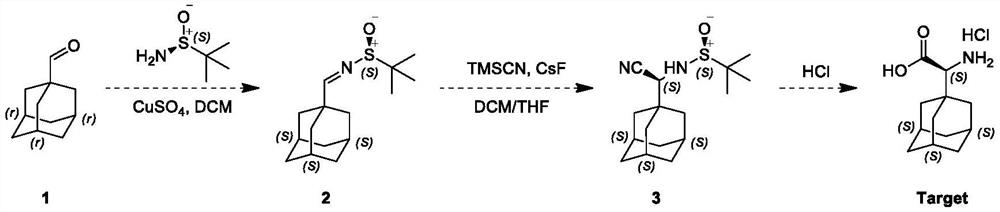
Figure 3
Abstract
Description
technical field
[0001] The invention relates to a method for synthesizing a compound, in particular to a method for preparing (S)-2-(adamantan-1-yl)-2-aminoacetic acid hydrochloride. Background technique
[0002] Compound (S)-2-(adamantan-1-yl)-2-aminoacetic acid hydrochloride, in the form of white powder, its structural formula is as follows structural formula (I), the new synthesis process and related derivatives are used in medicinal chemistry It has a wide range of applications in organic synthesis and can be used as an intermediate for drug development. For example, the drug saxagliptin uses a modified intermediate, and saxagliptin ONGLYZA TM (saxagliptin saxagliptin tablets) is a highly potent dipeptidyl peptidase-4 (Dipeptidyl Peptidase 4, DPP-4) inhibitor, by selectively inhibiting DPP-4, can increase endogenous glucagon-like Peptide-1 (Glucagon-like Peptide-1, GLP-1) and glucose-dependent insulin-releasing polypeptide (Glucose-dependentInsulinotropic Peptide, GIP) ...
Examples
Embodiment 1
[0026] Chinese definitions of the abbreviations of the present invention: TLC: thin layer chromatography, DCM: dichloromethane, THF: tetrahydrofuran.
[0027] The reaction formula of embodiment 1 is as follows:
[0028]
[0029] This embodiment adopts the following steps:
[0030] The first step: a 100 ml single-neck flask, magnetic stirring, to 1-adamantanecarboxaldehyde, namely compound 1 (1.64g, 9.87mmol) and tert-butylsulfinamide (1.21g, 10.85mmol) and CuSO 4 To a solution of (copper sulfate 3.19 g, 19.53 mmol) in dichloromethane (20 mL) was added pyridine p-toluenesulfonate (125 mg, 0.494 mmol), and the resulting reaction mixture was stirred at 20° C. for 12 hours under nitrogen protection; TLC (petroleum ether / ethyl acetate = 3 / 1, Rf = 0.2, phosphomolybdic acid) indicated complete consumption of compound 1 with the formation of a new spot; the reaction mixture was filtered, washed with saturated NaHCO 3 solution (10 mL of sodium bicarbonate solution) and saturated a...
Embodiment 2
[0034] Chinese definitions of the abbreviations of the present invention: TLC: thin layer chromatography, DCM: dichloromethane, THF: tetrahydrofuran.
[0035] The reaction formula of embodiment 2 is as follows:
[0036]
[0037] This embodiment adopts the following steps:
[0038] The first step: a 100 ml single-neck flask, magnetic stirring, to 1-adamantanecarboxaldehyde, namely compound 1 (1.64g, 9.87mmol) and tert-butylsulfinamide (1.21g, 10.85mmol) and CuSO 4 To a solution of (copper sulfate 6.39 g, 39.05 mmol) in dichloromethane (20 mL) was added pyridine p-toluenesulfonate (500 mg, 1.974 mmol), and the resulting reaction mixture was stirred under nitrogen at 22.5°C for 14 hours; TLC (petroleum ether / ethyl acetate = 3 / 1, Rf = 0.2, phosphomolybdic acid) indicated complete consumption of compound 1 with the formation of a new spot; the reaction mixture was filtered, washed with saturated NaHCO 3 solution (10 mL of sodium bicarbonate solution) and saturated ammonium chl...
Embodiment 3
[0042] Chinese definitions of the abbreviations of the present invention: TLC: thin layer chromatography, DCM: dichloromethane, THF: tetrahydrofuran.
[0043] The reaction formula of embodiment 3 is as follows:
[0044]
[0045] This embodiment adopts the following steps:
[0046] The first step: a 100 ml single-neck flask, magnetic stirring, to 1-adamantanecarboxaldehyde, namely compound 1 (1.64g, 9.87mmol) and tert-butylsulfinamide (1.21g, 10.85mmol) and CuSO 4 To a solution of (copper sulfate 4.79 g, 29.29 mmol) in dichloromethane (20 mL) was added pyridine p-toluenesulfonate (250 mg, 0.987 mmol), and the resulting reaction mixture was stirred under nitrogen at 25°C for 16 hours; TLC (petroleum ether / ethyl acetate = 3 / 1, Rf = 0.2, phosphomolybdic acid) indicated complete consumption of compound 1 with the formation of a new spot; the reaction mixture was filtered, washed with saturated NaHCO 3 solution (10 mL of sodium bicarbonate solution) and saturated ammonium chlor...