
X-ray sensitive resin composition, protruded body and barrier body formed thereby, forming method thereof, and liquid crystal display element
A technology of liquid crystal display element and resin composition, which is applied in the direction of nonlinear optics, photolithographic process of pattern surface, coating, etc., and can solve the problems of unspecified composition of photoresist material, failure to indicate the performance of protrusions and separators, etc. , to achieve the effects of excellent resolution and residual film rate, easy shape and size, and excellent voltage retention
Patent Information
- Authority / Receiving Office
- CN · China
- Patent Type
- Applications(China)
- Current Assignee / Owner
- Publication Date
- 2006-10-04
- Estimated Expiration
- Not applicable · inactive patent
Smart Images

Figure 1 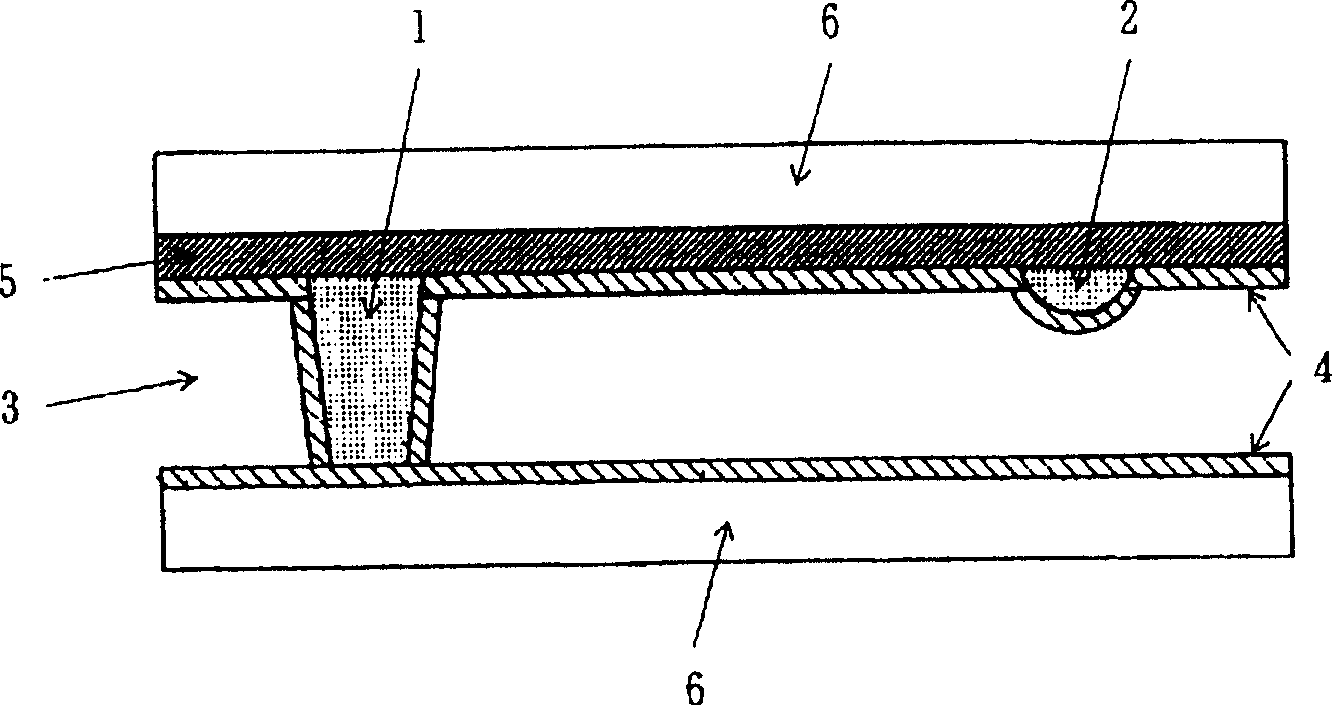
Figure 2
Abstract
Description
technical field
[0001] The present invention relates to a radiation-sensitive resin composition for forming protrusions and / or spacers used in vertical alignment liquid crystal display elements, protrusions and spacers used in vertical alignment liquid crystal display elements formed from the composition A spacer, a vertical alignment type liquid crystal display element comprising the protrusion and / or the spacer, and a method of forming the protrusion and / or the spacer. Background technique
[0002] Liquid crystal display elements are widely used in flat panel displays. In recent years, with the spread of OA equipment such as personal computers and word processors, and liquid crystal televisions, the display quality requirements for TFT (thin film transistor) liquid crystal displays (TFT-LCDs) have become increasingly stringent. Among TFT-LCDs, TN (Twisted Nematic) type LCDs are the most popular now. This LCD is manufactured by the following method: on the two outer sides...
Examples
Embodiment
[0157] Hereinafter, the present invention will be described more specifically by showing synthesis examples and examples, but the present invention is not limited to these examples.
[0158] Synthesis example of copolymer [A]
Synthetic example 1
[0160] In the flask with cooling tube and stirrer, add 5 parts by weight of 2,2'-azobis(2,4-dimethylvaleronitrile), 200 parts by weight of diethylene glycol methyl ethyl ether, and then add 18 Parts by weight of methacrylic acid, 40 parts by weight of glycidyl methacrylate, 5 parts by weight of styrene, 32 parts by weight of methacrylic acid tricyclic [5.2.1.0 2.6 ] decane-8-base, after nitrogen replacement, add 5 parts by weight of 1,3-butadiene, while slowly stirring, the solution temperature is raised to 70 ° C, and kept at this temperature for 5 hours to polymerize to obtain the copolymer [A -1] solution.
[0161] The solid content concentration of this solution was 33.0% by weight, the Mw of the copolymer [A-1] was 11,000, and the molecular weight distribution (ratio of weight average molecular weight / number average molecular weight) was 1.8. In addition, a weight average molecular weight and a number average molecular weight are the average molecular weight of polystyre...
Synthetic example 2
[0163] Into a flask equipped with a cooling tube and a stirrer, 7 parts by weight of 2,2'-azobis(2,4-dimethylvaleronitrile) and 220 parts by weight of propylene glycol monomethyl ether acetate were charged. Then add 20 parts by weight styrene, 25 parts by weight methacrylic acid, 20 parts by weight phenylmaleimide, 35 parts by weight 3-(methacryloyloxymethyl)-3-ethyloxetane Alkanes, 1.5 parts of α-methylstyrene dimer, while replacing nitrogen, began to stir slowly. The temperature of the solution was raised to 70° C. and heated at this temperature for 5 hours to obtain a polymer solution containing the copolymer [A-2]. The solid content concentration of the obtained polymer solution was 31.0%, the weight average molecular weight of the polymer was 21,000, and the molecular weight distribution was 2.1.