
Process for producing optically active cis-silyl olefin oxide compound
Patent Information
- Authority / Receiving Office
- US · United States
- Current Assignee / Owner
- Publication Date
- 2010-12-02
Smart Images
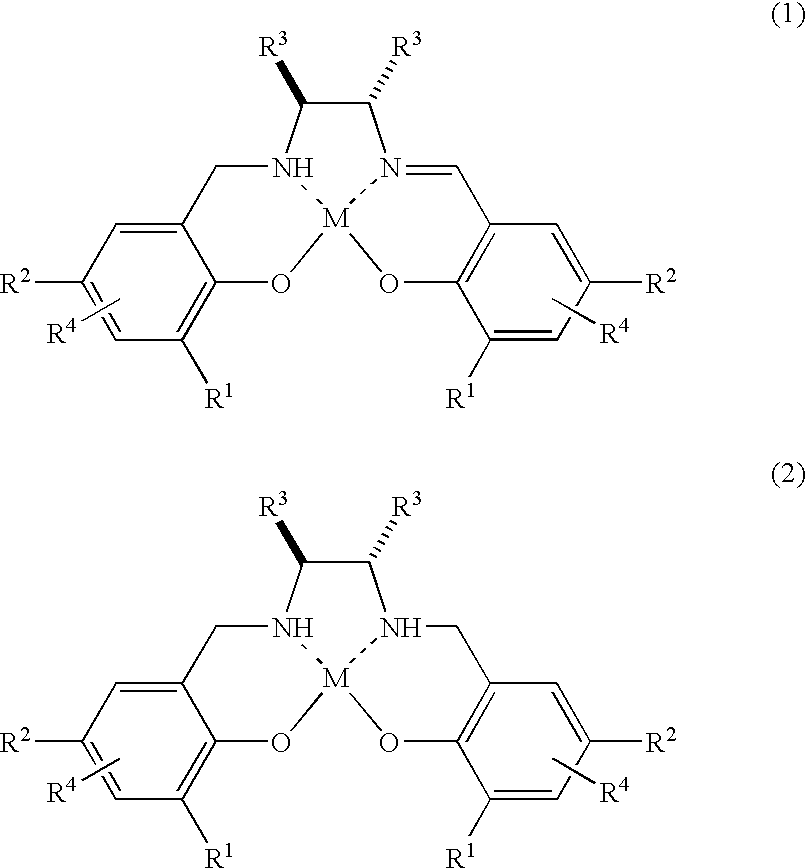
Figure 1 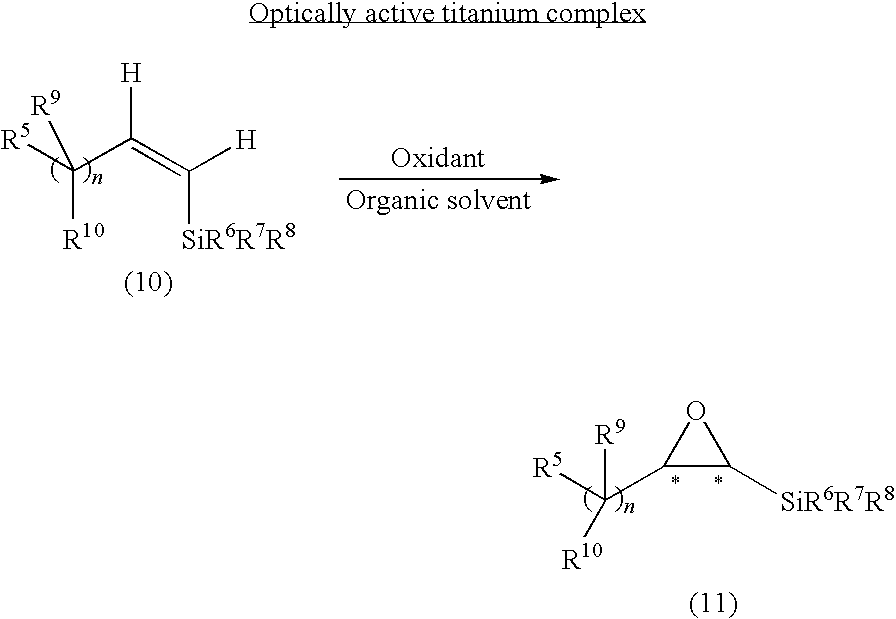
Figure 2 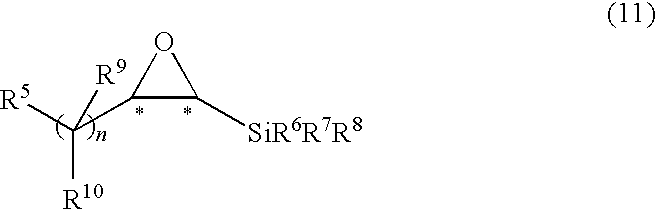
Figure 3
Abstract
Description
TECHNICAL FIELD
[0001] The present invention relates to an efficient production method of an optically active cis-silylolefin oxide compound useful as an intermediate for various compounds.BACKGROUND ART
[0002] Shi et al. have performed an epoxidation of a 2,2-di-substituted alkenylsilane using a catalyst derived from a sugar to obtain an epoxysilane with a selectivity of 94% ee, however, there is such a drawback that an equivalent catalyst is necessary (Non-patent Documents 1 to 4). From the introduction of a silyl group having a large steric hindrance into a vinyl-position, it is expected that the enantio-face selectivity is further enhanced, however, there is a problem that the large steric hindrance hinders the reaction (Non-patent Documents 5 and 6).[Non-patent Document 1]
[0003] Wong, 0. A.; Shi, Y. Chem. Rev. 2008, 108, 3958.[Non-patent Document 2]
[0004] Shi, Y. Acc. Chem. Res. 2004, 37, 488.[Non-patent Document 3]
[0005] Yang, D. Acc. Chem. Res. 2004, 37, 497.[Non-patent Document 4][...
Examples
example 1
Asymmetric Oxidation of Alkenylsilane
[0132]
[0133]A titanium salalen complex 1 (4.5 to 18 mg, 0.5 to 2.0 mol %) of the above formula and alkenylsilane (0.50 mmol) were dissolved in CH2Cl2 (0.50 mL) and thereto, 30 to 35% hydrogen peroxide water (85 μL, 0.75 mmol) was added, followed by stirring the resultant reaction mixture at 25° C. After the completion of the reaction, the mixture was purified by silica gel column chromatography using n-pentane as a developing solvent to produce the objective epoxysilane. The optical purity (ee) thereof was determined by an optically active HPLC analysis.
example 2
Production of Styrene Oxide from Epoxysilane
[0134]The epoxysilane was dissolved in THF (4 mL / mmol). Thereto, tetrabutylammonium fluoride (TBAF) (1 molL−1 THF solution, 1.5 to 2 equivalents) was added and the resultant reaction mixture was stirred at a room temperature or 50° C. After the completion of the reaction, the mixture was extracted with diethyl ether and the extract was washed with water and saline and dried over Na2SO4. The crude product was purified by silica gel chromatography using n-pentane / diethyl ether as a developing solvent to produce a corresponding epoxide. The optical purity (ee) thereof was determined by an optically active HPLC analysis.
[0135]Hereinafter, the yield, the optical purity and the physical properties of the compound produced according to Examples 1 and 2 are shown. In addition, CHIRALPAK IC, CHIRALCEL OD-H, CHIRALPAK AD-H, CHIRALPAK IA and CHIRALCEL OJ-H which were used for the determination of the optical purity are registered trademarks of Daicel...
example 3
Asymmetric Oxidation of Alkenylsilane No. 2
[0158]To a dichloromethane solution (0.5 mL) of a salan ligand (27 mg, 0.050 mmol) (10 mol % based on the mol of the substrate) of Formula 2:
titanium tetraisopropoxide [Ti (Oi-Pr)4] (2.8 mg, 0.010 mmol) was added at 20° C. The resultant reaction mixture was stirred at 20° C. for 1 hour and to the reaction mixture, a CH2Cl2 (0.50 mL) solution of cis-1-dimethyl (phenyl) silyl-2-phenylethylene (0.50 mmol) was added, followed by adding 30 to 35% hydrogen peroxide water (85 μL, 0.75 mmol) and by stirring the resultant reaction mixture at 40° C. After the completion of the reaction, the mixture was purified by silica gel column chromatography using n-pentane as a developing solvent to produce the objective dimethyl(phenyl) ((2R,3S)-3-phenyloxirane-2-yl] silane. The yield and the optical purity (ee) were 59% and 99% ee respectively.