
Photoreduction catalyst, and method for synthesizing ammonia and method for decreasing nitrogen oxides in water using the same
Patent Information
- Authority / Receiving Office
- US · United States
- Current Assignee / Owner
- Publication Date
- 2012-09-13
- Estimated Expiration
- Not applicable · inactive patent
Smart Images
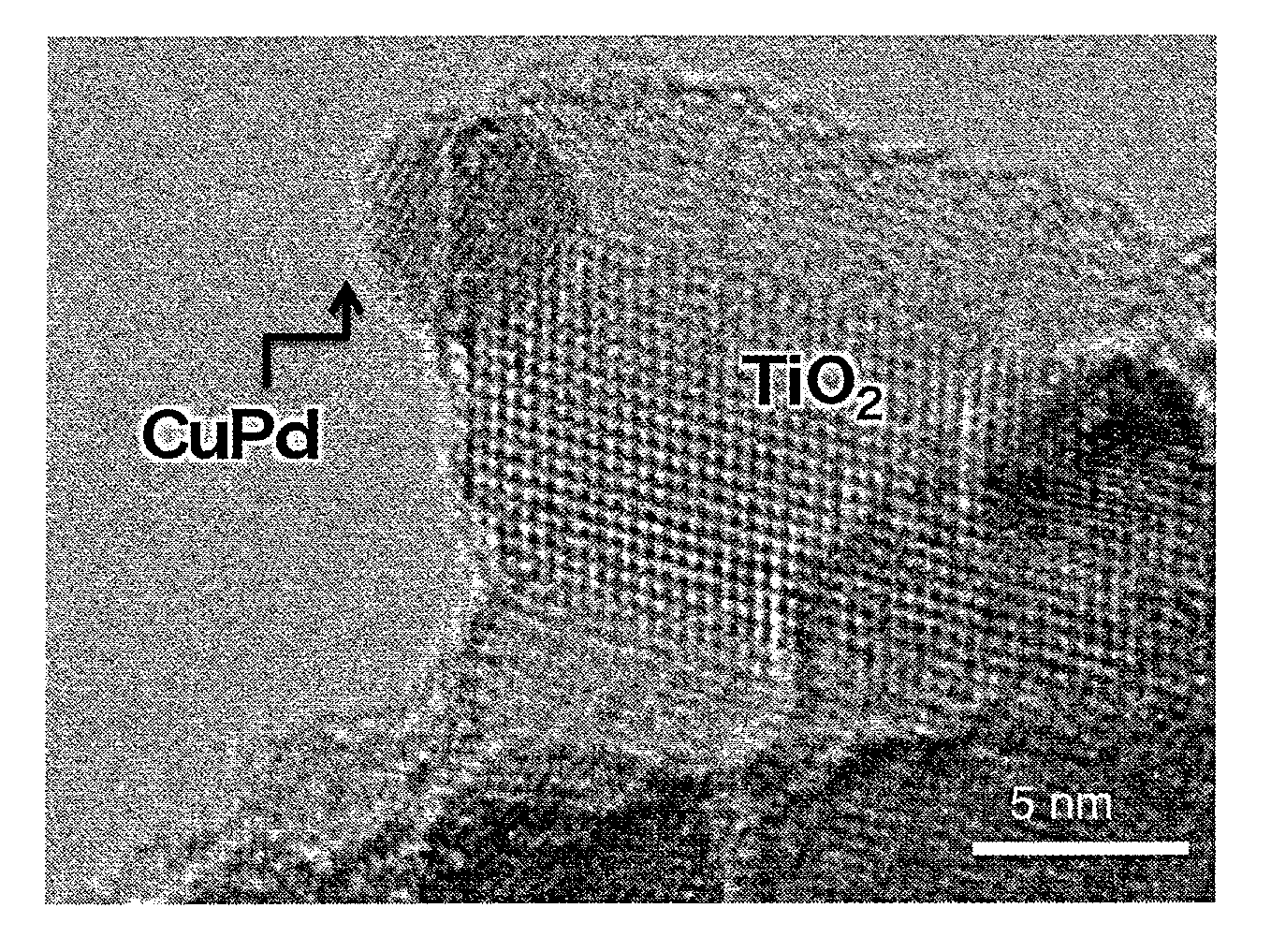
Figure 1 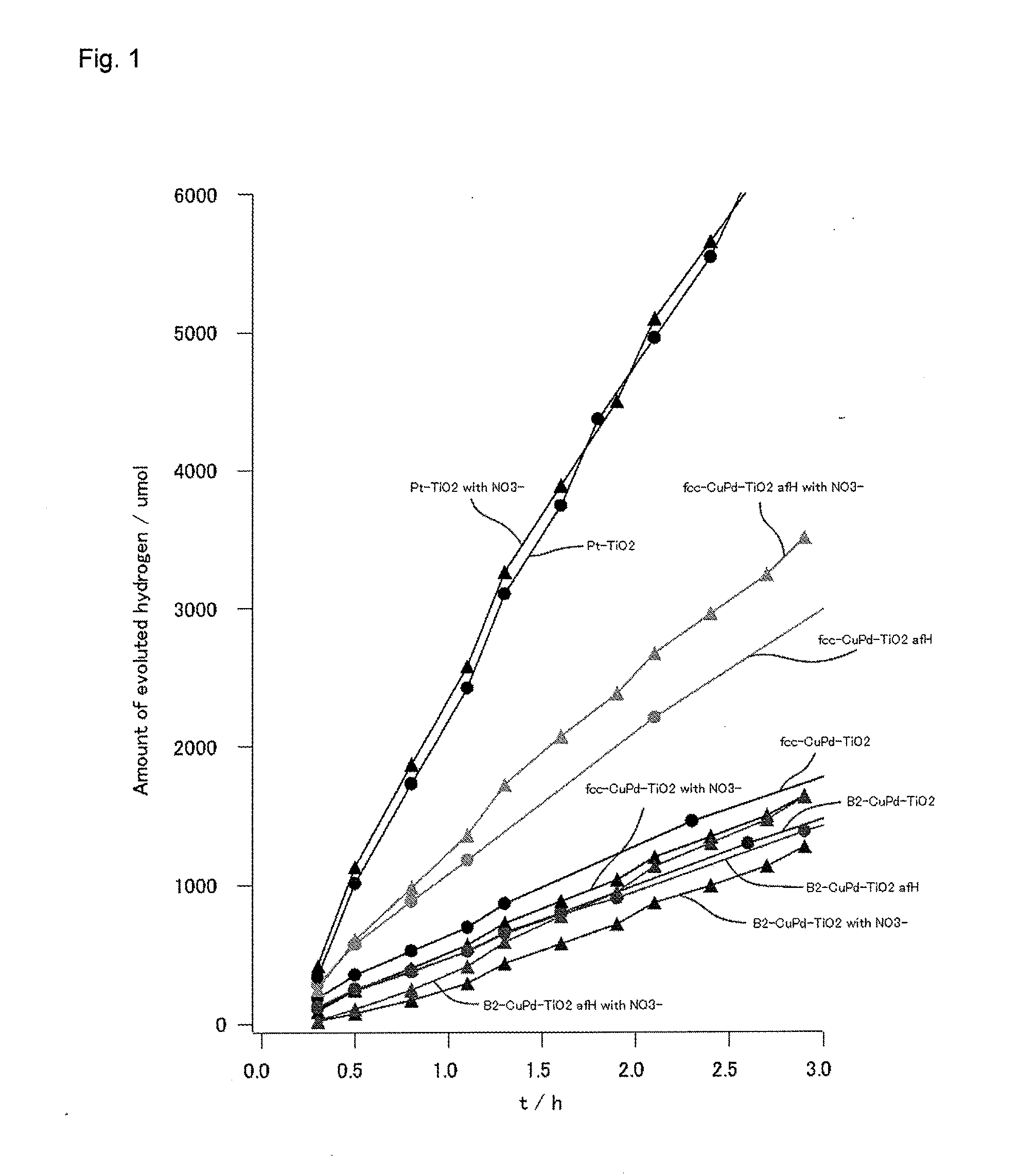
Figure 2 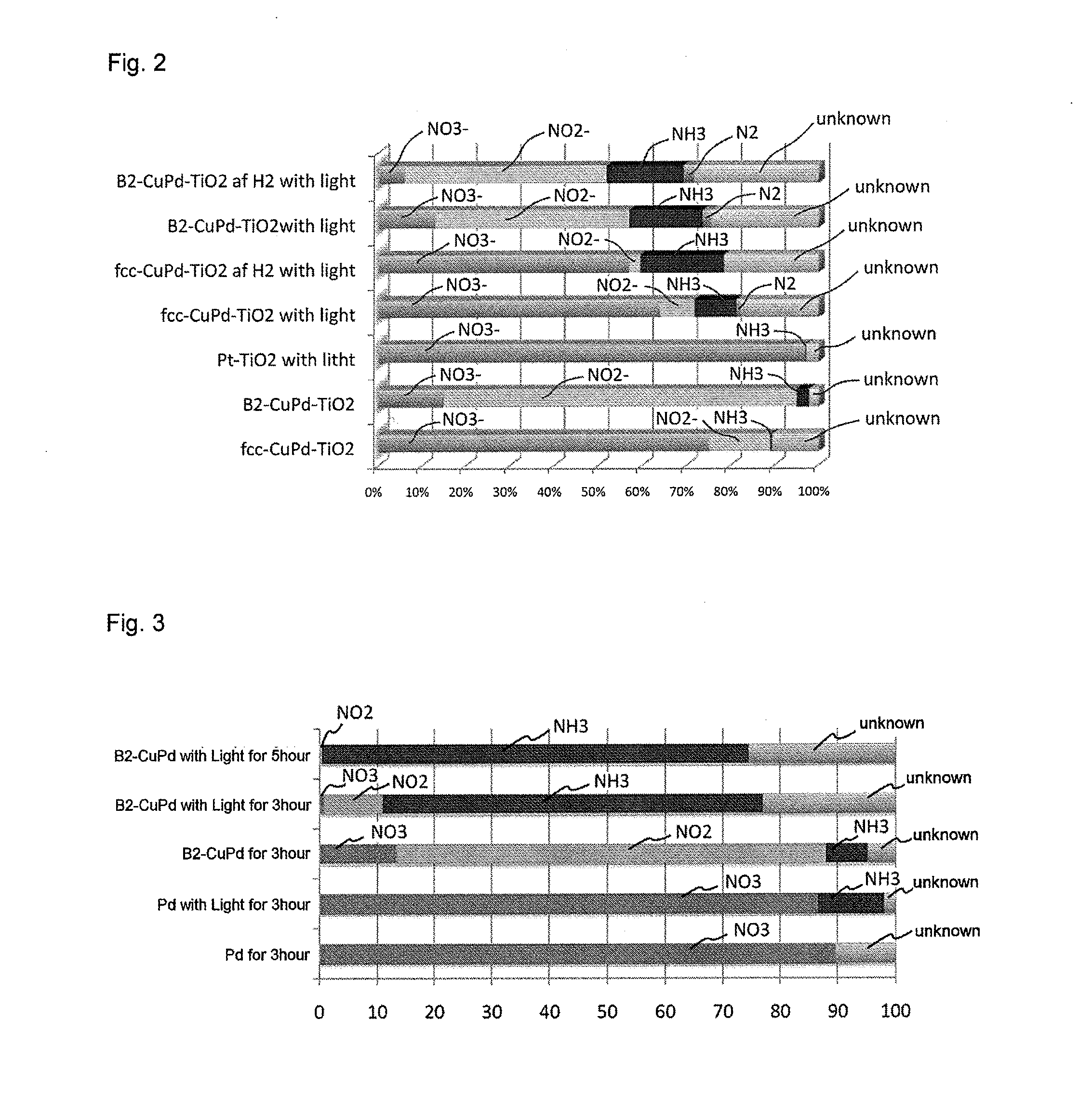
Figure 3
Abstract
Description
CROSS-REFERENCE TO RELATED APPLICATIONS
[0001] This application claims benefit of priority to Japanese Patent Application No. 2009-204556 filed on Sep. 4, 2009, which is expressly incorporated herein by reference in its entirety.
[0002] The present invention relates to a photoreduction catalyst employing CuPd alloy nanoparticles, a method for synthesizing ammonia using the same, and a method for decreasing nitrogen oxides in water using the same.BACKGROUND ARTAmmonia Production
[0003] The current level of ammonia production worldwide is about 150 million tons. Nearly 80% of this is used as raw material for fertilizers, and the remaining 20% or so is used to manufacture synthetic resins and fibers. In particular, the nitrogen component of crops (protein in the human body) can only be supplied as ammonia. Ammonia is a substance that is indispensible as a starting material for chemical fertilizers. In response to global population growth, inadequate arable land, and a shortage of grain due t...
Examples
embodiment 1
(1) Preparation of the Catalyst
(Preparation of CuPd Alloy Nanoparticles)
[0092]Preparation of Disordered Fcc Type CuPd Alloy Nanoparticles
[0093]7.5x 10⁻⁴ mol of copper acetate was dissolved in 100 mL of ion-exchange water and 7.5 x 10⁴ mol of palladium acetate was dissolved in 50 mL of acetone. These solutions and 1.5×10⁻¹ mol of poly[N-vinyl-2-pyrrolidone] (NW=48,000) were mixed and ion-exchange water was added to prepare 300 mL of solution. The solution was cooled to 0° C. When 7.5×10⁻³ mol of NaBH4 dissolved in 100 mL of ion-exchange water was added at once, a blackish brown colloidal solution was obtained. Stirring was conducted for 30 minutes, followed by three repeat cycles of reprecipitation using acetone, water, and diethyl ether. The solvent and by-product inorganic compounds were removed, yielding disordered fcc type CuPd alloy nanoparticles (fcc-CuPd) (average particle diameter=4.5±1.7 nm).
[0094]Preparation of Ordered B2 Type CuPd Alloy Nanoparticles
[0095]7.5×10⁻⁴ mol of c...
embodiment 2
(1) Method of Preparing Small Diameter CuxPd(1-x) nanoparticles
[0109](0xPd(1-x) nanoparticles were prepared by changing the concentration ratio of Cu and Pd contained in the copper acetate and palladium acetate of the starting materials employed in synthesis.
[0110]The method of preparing Cu0.5Pd0.5 nanoparticles is indicated below.
[0111]In a glass tube, 0.3 g of copper acetate (1.5×10⁻³ mol) and 1.666 g of polyvinylpyrrolidone K30 (1.5×10⁻² mol) were admixed with 10 mL of 2-ethoxyethanol. The mixture was dissolved by keeping for one hour at 1,300 rpm and 50° C. The dissolved solution was cooled to 30° C. In a separate glass container, 0.337 g of palladium acetate was dissolved in 15 mL of acetone. The palladium acetate solution was added to the copper acetate solution. A 0.227 g quantity of NaBH4 (6.0×10⁻³ mol) dissolved in 1.5 mL of Millipore water was added to the mixed solution of palladium acetate and copper acetate and the mixture was reacted for one hour with stirring at a spe...