

Polyion complex comprising hydrophobized polyamino acid and use of the same
Patent Information
- Authority / Receiving Office
- US · United States
- Current Assignee / Owner
- Publication Date
- 2012-04-19
- Estimated Expiration
- Not applicable · inactive patent
Smart Images
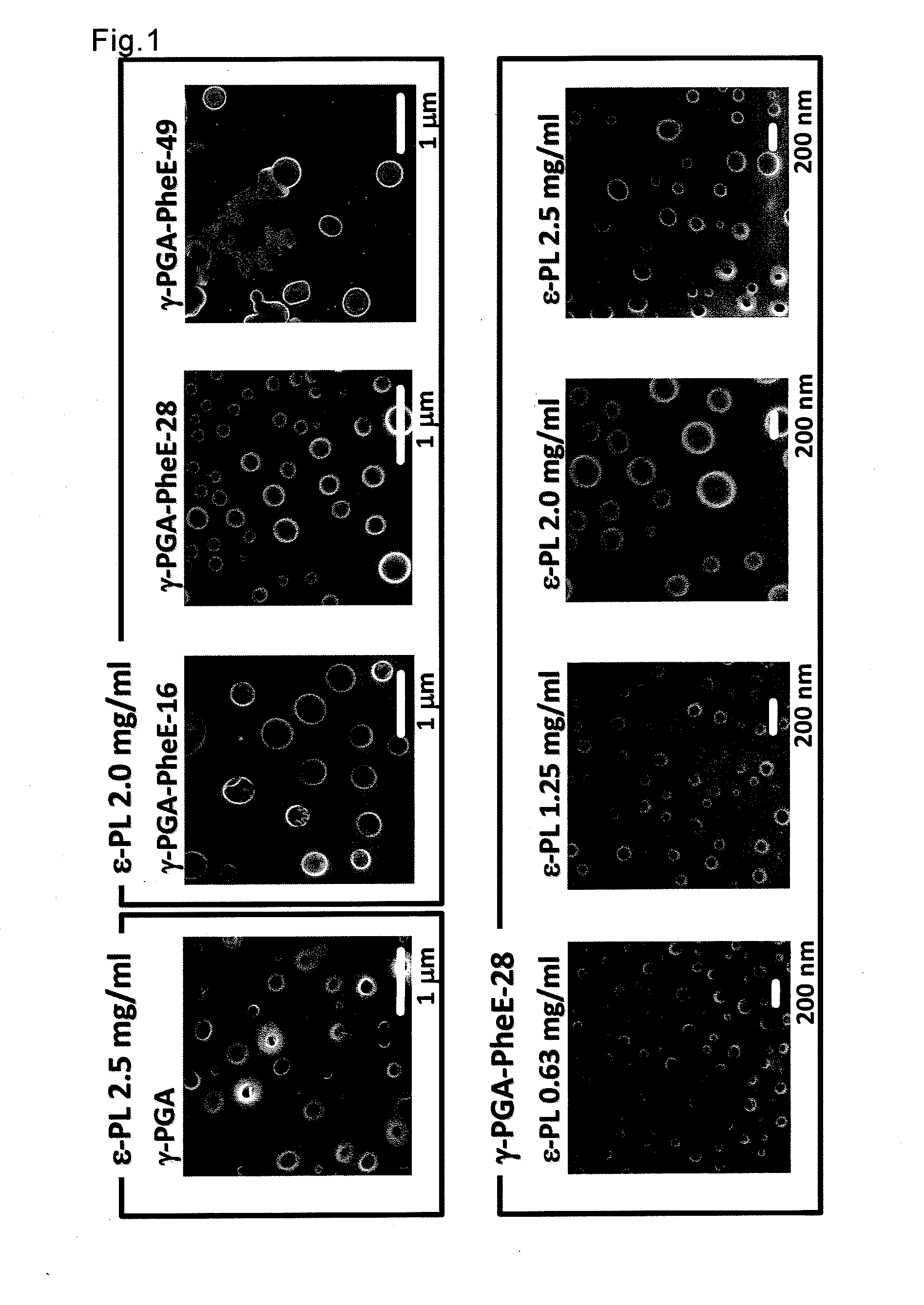
Figure 1 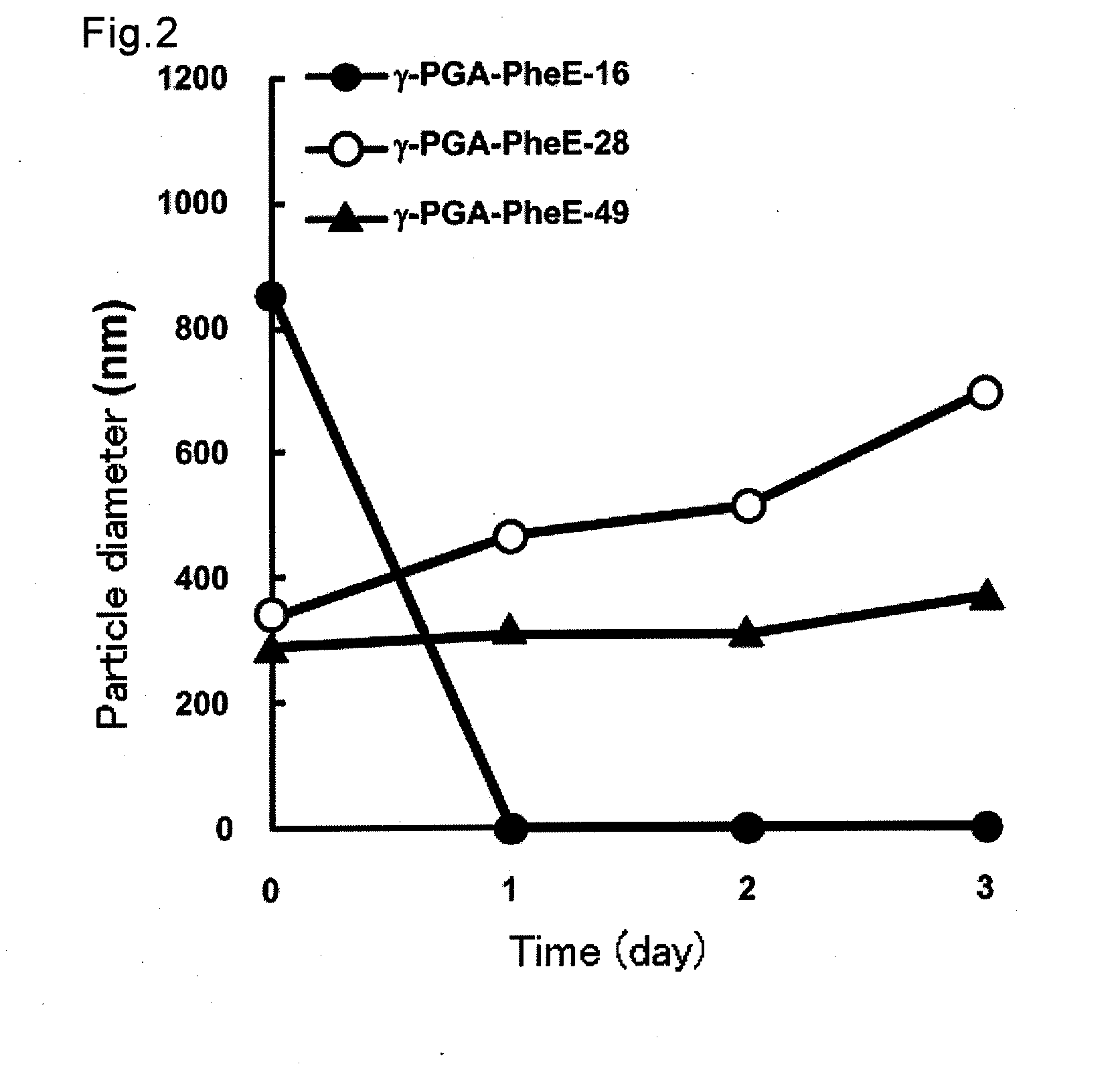
Figure 2 
Figure 3
Abstract
Description
[0001] The present application claims a benefit of the application No. 2009-079712 filed in Japan on Mar. 27, 2009, the contents of which are hereby incorporated by reference.FIELD OF THE INVENTION
[0002] The present invention relates to a field of a drug delivery system (DDS). More specifically, the present invention relates to a polyion complex useful as a carrier or an immunotherapy agent that exhibits a high immunity induction effect, and a polyion complex nanoparticle having a particle shape.BACKGROUND OF THE INVENTION
[0003] A drug delivery system (DDS) for making an effect of drugs to exhibit at the maximum is essential in a pharmaceutical development field, and development of a carrier for delivering the drugs is important. A carrier system utilizing a polymer nano-assembly allows construction of multifunctional polymer devices by a precise molecular design of a polymer chain, and has been anticipated as a DDS carrier application. As a polymer carrier used in this field, micelles...
Examples
preparation example 1
Preparation of Hydrophobized Polyamino Acid
[0065]In 100 ml of a 50 mM aqueous solution of sodium hydrogen carbonate, 607 mg of γ-PGA (Meiji Co., Ltd., molecular weight 3.8×10⁵, pKa=2.3) derived from a microorganism (Bacillus subtilis) was uniformly dissolved. To the solution, 225 to 901 mg of 1-ethyl-3-(3-dimethylaminopropyl)carbodiimide hydrochloride (WSC) and 1080 mg of L-phenylalanine ethyl ester (PheE) were added, and the resulting mixture was reacted on ice for 1 hour, and then at room temperature for 24 hours. After the reaction, the resulting solution was dialyzed against water using a dialysis membrane (molecular weight cut off: 50,000) for 3 days, and then the resulting solution was lyophilized. The obtained lyophilized substance was added to 100 ml of ethanol, and the resulting mixture was stirred overnight. The resulting solution was centrifuged (1,500×g, 20 minutes), and the precipitate was dried under reduced pressure to obtain hydrophobized γ-PGA. The introduction amou...
preparation example 2
Preparation of Polyion Complex (PIC) Nanoparticle
[0066]In PBS (pH 7.4) at 25° C., the various hydrophobized γ-PGA prepared as described above (γ-PGA-PheE-16, -28 and -49) or unmodified γ-PGA (Meiji Co., Ltd., molecular weight: 3.8×10⁵, pKa=2.3) and ε-PL (Chisso Corporation, molecular weight: 4.7×10³) derived from a microorganism (Streptomyces albulus 346) were separately dissolved at final concentrations of 10 mg / ml and 0 to 5 mg / ml, respectively, and these were equivalently mixed. The average particle diameter and particle diameter distribution immediately after mixing were measured by the dynamic light scattering method (instrument name, Zetasizer Nano ZS, Malvern Instruments Ltd.), and the state of particles was observed by the scanning electron microscope. The results are shown in Table 1 and FIG. 1.
TABLE 1Concentrations of ε-PL (mg / mL)Hydrophobized00.6251.252.02.55poly(acidicParticle diameter of PIC nanoparticle (nm, averageamino acid)aparticle diameter ± SE)γ-PGA14.5 ± 1.910.9...
example 1
Stability of PIC Nanoparticle
[0068]Next, stability of PIC nanoparticles formed as described above was measured. γ-PGA-PheE-16, -28 or -49 (10 mg / mL) to which hydrophobic groups were introduced at various ratios, and ε-PL (2 mg / mL) were separately dissolved in 1 ml of PBS (pH 7.4), and these solutions were equivalently mixed, and then the resulting solutions were allowed to stand at 4° C. and the average particle diameter was measured with time by the dynamic light scattering method (instrument name, Zetasizer Nano ZS, Malvern Instruments Ltd.). The results are shown in FIG. 2.
[0069]As is obvious from FIG. 2, when hydrophobized poly(acidic amino acid) and a basic polypeptide were mixed at a particular ratio, and when γ-PGA-PheE-16 was used, disruption and agglutination of particles were found after 1 day, and a monodispersed peak was not found by the dynamic light scattering method. On the other hand, when γ-PGA-PheE-28 was used, the particle diameter increased by swelling of particl...