
Polymerizable compound, polymerizable composition, polymer, and optically anisotropic body
a technology of polymerizable compound and composition, applied in the direction of optical elements, instruments, organic chemistry, etc., can solve the problems of increasing cost, narrow range in which liquid crystallinity is obtained, and low solubility of solvent normally used for industrial processes, etc., to achieve easy and inexpensive production, easy to obtain optical films, and satisfactory performan
Patent Information
- Authority / Receiving Office
- US · United States
- Patent Type
- Applications(United States)
- Current Assignee / Owner
- Publication Date
- 2014-07-17
Smart Images
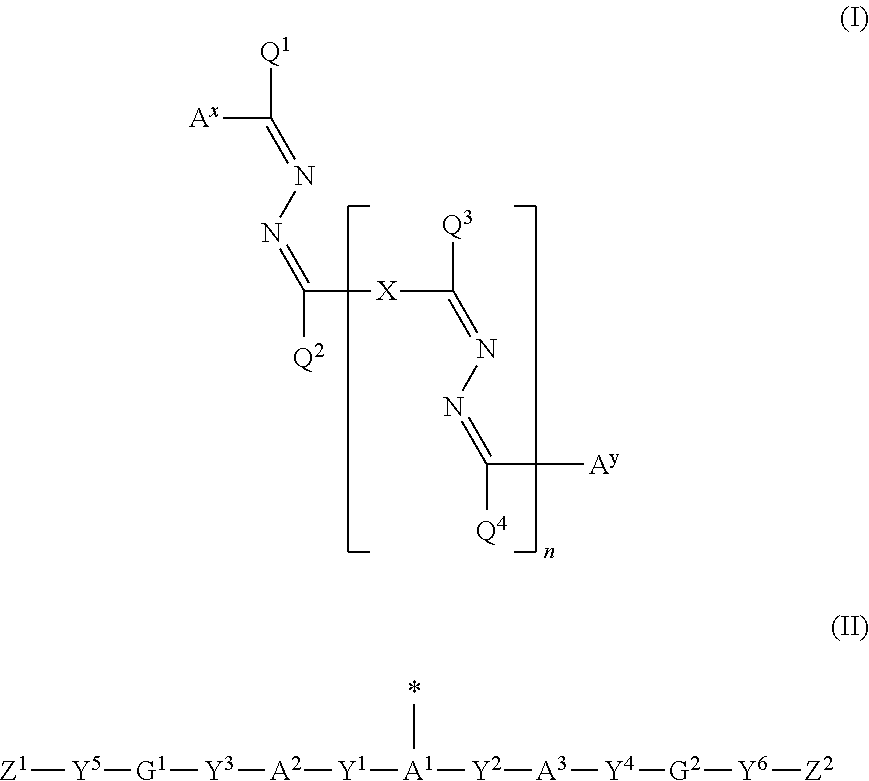
Figure 1 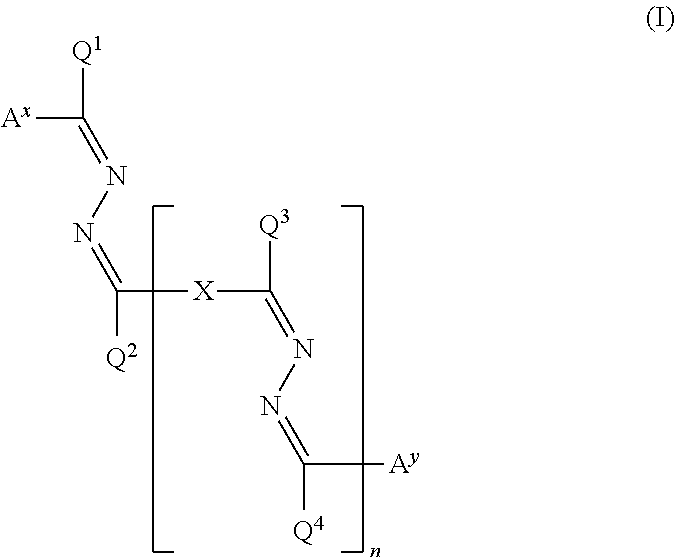
Figure 2 
Figure 3
Abstract
Description
TECHNICAL FIELD
[0001] The invention relates to a polymerizable compound, a polymerizable composition, and a polymer that may produce an optical film that achieves uniform conversion of polarized light over a wide wavelength band, and also relates to an optically anisotropic article.
[0002] A flat panel display (FPD) that utilizes an optical film (e.g., polarizer and retardation film) can achieve high-resolution display, and has been widely used as an advantageous display device.
[0003] However, a known retardation film has a problem in that polarized light that passes through the retardation film is converted into colored polarized light. In order to solve the above problem, various wideband retardation films that can achieve uniform retardation for light over a wide wavelength band (i.e., retardation films having reverse wavelength dispersion) have been studied (see Patent Documents 1 to 6, for example).
[0004] It has been desired to reduce the thickness of the flat panel display as much ...
Examples
example 1
Synthesis of Compound 1
[0181]
Step 1: Synthesis of intermediate A
[0182]
[0183]A four-necked reactor equipped with a thermometer was charged with 20 g (144.8 mmol) of 2,5-dihydroxybenzaldehyde, 105.8 g (362.0 mmol) of 4-(6-acryloylhex-1-yloxy)benzoic acid (manufactured by DKSH Japan K.K.), 5.3 g (43.4 mmol) of 4-(dimethylamino)pyridine, and 200 ml of N-methylpyrrolidone under a nitrogen stream to prepare a homogeneous solution. After the addition of 83.3 g (434.4 mmol) of 1-ethyl-3-(3-dimethylaminopropyl)carbodiimide hydrochloride (WSC) to the solution, the mixture was stirred at 25° C. for 12 hours. After completion of the reaction, the reaction mixture was added to 1.5 l of water, and extracted with 500 ml of ethyl acetate. The ethyl acetate layer was dried over anhydrous sodium sulfate, and sodium sulfate was filtered off. Ethyl acetate was evaporated from the filtrate under reduced pressure using a rotary evaporator to obtain a light yellow solid. The light yellow solid was purifie...
example 2
Synthesis of Compound 2
[0191]
Step 1: Synthesis of Intermediate B
[0192]
[0193]A four-necked reactor equipped with a thermometer was charged with 0.56 g (11.18 mmol) of hydrazine monohydrate and 10 ml of ethanol under a nitrogen stream to prepare a homogeneous solution. After the addition of 1.5 g (11.18 mmol) of 2,5-dihydroxybenzaldehyde and 10 ml of THF to prepare a homogenous solution, the solution was stirred at 25° C. for 1 hour. After the addition of 550 mg (3.98 mmol) of terephthalaldehyde to the reaction mixture, the mixture was stirred at 25° C. for 6 hours. After completion of the reaction, a precipitated solid was filtered off by suction filtration. The solid was dried under vacuum to obtain 0.8 g of an intermediate B as a yellow solid (yield: 50.0%). The intermediate B was used directly for the subsequent reaction without purification.
Step 2: Synthesis of Compound 2
[0194]A four-necked reactor equipped with a thermometer was charged with 2.54 g (8.69 mmol) of 4-(6-acryloylhe...
example 3
Synthesis of Compound 3
[0199]
Step 1: Synthesis of Intermediate C
[0200]
[0201]A four-necked reactor equipped with a thermometer was charged with 2.00 g (13.1 mmol) of 2,5-dihydroxyacetophenone, 296 mg (5.92 mmol) of hydrazine monohydrate, and 20 ml of 1-propanol under a nitrogen stream. The mixture was stirred at 60° C. for 4 hours. The reaction mixture was cooled to 25° C., and poured into 10% sodium bicarbonate water to precipitate crystals. The crystals were filtered off by suction filtration, washed with water, and air-dried. The crystals were used directly for the subsequent reaction without purification.
[0202]The structure of the target product was identified by 1H-NMR.
[0203]1H-NMR data for intermediate C
[0204]1H-NMR (500 MHz, CDCl3, TMS, δ ppm): 12.30 (s, 2H), 9.05 (s, 2H), 7.10 (d, 2H, J=2.5 Hz), 6.85 (dd, 2H, J=2.5 Hz, 9.2 Hz), 6.80 (d, 2H, J=9.2 Hz), 2.46 (s, 6H).
Step 2: Synthesis of Compound 3
[0205]A four-necked reactor equipped with a thermometer was charged with 3.27 g (1...