
Process for preparing a zirconium-based metal organic framework
a zirconium-based metal and organic framework technology, applied in the field of process for preparing metal organic frameworks (mofs), can solve the problems of increasing process costs, and affecting the effect of organic solvents
Patent Information
- Authority / Receiving Office
- US · United States
- Patent Type
- Applications(United States)
- Current Assignee / Owner
- Publication Date
- 2017-10-12
Smart Images
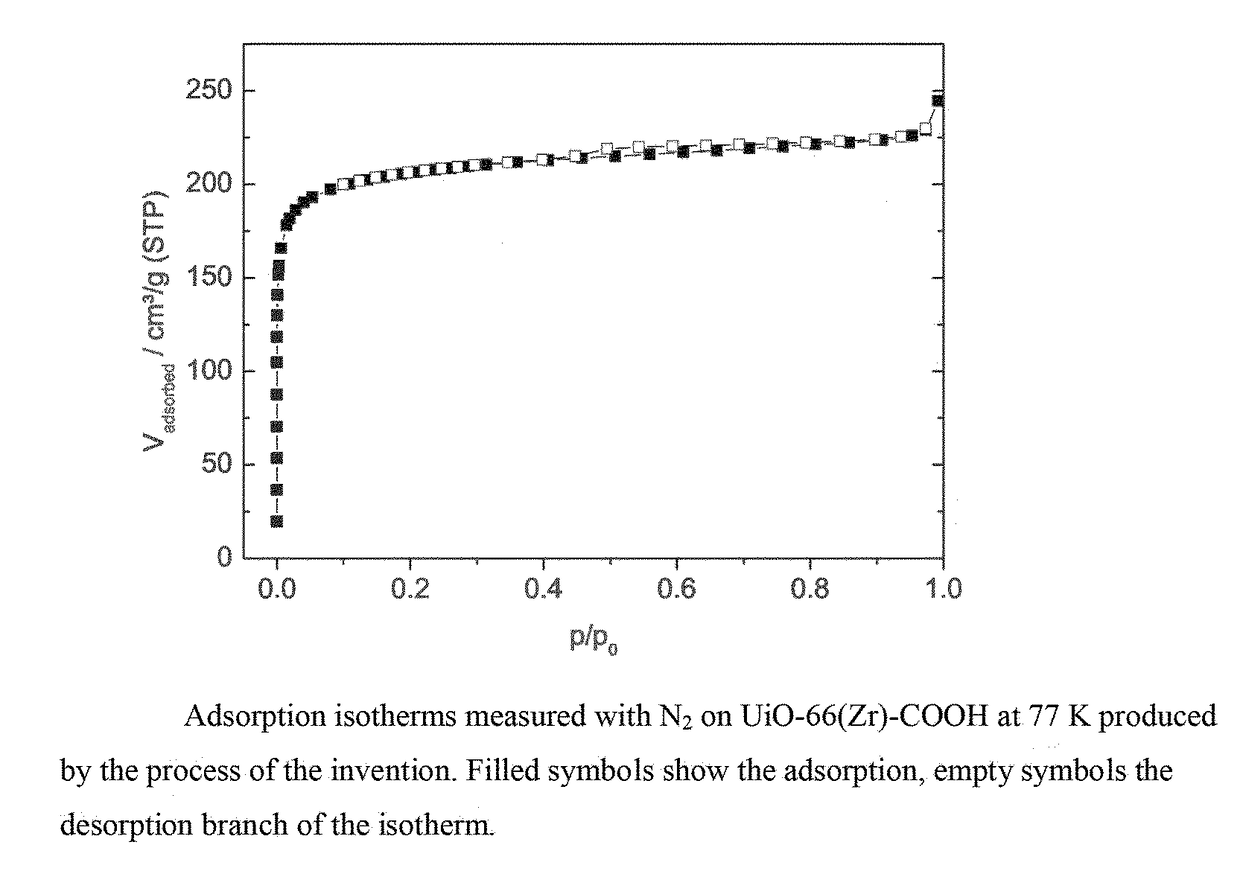
Figure 1 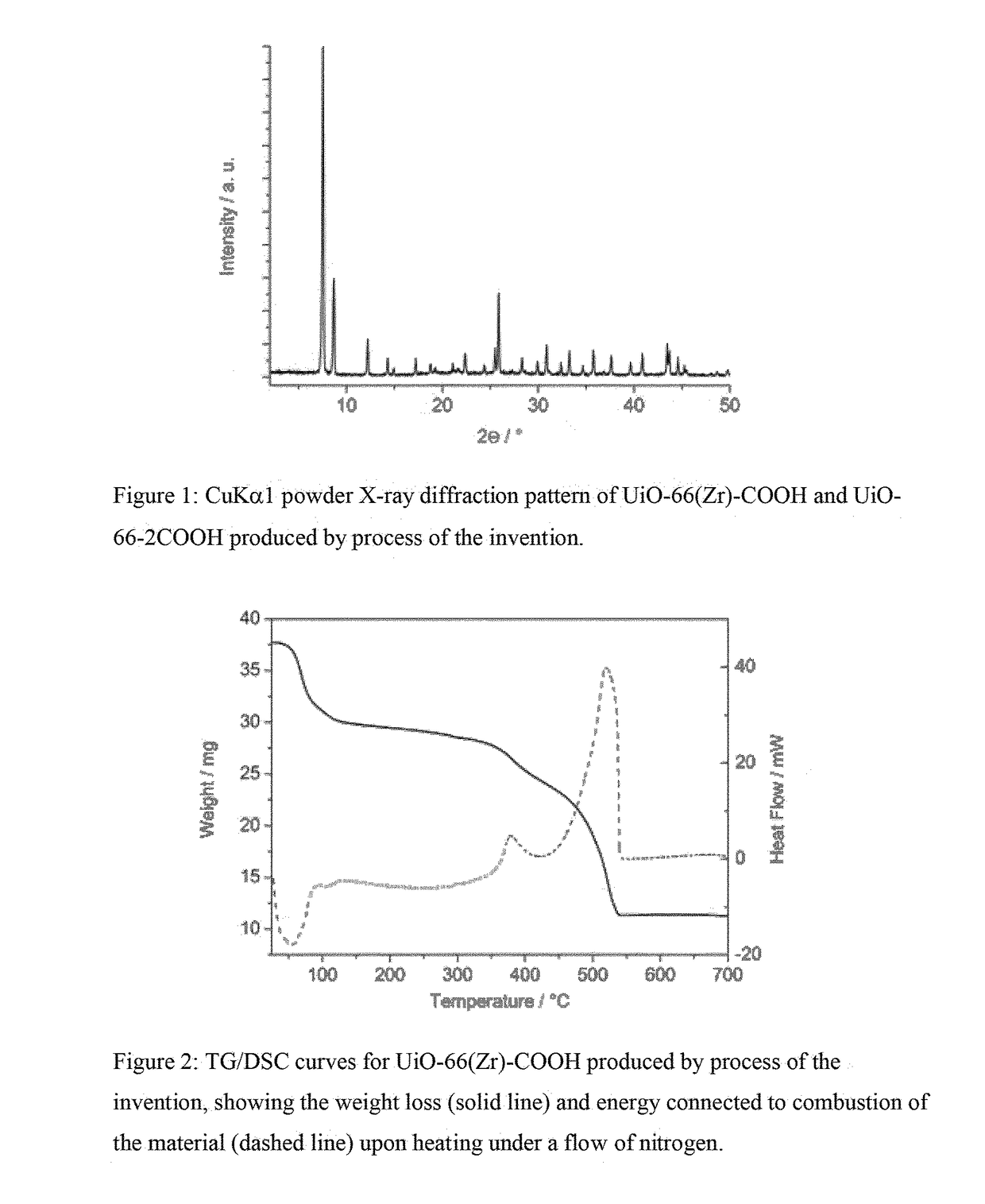
Figure 2 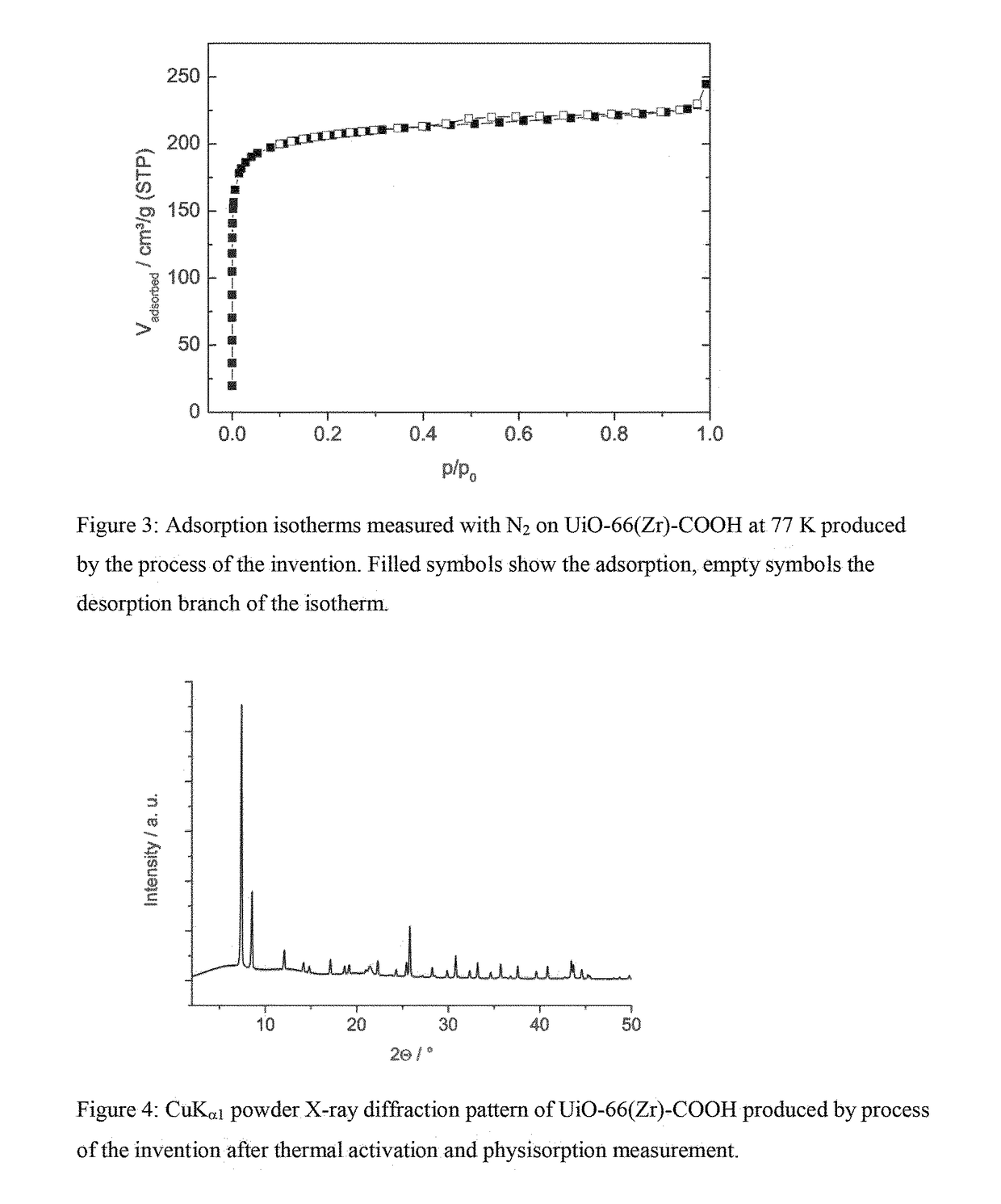
Figure 3
Abstract
Description
FIELD OF THE INVENTION
[0001] The present invention relates to a process for preparing metal organic frameworks (MOFs), in particular to a process for preparing Zr-MOFs. The invention also relates to Zr-MOFs produced by such processes.BACKGROUND
[0002] MOFs or “metal organic frameworks” are compounds having a lattice structure having vertices or “cornerstones” which are metal-based inorganic groups, for example metal oxides, linked together by organic linkers. The linkers are usually at least bidentate ligands which coordinate to the metal-based inorganic groups via functional groups such as carboxylate and / or amine. The porous nature of MOFs renders them promising materials for many applications such as gas storage and catalyst materials.
[0003] Perhaps the best known MOF is MOF-5 in which each Zn4O cornerstone is coordinated by six bis-carboxylate organic linkers. Other MOFs in which the inorganic cornerstone is for example chromium, copper, vanadium, cadmium or iron are also known. The...
Examples
examples
[0078]Techniques
[0079]Surface Area measurement
[0080]The specific surface area was determined by means of N2 physisorption measured on a Belsorp-mini apparatus at 77 K. Prior to the measurement the sample was activated at 373 K under vacuum for 3 h to remove occluded water molecules. The surface area was calculated by the BET-method (DIN 66131) and the Langmuir method (DIN 66135).
[0081]X-Ray Crystallography
[0082]The crystal structure was investigated by means of powder X-ray diffraction under ambient conditions in Bragg-Brentano-geometry utilizing Cu-Kα1-radiation.
[0083]Stability
[0084]The thermal stability was investigated by means of thermogravimetry coupled with differential scanning calorimetry. Therefore the sample was heated up with a rate of 1 K / min under a flow of nitrogen gas, constantly monitoring weight loss and the resulting heat of combustion.
[0085]IR-Spectroscopy
[0086]In-situ Diffuse Reflectence Infrared Fourier transform spectra (DRIFT) were recorded on KBr mixed with U...