
Polyamide nanoparticles and uses thereof
a technology of polyamide nanoparticles and crosslinked polyamides, which is applied in the field of nanosized crosslinked polymeric backbones, can solve the problems of bacterial attachment to surfaces and the formation of community of bacterial cells, and achieve the effect of remarkable stability and durability
Patent Information
- Authority / Receiving Office
- US · United States
- Patent Type
- Applications(United States)
- Current Assignee / Owner
- Publication Date
- 2019-01-03
Smart Images
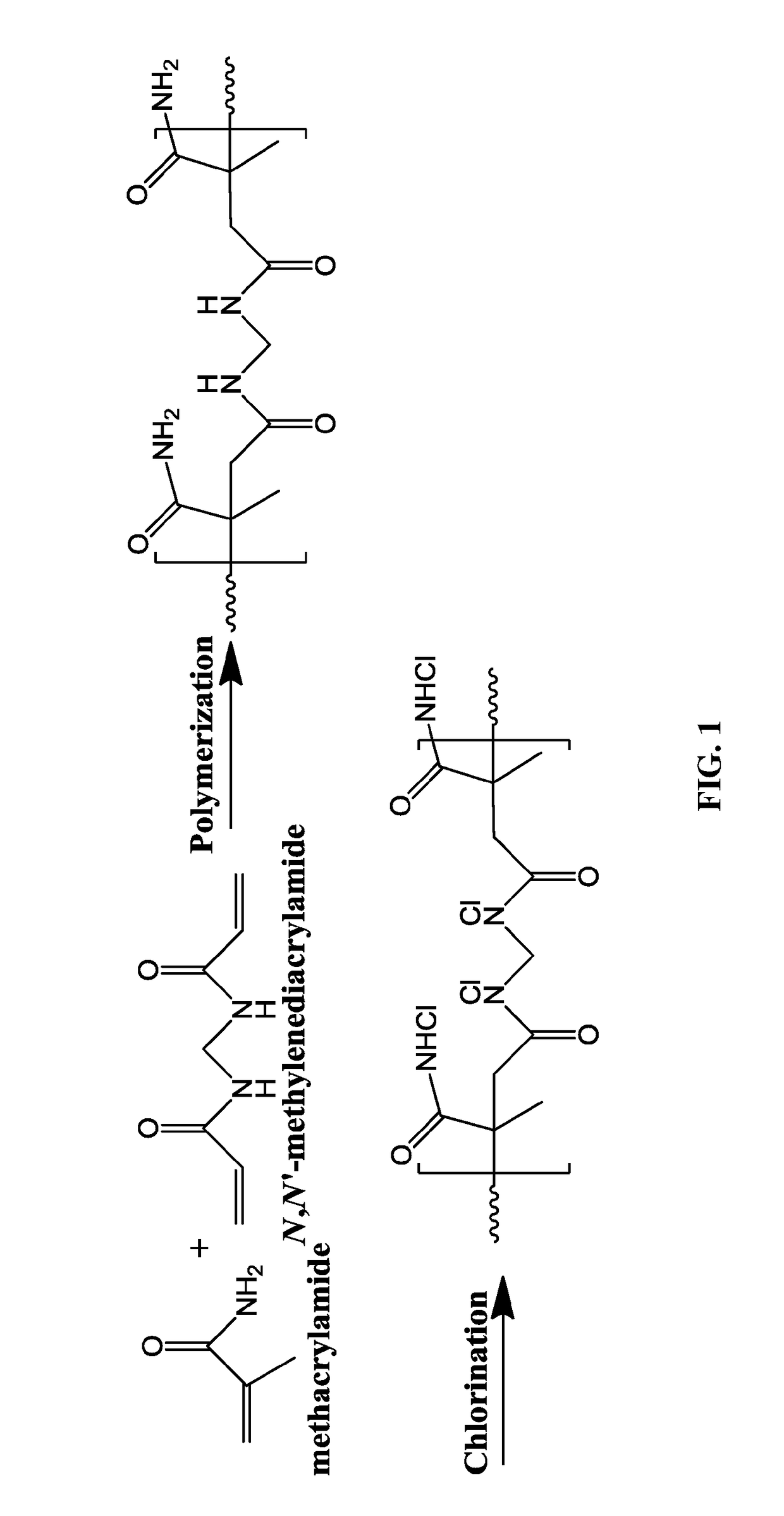
Figure 1 
Figure 2 
Figure 3
Abstract
Description
FIELD OF THE INVENTION
[0001] The present invention, in some embodiments thereof, relates to nanosized crosslinked polymeric backbones, and more particularly, but not exclusively, to nanosized N-halamine-derivatized crosslinked polyamide and uses thereof in, for example, reducing or preventing organic-based contaminant.BACKGROUND OF THE INVENTION
[0002] Various organic antimicrobial agents, such as quaternary ammonium salts, phosphonium salts, and N-halamine compounds, have been extensively investigated over the past 20 years. Compared with halogens, which are inorganic, N-halamines are more stable and less corrosive, and their numerous sought-after qualities (i.e., effectiveness at killing toward a broad spectrum of microorganisms, long-term stability, the possibility of recycling, low cost, and safety for humans and the environment) make N-halamines particularly attractive. The dissociation constant of N-halamine compounds in water is relatively low and varies based on chemical struct...
Examples
example 1
Material and Methods
Materials
[0230]All chemicals were of analytical-grade and used with no further purification.
[0231]MAA, MBAA sodium hypochlorite (4%), potassium persulfate (PPS) dichlorocyanuric acid (DCCA) and 2,20-Azobisisobutyronitrile (AIBN) were purchased from Sigma Aldrich (Rehovot, Israel); sodium iodide was purchased from Strem Chemicals (Newburyport, Mass., USA); acetic acid was purchased from Fisher Scientific (Loughborough, UK); sodiumthiosulfate (0.01 N) was purchased from Acros Organics (Geel, Belgium); and water was purified by passing deionized water through an Elgastat Spectrum reverse osmosis system (Elga LTD, High Wycombe, UK).
Instruments
[0232]Attenuated total reflectance (ATR) analysis was performed with Bruker Platinum ATR QuickSnap™ sampling modules A220 / D-01. The samples were analyzed over 100 scans at a 4 cm−1 resolution. The hydrodynamic diameter and size distribution of the particles dispersed in water were measured at room temperature with a particle ana...
example 2
Polymer Synthesis
[0233]Preparation of the Cross-Linked P(MAA-MBAA) Nanoparticles
[0234]In exemplary procedures, P(MAA-MBAA) nanoparticles of hydrodynamic sizes ranging from 18±2 to 460±60 nm were formed by surfactant-free dispersion copolymerization of the monomers MAA and MBAA in water as a continuous phase. In exemplary procedures, P(MAA-MBAA) nanoparticles of 27±3 nm hydrodynamic diameter were formed by dissolution of 4.4 g of MAA, 3.6 g of MBAA (2% w / v total monomers), and 240 mg of PPS in 400 mL of distilled water. The 1 L round-bottom flask containing this solution was stirred with a mechanical stirrer (200 rpm) at 100° C. for 1 h. The MAA and MBAA residues were subsequently removed from the nanoparticle aqueous dispersion by extensive dialysis against water. The dried P(MAA-MBAA) nanoparticles were obtained by lyophilization. FIG. 1 presents a schematic illustration of the synthesis process.
[0235]Effect of Various Parameters on the Characterization of the Cross-Linked P(MAA-MB...
example 3
[0254]Chlorination of the P(Mma-Mbaa) Nanoparticles
[0255]Chlorination of the P(MAA-MBAA) Nanoparticles:
[0256]Following the synthesis of the optimal P(MAA-MBAA) nanoparticles, P(MAA-MBAA) nanoparticles of 27±3 nm hydrodynamic diameter were used to investigate the effect of varying the chlorination process parameters as follows:
Sodium hypochlorite aqueous solution (5 mL, 4% w / v) was added to an aqueous dispersion of the P(MAA-MBAA) nanoparticles (5 mL, 15 mg / mL), which was shaken at room temperature for 1 hour. Excess sodium hypochlorite was removed from the P(MAA-MBAA)-Cl nanoparticle dispersion by extensive dialysis against water. The bound-Cl content of the P(MAA-MBAA)-Cl nanoparticles was determined by iodometric / thiosulfate titration according to the art using the following expression:
Cl+(mM)=N×V×10002
where N is the normality (equiv / L) and V is the volume (L) of the titrated sodium thiosulfate solution.
[0257]In further exemplary procedures, as detailed in the Results section that...