
Thienotriazolodiazepine compound and medicinal use thereof
a technology of thienotriazolodiazepine and compound, which is applied in the field of thienotriazolodiazepine compound, to achieve the effects of prophylaxis or suppression, prophylaxis or treatment, and inducing antigen specific immunological toleran
Patent Information
- Authority / Receiving Office
- US · United States
- Patent Type
- Patents(United States)
- Current Assignee / Owner
- Publication Date
- 2011-10-25
Smart Images
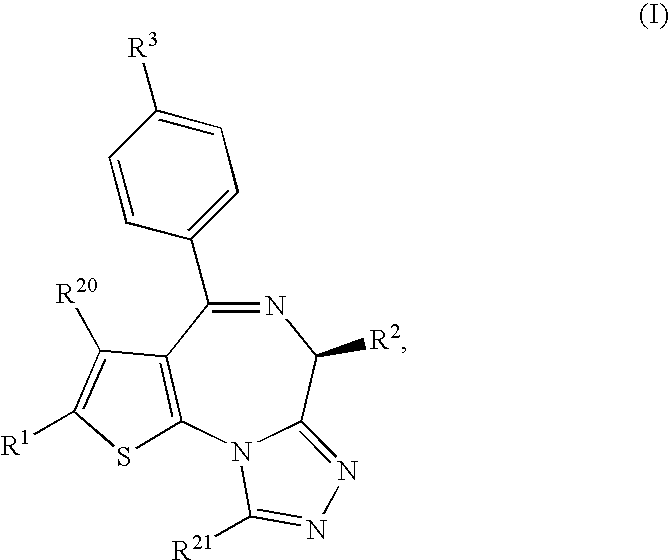
Figure 1 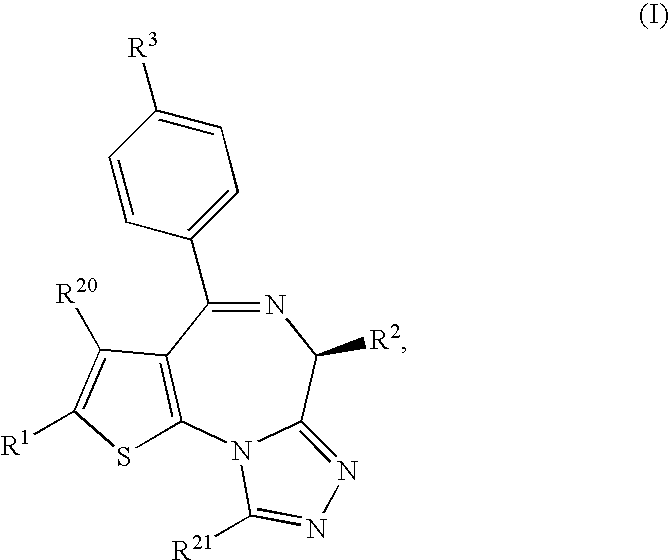
Figure 2 
Figure 3
Abstract
Description
CROSS-REFERENCE TO A RELATED APPLICATION
[0001] This patent application is the U.S. national phase application of International Patent Application No. PCT / JP2006 / 310709, filed May 30, 2006.TECHNICAL FIELD
[0002] The present invention relates to a thienotriazolodiazepine compound, a pharmaceutical agent comprising this as an active ingredient, and a production intermediate for and a production method of the thienotriazolodiazepine compound.BACKGROUND ART
[0003] When an antigen is presented by a major histocompatibility complex (MHC) on an antigen-presenting cell such as dendritic cell, macrophage, B cell and the like, T cells recognize the antigen via a T cell receptor (TcR / CD3 complex) and are activated. However, an antigen specific signal (first signal) from the T cell receptor alone is not sufficient for the normal activation of T cells, and a second signal called costimulatory signal is essential. Solely with the stimulation by the first signal via TcR, sufficient activation of T cells...
Examples
example 1
Methyl (S)-{4-(4-chlorophenyl)-2,3,9-trimethyl-6H-thieno[3,2-f][1,2,4]triazolo[4,3-a][1,4]diazepin-6-yl}acetate
[0228]To a suspension of starting material B (300 g) in methanol (1.5 L) was added dropwise (10-25° C.) thionyl chloride (320 g) over 1 hr under ice-cooling, and the mixture was stirred at room temperature for 4 hr. After completion of the reaction, the solvent was evaporated under reduced pressure. The residue was partitioned by adding chloroform (1.5 L) and water (1 L) and the mixture was further extracted with chloroform (500 mL). The organic layer was washed with saturated aqueous sodium hydrogencarbonate (500 mL) and dried over anhydrous sodium sulfate. The solvent was evaporated under reduced pressure (azeotroped twice with methanol) and the residue was washed with methanol / water (300 mL / 300 mL) to give the title compound (250 g).
[0229]1H-NMR (400 MHz, DMSO-d6) δ: 1.62 (3H, s), 2.41 (3H, s), 2.61 (3H, s), 3.41 (1H, dd, J=16.4, 6.8 Hz), 3.49 (1H, dd, J=16.4, 6.8 Hz), 3...
example 2
Methyl (S)-{2,3,9-trimethyl-4-(4′-methylthiobiphenyl-4-yl)-6H-thieno[3,2-f][1,2,4]triazolo[4,3-a][1,4]diazepin-6-yl}acetate
[0261]To a mixture of the compound described in Example 1 (415 mg), palladium acetate (11 mg), 2-(di-tert-butylphosphino)biphenyl (30 mg), potassium fluoride (174 mg) and 4-methylthiophenylboronic acid (252 mg) was added tetrahydrofuran (3 mL), and the mixture was heated under reflux for 8 hr. After cooling, water was added, and the mixture was extracted with ethyl acetate. The organic layer was washed with saturated brine, and dried over anhydrous sodium sulfate. The solvent was evaporated and the residue was purified by column chromatography (chloroform:methanol=100:1) to give the title compound (503 mg).
[0262]1H-NMR (270 MHz, DMSO-d6) δ: 1.69 (3H, s), 2.43 (3H, s), 2.62 (3H, s), 3.30 (3H, s), 3.3-3.6 (2H, m), 3.68 (3H, s), 4.51 (1H, d, J=7.3 Hz), 7.35 (2H, d, J=8.6 Hz), 7.48 (2H, d, J=8.6 Hz), 7.66 (2H, d, J=8.4 Hz), 7.72 (2H, d, J=8.4 Hz)
[0263]MS (ESI) m / z: ...
example 3
Methyl (S)-{4-(4′-methylsulfonylbiphenyl-4-yl)-2,3,9-trimethyl-6H-thieno[3,2-f][1,2,4]triazolo[4,3-a][1,4]diazepin-6-yl}acetate
[0264]The compound described in Example 2 (395 mg) was dissolved in a mixture of methanol (40 mL) and water (4 mL), sodium hydrogencarbonate (198 mg) and oxone (966 mg) were successively added thereto, and the mixture was stirred at room temperature for 3 hr. After completion of the reaction, water was added, and the mixture was extracted with ethyl acetate. The organic layer was washed with saturated brine, and dried over anhydrous sodium sulfate. The solvent was evaporated and the residue was purified by column chromatography (chloroform:methanol=100:1) to give the title compound (289 mg).
[0265]1H-NMR (270 MHz, DMSO-d6) δ: 1.69 (3H, s), 2.44 (3H, s), 2.63 (3H, s), 3.26 (3H, s), 3.3-3.6 (2H, m), 3.69 (3H, s), 4.54 (1H, d, J=7.6 Hz), 7.55 (2H, d, J=8.4 Hz), 7.83 (2H, d, J=8.4 Hz), 7.97 (2H, d, J=8.6 Hz), 8.02 (2H, d, J=8.6 Hz)
[0266]MS (ESI) m / z: 535 (M+H)+.