
Reagent kit for inosculating status analysis after hemopoietic stem cell transplantation and uses thereof
A hematopoietic stem cell and state analysis technology, applied in the direction of material analysis, material analysis by electromagnetic means, biochemical equipment and methods, etc., can solve the problems of untraceable detection, avoid mutual interference, and achieve simple and clear results
- Summary
- Abstract
- Description
- Claims
- Application Information
AI Technical Summary
Problems solved by technology
Method used
Image

Examples
Embodiment 1
[0069] Example 1 Screening of STR sites
[0070] Informative analysis of STR loci on Asian hematopoietic stem cell DNA,
[0071] experiment method:
[0072] 1. After obtaining the informed consent of the patients, 2ML of peripheral blood from 16 patients with bone marrow hematopoietic stem cell transplantation and their donors were collected, of which 5 cases were non-blood relationship donor-recipient pairs, and 11 cases were donor-recipient pairs between compatriots right. Genomic DNA was extracted according to the instructions of Tiangen Whole Blood DNA Extraction Kit (Tiangen Company, Beijing, China). After measuring the DNA concentration (nucleic acid and protein detector, Eppendorf, Germany), it was diluted to 10ug / mL, and stored in aliquots.
[0073] 2. Use TAMRA, FAM, and HEX to mark and synthesize different primers (consigned to Shanghai Sangong) for amplification. The amplification sites are shown in Table 1.
[0074] 3. PCR amplification: the amplification syst...
Embodiment 2
[0098] The assembly of embodiment 2 kit
[0099] The primers of SEQ ID NO.1-SEQ ID NO.16 were synthesized respectively.
[0100] For all odd-numbered forward primers, 5’ fluorescently labeled TAMRA or FAM or HEX was used, see Table 1 for details.
[0101] Put different labeled primers into different 0.5mL plastic tubes, seal and protect from light, and put them into the kit to complete the assembly of the kit.
Embodiment 3
[0102] Example 3 Evaluation of the accuracy of the chimerism rate detected by the kit
[0103] experiment method:
[0104] 1. On the basis of the experiment in Example 1, randomly select a sample for the recipient, and determine that the ideal information locus is the D22S689STR locus, the recipient has 16, 17 alleles, and the donor has 13, 20 alleles.
[0105] 2. Both the recipient's DNA and the donor's DNA were placed at 37°C for 30 minutes, and the DNA concentration was pre-adjusted to 10ug / mL.
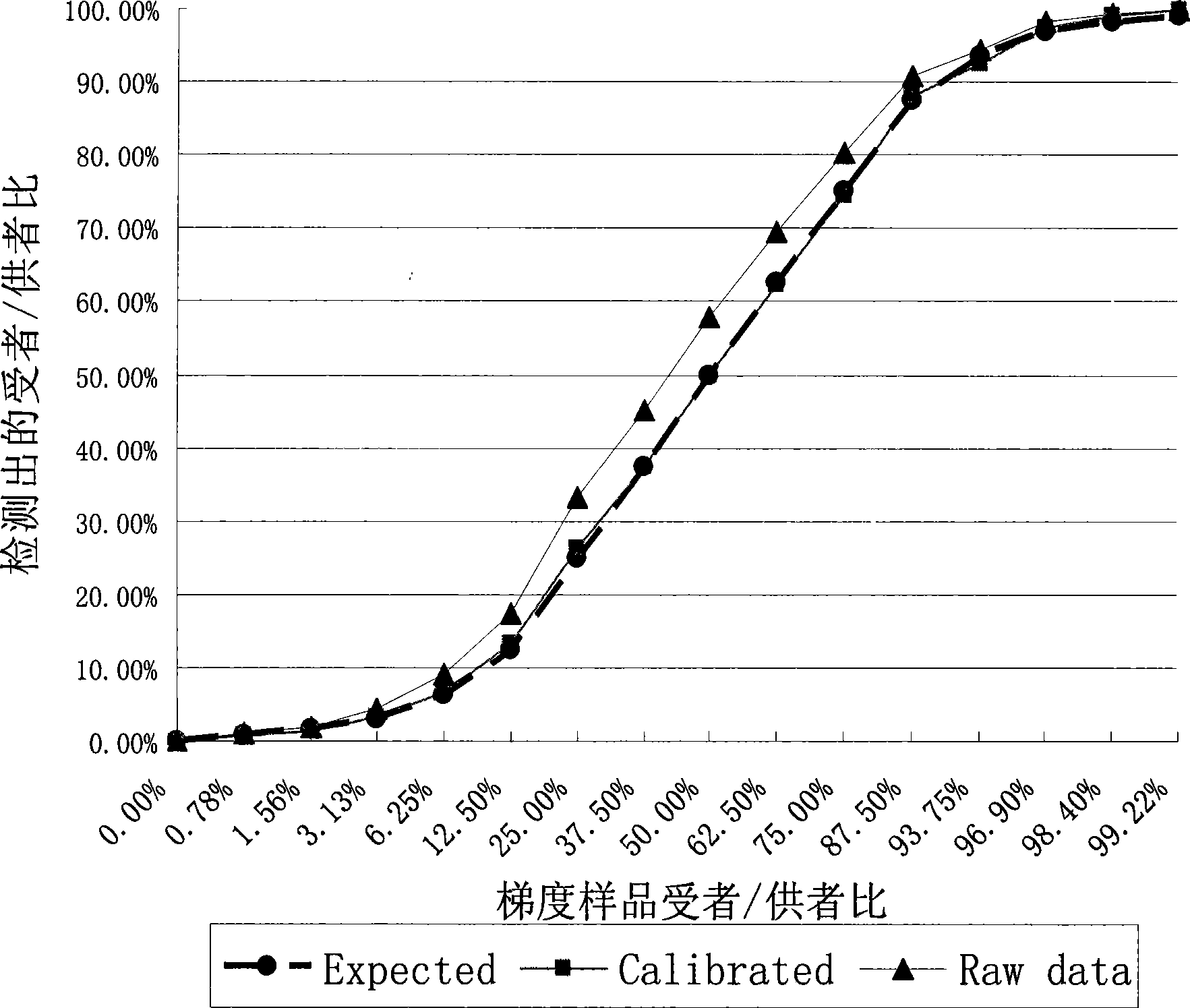
[0106] 3. Gradient sample preparation Mix the above-mentioned DNA in equal volumes, prepare 50% donor:recipient DNA, and use it as the starting product of the gradient sample, mix it with the donor DNA in turn to form 75%, 87.5%, 93.75%, Gradient samples with chimerism rates of 96.8%, 98.4%, and 99.2%; 50% donor:recipient DNA mixed samples were used as initial samples, which were mixed with recipient DNA before transplantation to form 25%, 12.5%, and 6.25% , 3.13%, 1.56%, 0.8% ch...
PUM
 Login to View More
 Abstract
Description
Claims
Application Information
 Login to View More