
Method for detecting greenhouse gas emission of transgenic rice
- Summary
- Abstract
- Description
- Claims
- Application Information
AI Technical Summary
Problems solved by technology
Method used
Image



Examples
Embodiment
[0019] In this example, a Bt gene-transfer rice and its parent rice and their straws were taken as objects, and the marked Bt-gene rice straws were returned to the rice field for 7 days, 15 days, 30 days, 55 days, and 80 days respectively. and 110 days for transgenic Bt gene and parental rice 13 C-CH 4 and 13 C-CO 2 Detect and evaluate the impact of transgenic Bt gene on rice greenhouse gas emissions.
[0020] The method for detecting greenhouse gas emissions from transgenic rice, the specific steps are as follows:
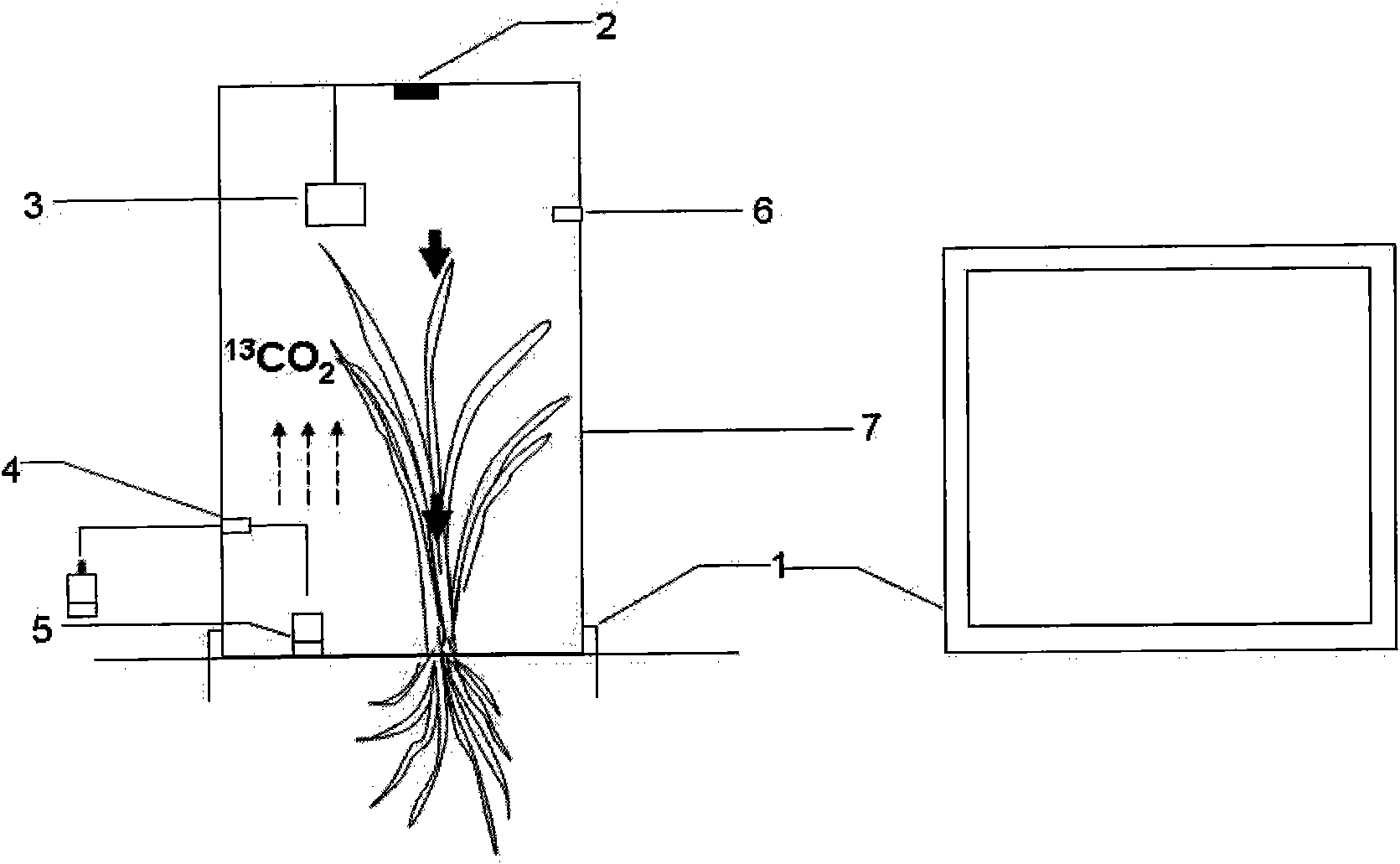
[0021] (1) production 13 C stable carbon isotope labeling box (see figure 1 ): The marking box is composed of a 5mm thick transparent barrel-shaped box 7 and a base 1, and the surfaces of the plexiglass are bonded with chloroform, and the length, width, and height of the box are adjusted according to different rice varieties and different growth stages of the plants. Generally, the length and width of a single rice plant are about 20 cm, and the length and w...
PUM
 Login to View More
 Abstract
Description
Claims
Application Information
 Login to View More