Method and system for self-adaptive enhancement of contrast ratio of X-ray image

A technology of adaptive enhancement and image contrast, applied in the field of image processing, which can solve the problem of unstable log stretching effect of images.

CN104463807AActive Publication Date: 2015-03-25SHENZHEN ANGELL TECH
4 Cites 8 Cited by

Patent Information

Authority / Receiving Office
CN · China
Patent Type
Applications(China)
Current Assignee / Owner
Publication Date
2015-03-25

Smart Images

  • Figure 1
    Figure 1
  • Figure 2
    Figure 2
  • Figure 3
    Figure 3
Patent Text Reader

Abstract

The invention relates to the field of image processing, in particular to a method and system for self-adaptive enhancement of the contrast ratio of an X-ray image. The method for self-adaptive enhancement of the contrast ratio of the X-ray image comprises the following steps that a grey level histogram of a tissue area image is established, and parameters of the grey level histogram are counted; the log tensile curve coefficient of the tissue area image is calculated according to the parameters of the grey level histogram; a log tensile curve is formed according to the log tensile curve coefficient; the tissue area image is drawn according to the log tensile curve. According to the method for self-adaptive enhancement of the contrast ratio of the X-ray image, automatic analysis of tissue area images with different volumes and of different body positions can be achieved, the influences of an air area and a collimator shading area are avoided, the log tensile curve is generated in a self-adaptive mode, the original image of the tissue area image is drawn by means of the curve, and thus the brightness and contrast ratio of all tissue areas can meet the requirements for observing the tissue areas with human eyes more suitably.
Need to check novelty before this filing date? Find Prior Art

Description

technical field

[0001] The invention relates to the field of image processing, in particular to an X-ray image contrast self-adaptive enhancement method and system. Background technique

[0002] According to the Weber-Fechner law, the human eye's perception of brightness is linearly related to the logarithm of the actual brightness value. Therefore, the image captured by the X-ray system must be processed by log stretching to make the brightness and contrast of the original image It is improved to achieve the purpose of being more suitable for human eyes to observe. However, in the actual operation process, due to the application of different film doses (KV and MAS) in different body positions, coupled with the differences in hardware systems, the original images captured will be too bright or too dark. In this case, If the original image is stretched with a fixed log curve, it cannot be ensured that all bones and soft tissue parts on the original image can be clearly displ...

Examples

Embodiment Construction

[0040] In order to make the object, technical solution and advantages of the present invention clearer, the present invention will be further described in detail below in conjunction with the accompanying drawings and embodiments.

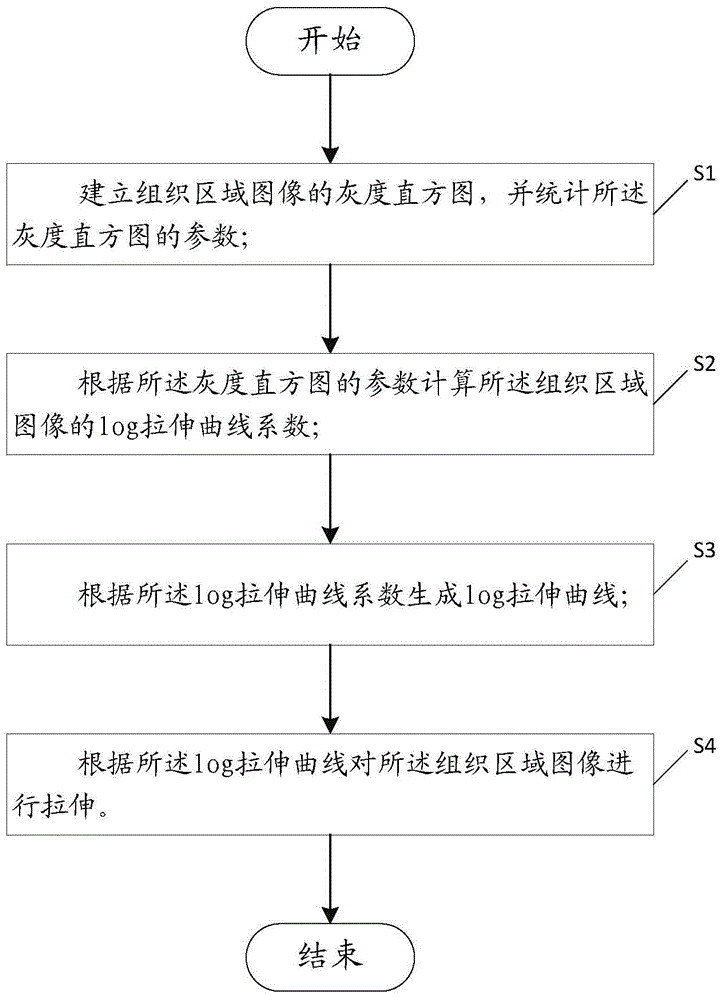
[0041] Such as figure 1 As shown, the embodiment of the present invention provides a method for self-adaptive enhancement of X-ray image contrast, comprising the following steps:

[0042] Step S1: Establish a grayscale histogram of the tissue region image, and count the parameters of the grayscale histogram;

[0043] Step S2: Calculate the log stretch curve coefficient of the tissue region image according to the parameters of the gray histogram;

[0044] Step S3: generating a log stretch curve according to the log stretch curve coefficient;

[0045] Step S4: Stretch the image of the tissue region according to the log stretch curve.

[0046] The generation of the Log stretch curve is based on the gray histogram of the tissue area, so the gray his...