
Three-dimensional orthodontic force dynamic measurement method and apparatus capable of simulating movement of teeth
A technology of tooth movement and dynamic measurement, applied in dentistry, medical science, etc., can solve problems such as inability to simulate teeth, inability to design orthodontic treatment plans, etc., and achieve accurate measurement results
- Summary
- Abstract
- Description
- Claims
- Application Information
AI Technical Summary
Problems solved by technology
Method used
Image

Examples
Embodiment 1
[0033] Embodiment 1 The three-dimensional orthodontic force dynamic measurement method of the simulated tooth movement process of the present invention comprises the following steps:
[0034] (1) Obtain the patient's oral cavity data through CT scanning;
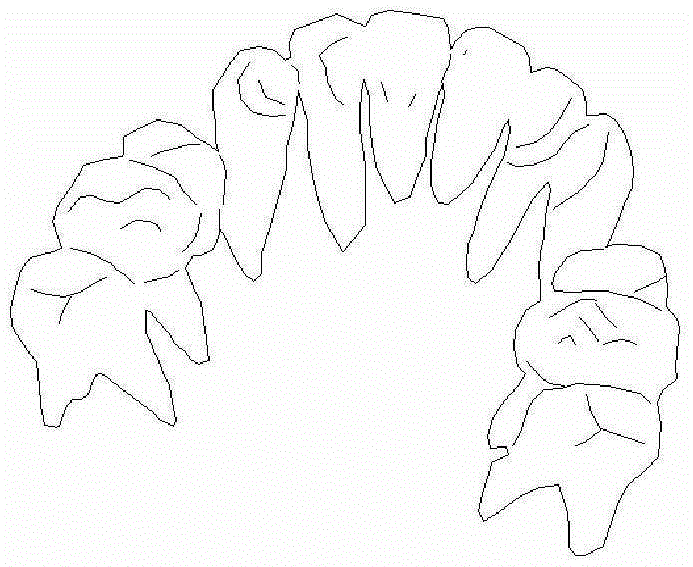
[0035] (2) Reconstruct a complete tooth model, and divide the tooth whose correction force is to be measured, such as the canine, into two parts, the crown and the root;
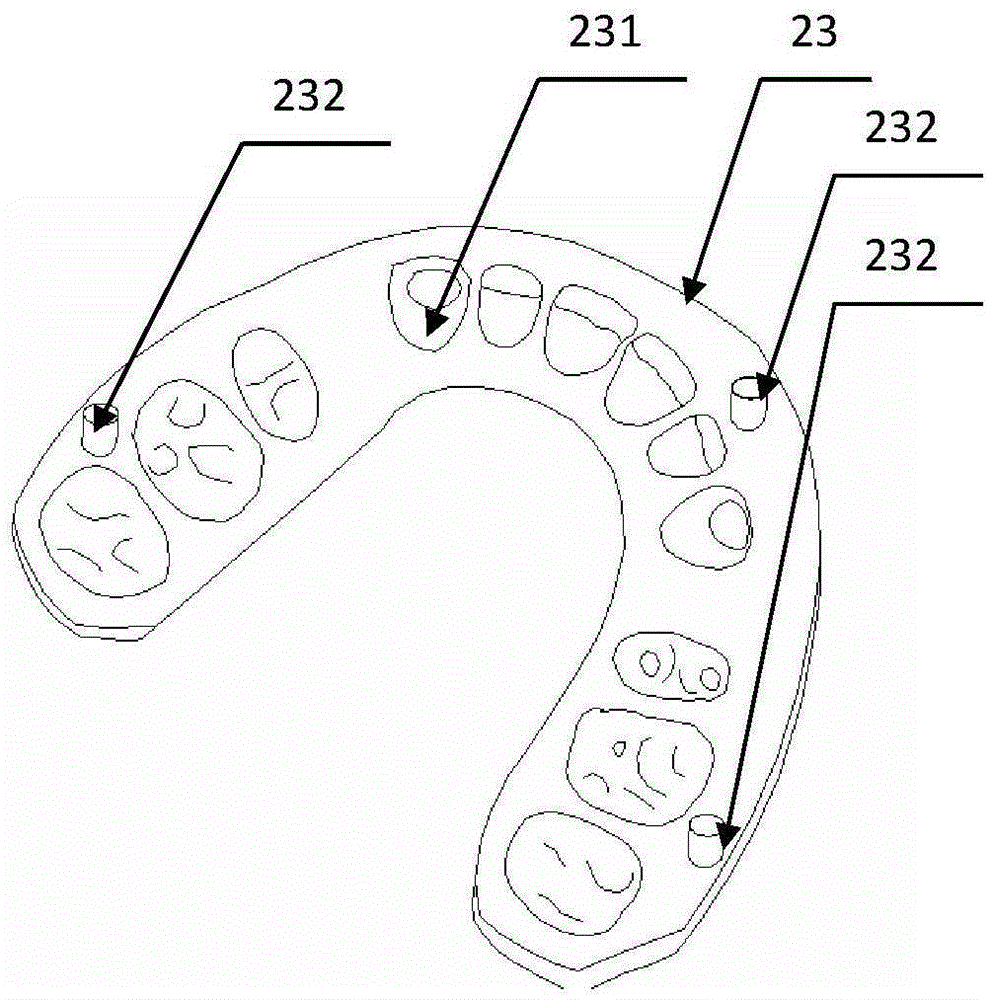
[0036] (3) The dentition positioning guide plate is designed according to the patient's dentition shape. The positioning pins on the guide plate ensure the position of the overall dentition and the insertion depth are accurate, and ensure that each tooth reproduces the angle, position and depth in the oral cavity;
[0037] (4) Make teeth and positioning guides with three-dimensional printing;
[0038] (5) For teeth that need to measure the orthodontic force, such as canines, the tooth root and the crown that are divided into two parts are connected to the...
Embodiment 2
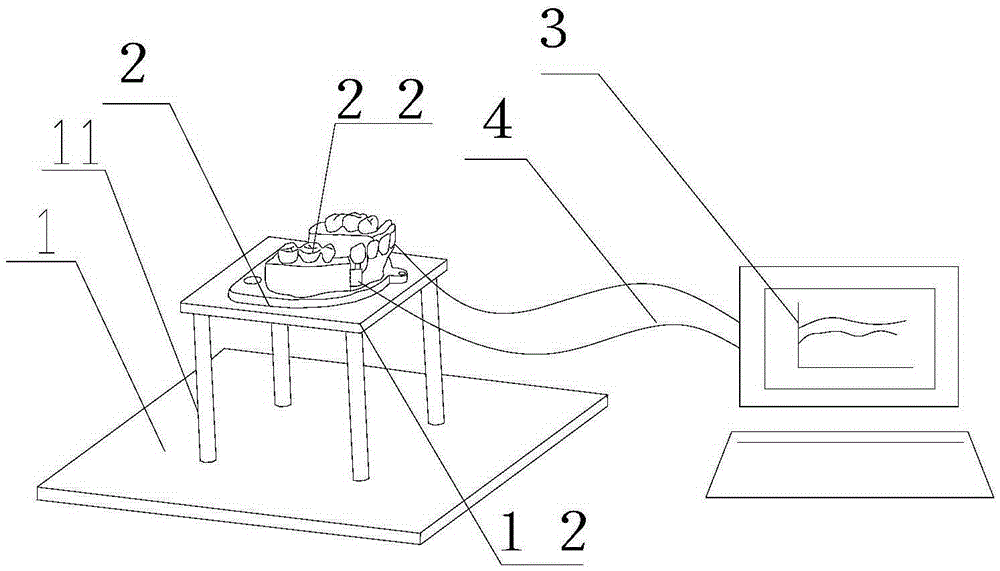
[0044]Embodiment 2 The device constructed according to the dynamic measurement method described in Embodiment 1 includes a measurement base 1, a test occlusal model 2 and a processor 3. A plurality of uprights 11 are installed on the measurement base 1, and the uprights 11 The top of the test occlusal model 2 is fixed on a horizontally arranged support plate 12, and the test occlusal model 2 is installed on the support plate 12, and the signal output end of the tooth mechanics measurement component of the test occlusal model 2 is passed through a transmission cable 4 is connected to the signal input end of the processor 3; the test occlusal model 2 includes a paraffin base 21, a tooth model 22 made up of several teeth, a positioning guide plate 23 and a tooth mechanics measurement assembly 24, the The positioning guide plate 23 is provided with a positioning groove 231 that matches the crown of the tooth in the patient's oral cavity; the crown 221 of the tooth to be tested and ...
PUM
 Login to View More
 Abstract
Description
Claims
Application Information
 Login to View More