Method for improving continuing efficiency in artificial telephone traffic system

A traffic and manual technology, applied in the field of manual traffic communication, can solve the problems of inability to know that operator C has approached user A, long time interval, and inability to remember numbers, etc., so as to improve the probability of successful outgoing calls and reduce the connection efficiency. The effect of reducing and improving the connection efficiency

CN105530388AActive Publication Date: 2016-04-27BEIJING JIAXUN FEIHONG ELECTRIC CO LTD
3 Cites 2 Cited by

Patent Information

Authority / Receiving Office
CN · China
Patent Type
Applications(China)
Current Assignee / Owner
Publication Date
2016-04-27

Smart Images

  • Figure 1
    Figure 1
Patent Text Reader

Abstract

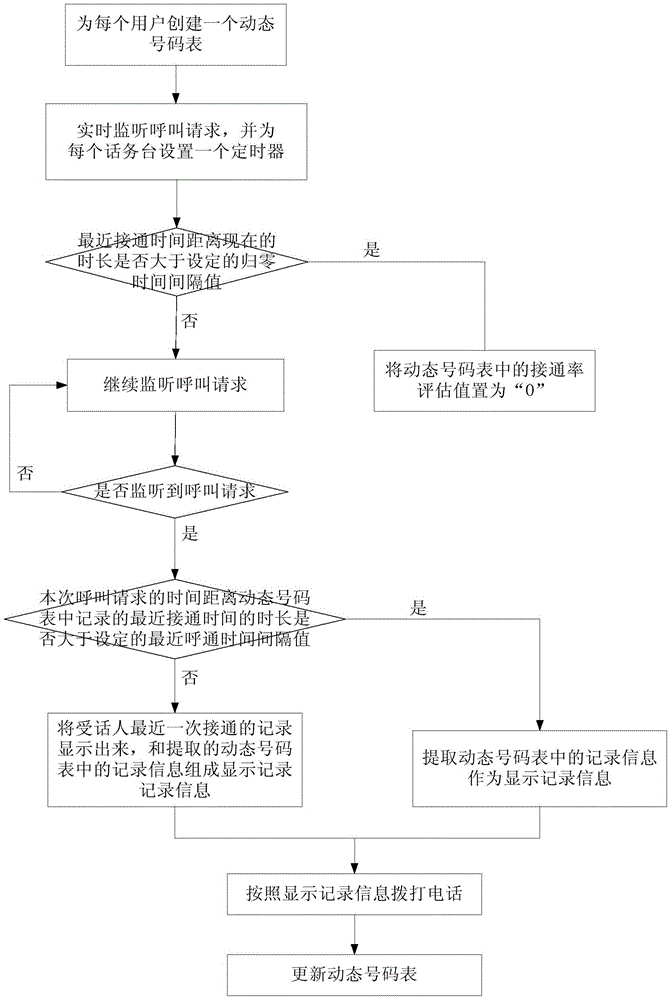
The invention discloses a method for improving continuing efficiency in an artificial telephone traffic system, comprising following steps: S1, building a dynamic number table for every user; S2, monitoring call requests in real time, setting a timer for every telephone switchboard, detecting whether the duration from the latest call-through time recorded in the dynamic number table to the current time is more than a preset zeroing time interval value, if so, setting the call-through rate estimation value to be 0, or turning to the step S3; S3, when the call requests are monitored, judging whether the duration from the time of the current call request to the latest call-through time recorded in the dynamic number table is more than a preset latest call-through time interval value, if so, extracting the recoding information as display recording information, or turning to the step S4; S4, combining the record of the latest call-through of the user and the extracted recording information into the display recording information; S5, dialing according to the display recording information. According to the method, the user can be called through quickly, and the continuing efficiency is improved.
Need to check novelty before this filing date? Find Prior Art

Description

technical field

[0001] The invention relates to a method for improving connection efficiency in a manual traffic system, belonging to the technical field of manual traffic communication. Background technique

[0002] With the rapid development of communication technology, manual traffic system (composed of background program-controlled switching control system and front desk console) has been widely used in various industries. In the existing manual call system, the whole connection service process is usually: the caller calls to the platform, and initiates a call to the attendant console. The foreground program of the attendant console displays the telephone information in the corresponding connection window and plays the ringing of the incoming call. The operator talks to the caller after seeing the call coming on stage or hearing the ring tone of the caller. Obtain the callee information (name, number, etc.) according to the calling needs of the caller and call the call...

Examples

Embodiment Construction

[0031] The technical content of the present invention will be described in detail below in conjunction with the accompanying drawings and specific embodiments.

[0032] Such as figure 1 As shown, the method for improving connection efficiency in the manual traffic system provided by the present invention comprises the following steps: at first, a dynamic number table is created for each user at the attendant station, which is used to save the user number information, and the included fields are: name, number, evaluation value of completion rate, and latest connection time; then, real-time monitoring of call requests, setting a timer for each attendant console, and detecting whether the distance between the latest connection time recorded in the dynamic number table and the present time is greater than Set zero interval value; if it is greater than, set the completion rate evaluation value in the dynamic number table to "0"; otherwise, continue to monitor the call request; when...