
Load balancing method for heterogeneous wireless network
A heterogeneous wireless network and load balancing technology, applied in wireless communication, network traffic/resource management, electrical components, etc., can solve problems such as limited capacity, reduce complexity, meet user business service quality requirements, and reduce system overhead Effect
- Summary
- Abstract
- Description
- Claims
- Application Information
AI Technical Summary
Problems solved by technology
Method used
Image

Examples
Embodiment
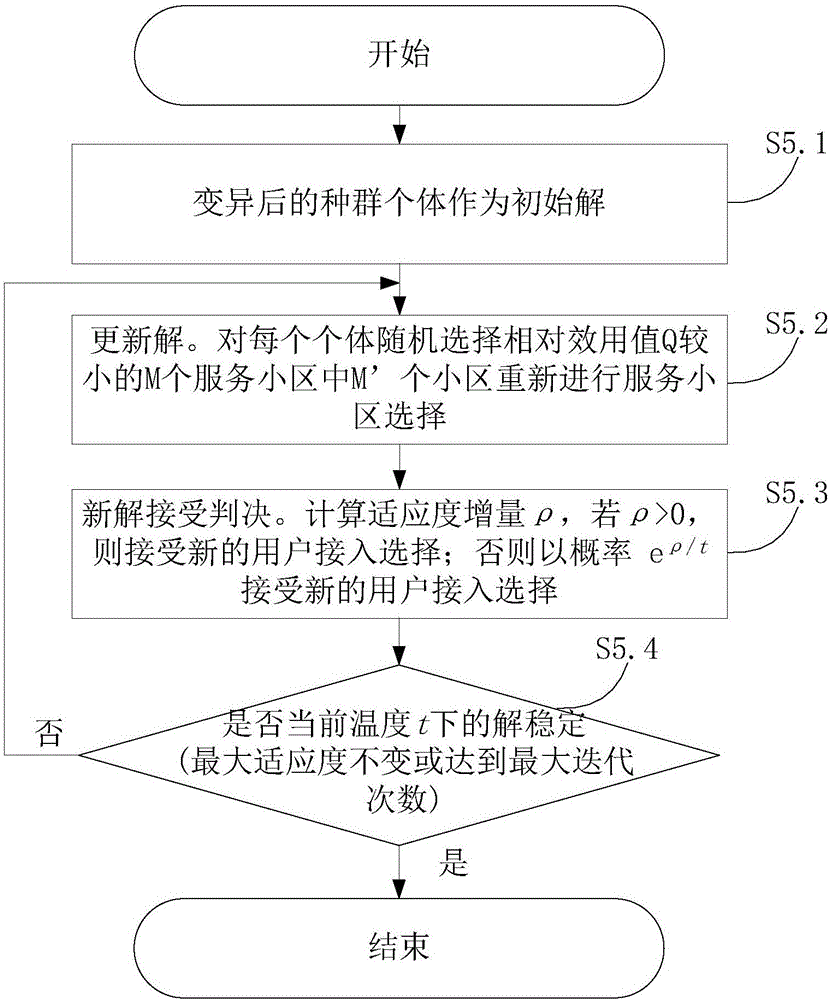
[0125] In the genetic simulated annealing algorithm of the present invention, a step for load balancing is added, an initial solution needs to be generated, and an updated solution is selected according to the user serving cell.
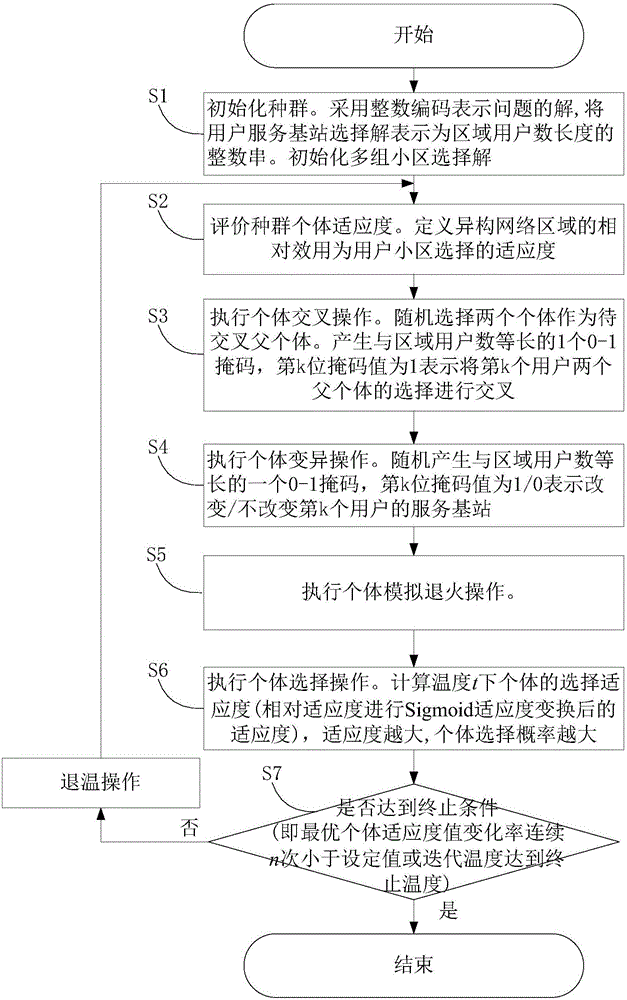
[0126] refer to figure 1 , according to an embodiment of the present invention, the method for solving heterogeneous wireless network load balancing based on the improved hybrid genetic simulated annealing algorithm includes:
[0127] S1: Initialization. The initial value of the evolution times counter m is 0, the initialization temperature t, and the temperature decay factor is Generate V solution vectors to construct the initial population S 0 (m)={X 1 ,...,X v ,...,X V} (that is, the initial solution), X v ={x 1 , x 2 ,...x k ,...,x K},x k ∈{1,…,S}, where x k Indicates the indication of the serving cell selected by user k, that is, x k Indicates the access serving cell selected by user k in the heterogeneous network area, expressed b...
PUM
 Login to View More
 Abstract
Description
Claims
Application Information
 Login to View More