
In-situ rotary bone fracture restoration fixer
A fixer, in-situ technology, applied in the field of medical devices, can solve the problems of inconvenience of surgery, prolong the operation time, increase the probability of infection, etc., and achieve the effect of being easy to manufacture and popularize
- Summary
- Abstract
- Description
- Claims
- Application Information
AI Technical Summary
Problems solved by technology
Method used
Image


Examples
Embodiment Construction
[0018] Below in conjunction with accompanying drawing, the present invention is further described.
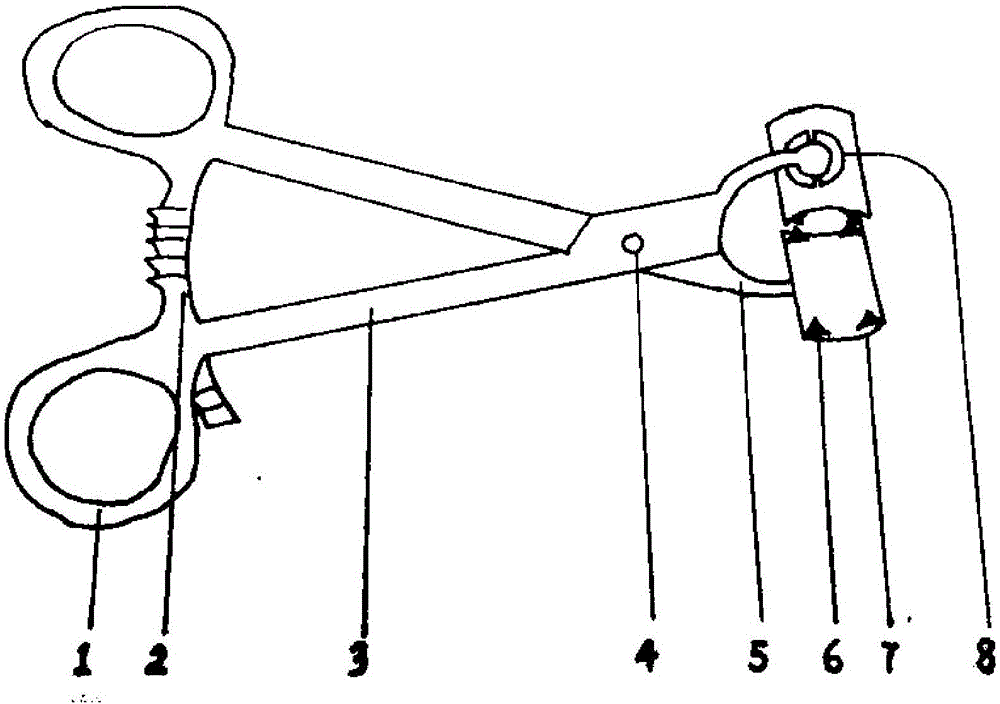
[0019] A long bone fracture reduction and fixation forceps, comprising two forceps handles 3, the two forceps handles 3 are connected by a front hinge shaft 4, the front end of the forceps handle 3 has an arc-shaped forceps head 5, and the end of the arc-shaped forceps head 5 passes through the ball The socket shaft 8 is connected with the arc-shaped elastic fixing plate 7, and the four corners of the inner surface of the fixing plate 7 each have a positioning protrusion 6, and the rear end of the pincer handle 3 has an annular pincer handle 1. The end of the pliers head is connected to the arc-shaped elastic fixing plate 7 through the ball-and-socket shaft 8, and this joint is rotatable and detachable; the fixing plate 7 is made of a material with better elasticity.
[0020] As shown in the figure, the end of the arc-shaped pliers head 5 is connected to the arc-shaped elastic ...
PUM
 Login to View More
 Abstract
Description
Claims
Application Information
 Login to View More