
A high-strength nickel-tungsten alloy substrate with strong cubic texture and its preparation method
A strong cubic texture, nickel-tungsten alloy technology, applied in the direction of chemical instruments and methods, metal layered products, layered products, etc., can solve the problems of low yield strength, cumbersome process, poor surface quality of baseband, etc., and achieve yield strength High, high yield strength, easy to control the effect
- Summary
- Abstract
- Description
- Claims
- Application Information
AI Technical Summary
Problems solved by technology
Method used
Image

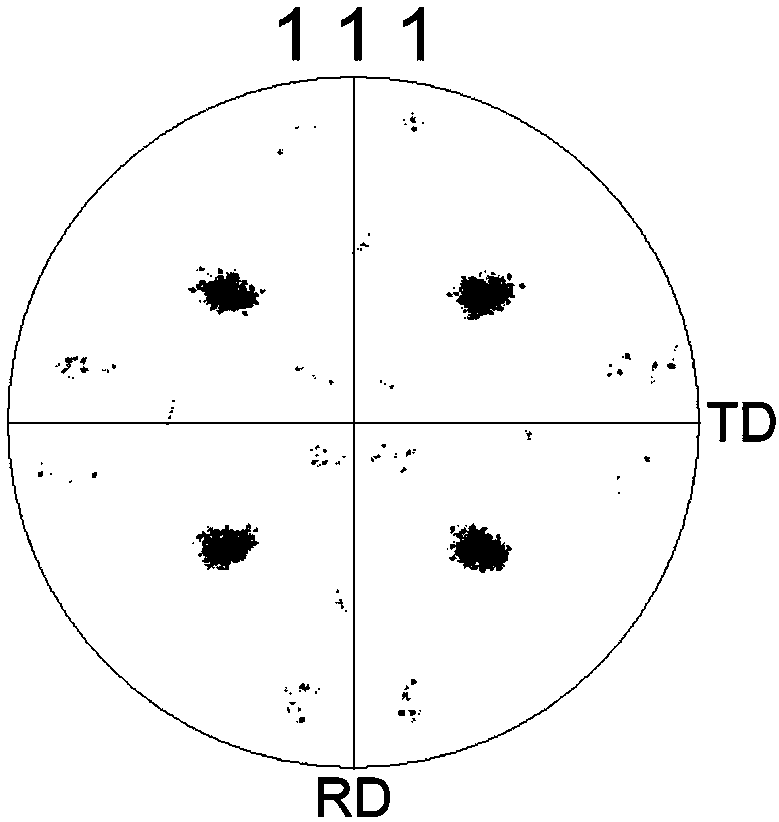
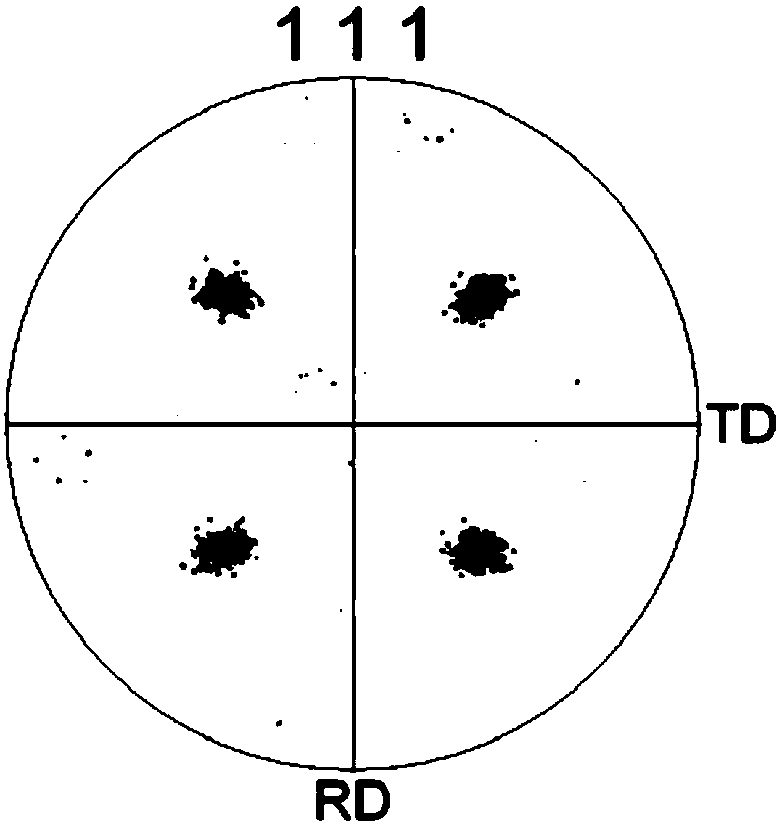
Examples
example 1
[0042] The steps for Example 1 are as follows:
[0043] The nickel block and the tungsten block are proportioned according to the atomic percentage of tungsten at 5.0%, and the mixed material after proportioning is melted in a vacuum induction melting furnace to obtain a nickel-tungsten alloy ingot, and then the alloy ingot is cast at a high temperature Under forging and hot rolling to obtain the initial billet before cold rolling;
[0044] Remove the oxide skin on the surface of the hot-rolled ingot, and then perform cold rolling to a thickness of 70-100 μm, with a total deformation of 88%;
[0045] Electrodepositing a nickel-tungsten alloy coating on the upper and lower surfaces of the cold-rolled nickel-tungsten alloy base strip, the thickness of the coating is 5-20 μm, and the atomic percentage of tungsten in the coating is 18%; and
[0046] The electro-deposited nickel-tungsten alloy substrate is subjected to recrystallization annealing. The specific process is: the heat...
example 2
[0050] The steps for Example 2 are as follows:
[0051]The nickel block and the tungsten block are proportioned according to the atomic percentage of tungsten at 7.5%, and the mixed material after proportioning is melted in a vacuum induction melting furnace to obtain a nickel-tungsten alloy ingot, and then the alloy ingot is cast at a high temperature Under forging and hot rolling to obtain the initial billet before cold rolling;
[0052] Remove the oxide skin on the surface of the hot-rolled ingot, and then perform cold rolling to a thickness of 70-100 μm, with a total deformation of 88%;
[0053] Electrodepositing a nickel-tungsten alloy coating on the upper and lower surfaces of the cold-rolled nickel-tungsten alloy base strip, the thickness of the coating is 5-20 μm, and the atomic percentage of tungsten in the coating is 18%; and
[0054] The electro-deposited nickel-tungsten alloy substrate is recrystallized and annealed. The specific process is as follows: the heating...
PUM
| Property | Measurement | Unit |
|---|---|---|
| thickness | aaaaa | aaaaa |
| thickness | aaaaa | aaaaa |
| yield strength | aaaaa | aaaaa |
Abstract
Description
Claims
Application Information
 Login to View More