AI technical title is built by Patsnap AI team. It summarizes the technical point description of the patent document.
A technology of insect repellant and straw mat, which is applied in the direction of biocide, pest repellent, pest control, etc., and can solve the problems of straw mats prone to insects and other problems
Active Publication Date: 2021-04-13
阜南县润杨家居有限公司
View PDF5 Cites 0 Cited by
Summary
Abstract
Description
Claims
Application Information
AI Technical Summary
This helps you quickly interpret patents by identifying the three key elements:
Problems solved by technology
Method used
Benefits of technology
Problems solved by technology
But straw mats have the disadvantage of being prone to insects
Method used
the structure of the environmentally friendly knitted fabric provided by the present invention; figure 2 Flow chart of the yarn wrapping machine for environmentally friendly knitted fabrics and storage devices; image 3 Is the parameter map of the yarn covering machine
View more
Image
Smart Image Click on the blue labels to locate them in the text.
Viewing Examples
Smart Image
Click on the blue label to locate the original text in one second.
Reading with bidirectional positioning of images and text.
Smart Image
Examples
Experimental program
Comparison scheme
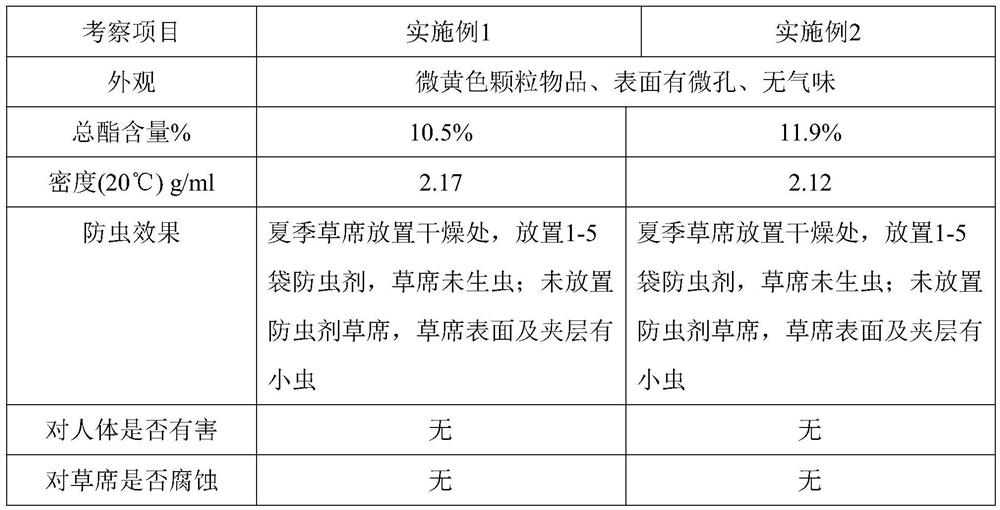
Effect test
Embodiment 1
[0021] A straw mat insect repellent is made of the following raw material components in parts by weight:
[0022] 36 parts of nitrocellulose particles, 7 parts of carboxymethyl chitosan, 15 parts of epoxidized soybean oil, 15 parts of sodium alginate, 11 parts of plant extract, 9 parts of polyglycerol fatty acid ester, 21 parts of castor oil hydrogenation mixture , 8 parts of glyceryl monostearate, 8.5 parts of polymerized aluminum oxide, 14 parts of terpene resin, 10 parts of zeolite powder, 7 parts of straw powder, 11 parts of lysozyme, 35 parts of nano silver-zinc oxide complex, potassium sorbate 7.5 parts, glycerin 6.5 parts, corn syrup 5.5 parts, deionized water 15 parts.
[0023] The castor oil hydrogenation mixture is modified by castor oil, and the modification method is: add 3 parts of turpentine, 2 parts of cationic polyacrylamide and 0.5 part of polydimethyldiallyl chloride to 15 parts of castor oil Ammonium chloride, after mixing thoroughly, microwave at a microwa...
Embodiment 2
[0033] A straw mat insect repellent is made of the following raw material components in parts by weight:
[0034] 46 parts of nitrocellulose particles, 5 parts of carboxymethyl chitosan, 15 parts of epoxidized soybean oil, 16 parts of sodium alginate, 6 parts of plant extract, 7.5 parts of polyglycerol fatty acid ester, 11 parts of castor oil hydrogenation mixture , 10 parts of glyceryl monostearate, 7 parts of polyaluminum oxide, 12 parts of terpene resin, 6 parts of zeolite powder, 7 parts of straw powder, 13 parts of lysozyme, 15 parts of nano silver-zinc oxide complex, potassium sorbate 8 parts, glycerin 8.5 parts, corn syrup 9 parts, deionized water 16 parts.
[0035] Wherein the castor oil hydrogenation mixture is modified by castor oil, the modification method is: add 3.5 parts of turpentine, 2.2 parts of cationic polyacrylamide and 0.5 part of polydimethyldiallyl to 15 parts of castor oil Ammonium chloride, after mixing well, microwave at a microwave frequency of 2450...
the structure of the environmentally friendly knitted fabric provided by the present invention; figure 2 Flow chart of the yarn wrapping machine for environmentally friendly knitted fabrics and storage devices; image 3 Is the parameter map of the yarn covering machine
Login to View More
PUM
Login to View More
Abstract
The invention discloses an insect repellant for straw mats, which relates to the technical field of straw mat hygiene protection, and is made of the following raw material components: nitrocellulose particles, carboxymethyl chitosan, epoxy soybean oil, sodium alginate, plant extracts liquid, polyglycerol fatty acid ester, castor oil hydrogenation mixture, glyceryl monostearate, polyaluminum oxide, terpene resin, zeolite powder, straw powder, lysozyme, nano silver-zinc oxide complex, potassium sorbate, Glycerin, corn syrup, deionized water; the materials used to prepare the straw mat insect repellant are safe and non-toxic, have no pollution to the environment, and have no corrosive effect on the straw mat. When the straw mat is not in use, fold the straw mat and place the straw mat insect repellant In the middle of the interlayer, it can be placed until the next season, and the straw mat should be washed once before use. The insect repellent for the straw mat can be used for a long time, and can prevent mites, damp bugs, etc.
Description
Technical field: [0001] The invention relates to the technical field of straw mat hygiene protection, in particular to a straw mat insect repellant. Background technique: [0002] Straw mats refer to mats woven with flexible grass stems. Generally, straw mats cannot be folded, but can only be rolled up. But the improved straw mat can be folded and stored. [0003] Straw mats have a relatively strong water absorption capacity, and after a season of use, the color of the mat surface tends to turn yellow. Straw mats woven with rushes, cattail grass, and Malan grass are mostly loved by the elderly. But straw mats have the disadvantage of being prone to insects. Before using the new straw mat, it is best to take a photo in the sun, pat it several times repeatedly, then wipe off the dust with warm water, and put it in the shade to dry. When reusing the straw mat in the second year, wipe it with disinfectant water, or wash off the mildew with soapy water, filter it with warm wa...
Claims
the structure of the environmentally friendly knitted fabric provided by the present invention; figure 2 Flow chart of the yarn wrapping machine for environmentally friendly knitted fabrics and storage devices; image 3 Is the parameter map of the yarn covering machine
Login to View More
Application Information
Patent Timeline
Application Date:The date an application was filed.
Publication Date:The date a patent or application was officially published.
First Publication Date:The earliest publication date of a patent with the same application number.
Issue Date:Publication date of the patent grant document.
PCT Entry Date:The Entry date of PCT National Phase.
Estimated Expiry Date:The statutory expiry date of a patent right according to the Patent Law, and it is the longest term of protection that the patent right can achieve without the termination of the patent right due to other reasons(Term extension factor has been taken into account ).
Invalid Date:Actual expiry date is based on effective date or publication date of legal transaction data of invalid patent.


 Login to View More
  Login to View More