Windage yaw flashover risk assessment method in sand and dust environment of power transmission line

A transmission line and risk assessment technology, applied in the direction of instruments, data processing applications, resources, etc., can solve problems that cannot truly reflect the impact of transmission lines, and achieve the effect of guiding differentiated design and operation and maintenance

CN110796327APending Publication Date: 2020-02-14ILI POWER SUPPLY COMPANY SATE GRID XINJIANG ELECTRIC POWER +1
0 Cites 0 Cited by

Patent Information

Authority / Receiving Office
CN · China
Patent Type
Applications(China)
Current Assignee / Owner
Publication Date
2020-02-14

Smart Images

  • Figure 1
    Figure 1
  • Figure 2
    Figure 2
  • Figure 3
    Figure 3
Patent Text Reader

Abstract

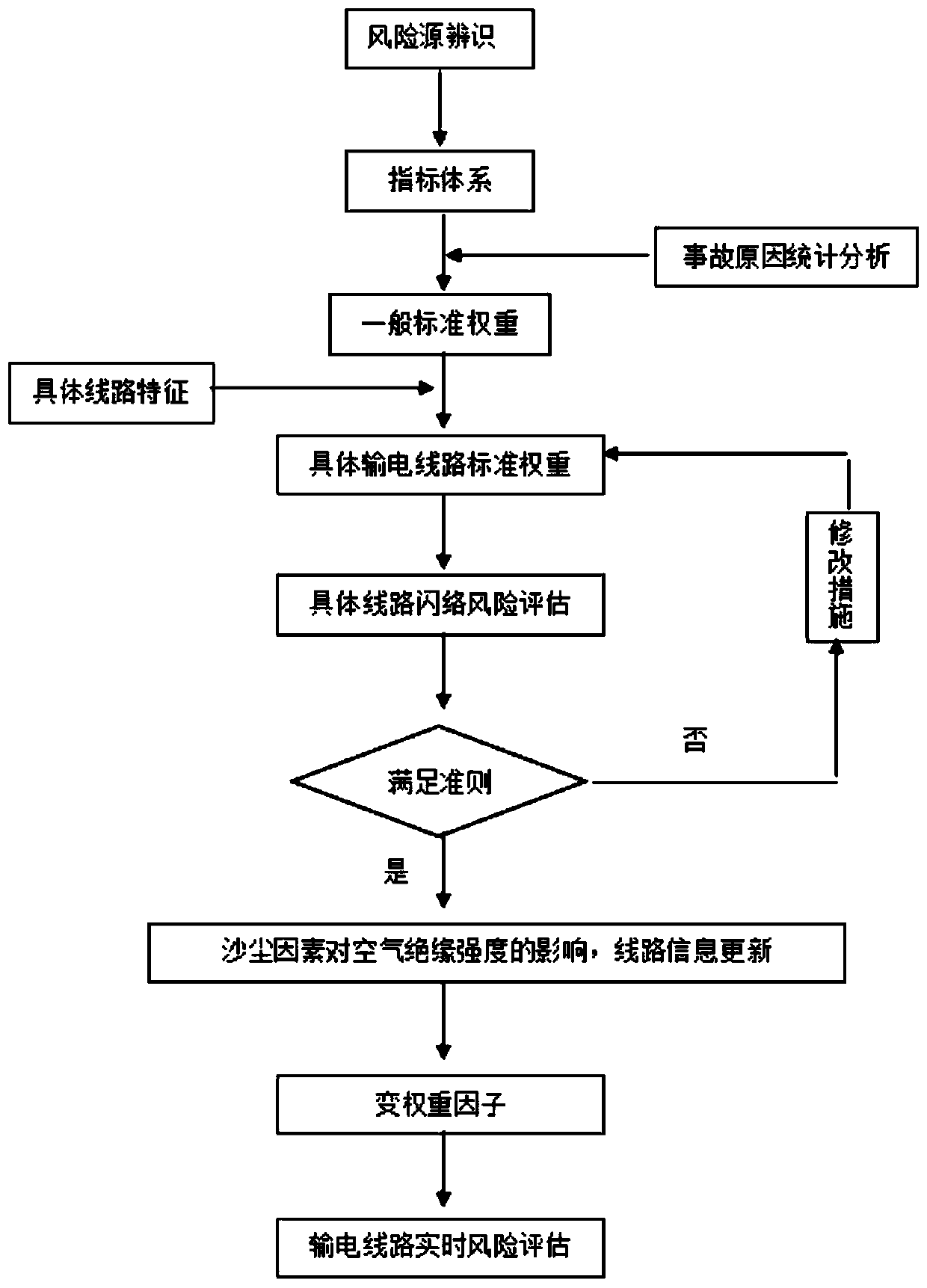
The invention relates to a windage yaw flashover risk assessment method in a sand and dust environment of a power transmission line. The method comprises the following steps: S1, identifying a windageyaw flashover risk source; S2, establishing a power transmission line windage yaw flashover risk assessment index system, and performing risk grading; S3, giving a risk assessment scoring standard according to the accident case and the statistical data, and calculating a general standard weight; S4, calculating a specific power transmission line standard weight; S5, evaluating the influence of sand and dust factors on the air insulation strength; S6, updating weight factor changes; and S7, evaluating the real-time windage yaw flashover risk of the specific power transmission line. According to the method, the influence of sand and dust on windage yaw flashover of the power transmission line is fully considered. Meanwhile, the weight value of the evaluation index is updated in real time through feedback data in the windage yaw flashover accident development process, and the risk situation of windage yaw flashover of the power transmission line in the sand and dust environment can be judged more reasonably.
Need to check novelty before this filing date? Find Prior Art

Description

technical field

[0001] The invention relates to the technical field of power grid disaster prevention and mitigation, and more specifically, relates to a method for assessing the risk of wind deflection flashover in dusty environment of transmission lines. Background technique

[0002] A large number of overhead transmission lines and other power transmission and transformation equipment in the power grid are exposed to the atmospheric environment for a long time, and their operation safety is directly related to the operation safety of the power system. Long-term operation experience shows that the failure of power transmission and transformation equipment caused by dusty weather environment is one of the main reasons affecting the safety of power systems. According to statistics, in the past three years, there have been more than 300 wind deflection discharges on State Grid Corporation’s 110kV and above lines, including more than 50 wind deflection discharges on 500kV line...

Examples

Embodiment Construction

[0029] In order to better explain the present invention and facilitate understanding, the present invention will be described in detail below in conjunction with the accompanying drawings and through specific embodiments.

[0030] Such as figure 1 As shown, the present invention provides a wind deflection flashover risk assessment method under the sand dust environment of a transmission line, and the method comprises the following steps:

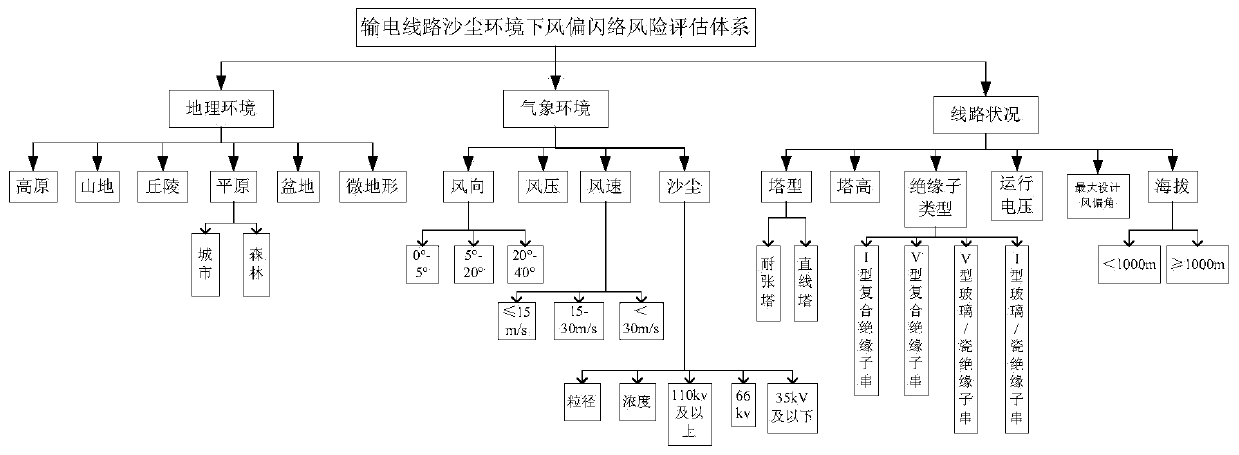
[0031] S1. Identify the risk source of flashover due to wind deviation, from the operating geographical environment of the transmission line, the meteorological environment where the transmission line is located, and the operating status of the transmission line.

[0032] S2. Establish a wind deflection flashover risk assessment index system for transmission lines, such as figure 2 As shown, and the risk level is divided: when the risk value p≥3.5, the risk level is level IV, indicating extremely high risk; when 2.5≤p<3.5, the risk level i...