
Vehicle system transfer function solving method based on transfer matrix
A transfer matrix and transfer function technology, applied in the field of vehicle system transfer function solution, can solve problems such as error-prone and difficult, and achieve the effect of high degree of programmability and convenient calculation process.
- Summary
- Abstract
- Description
- Claims
- Application Information
AI Technical Summary
Problems solved by technology
Method used
Image

Examples
Embodiment Construction
[0017] The present invention will be described in more detail below in conjunction with the accompanying drawings and embodiments.
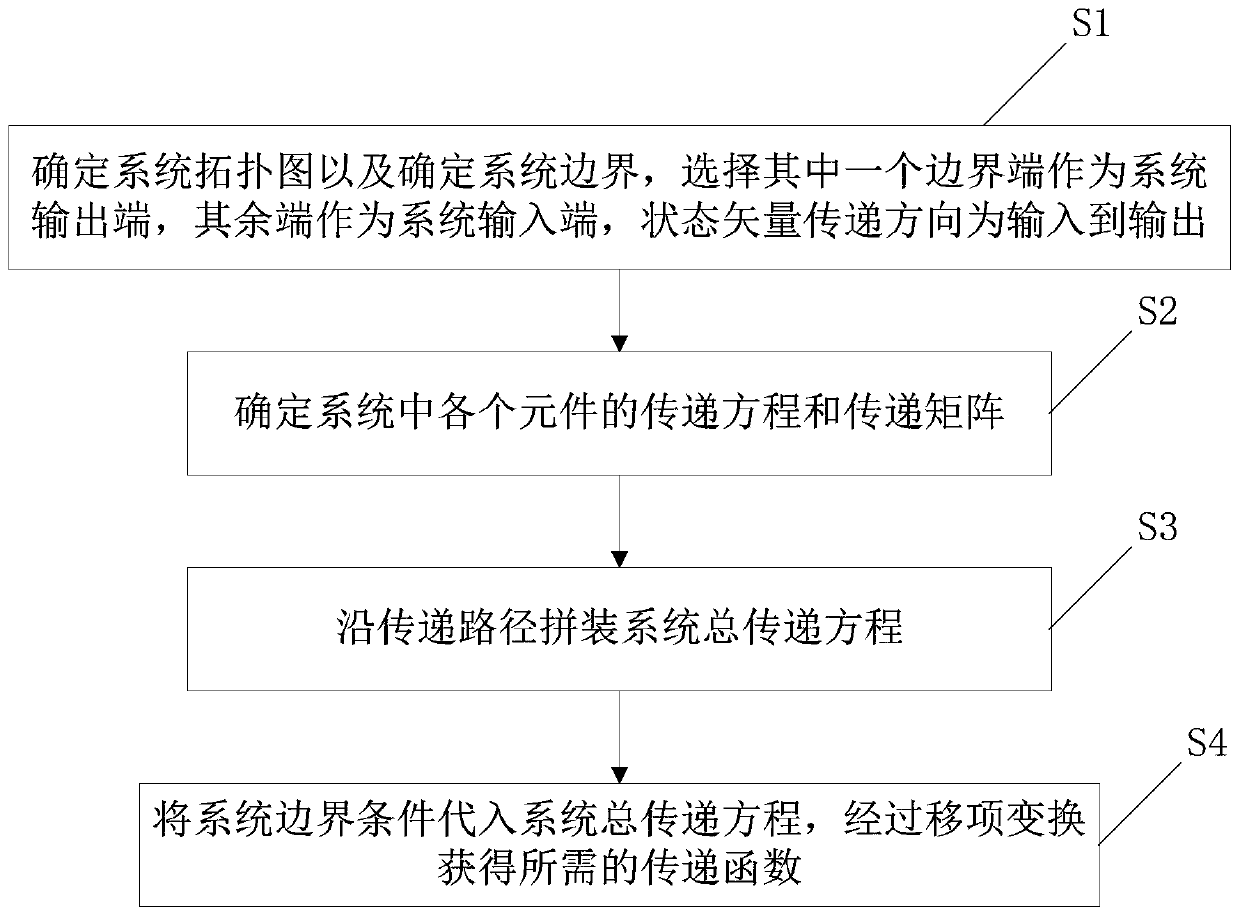
[0018] The invention discloses a method for solving the transfer function of the vehicle system based on the transfer matrix, please refer to figure 1 , the method includes:
[0019] Step S1, determining the system topology and determining the system boundary;
[0020] Step S2, determining the transfer equation and transfer matrix of each element in the system;
[0021] Step S3, assembling the total transfer equation of the system along the transfer path;
[0022] Step S4, substituting the boundary conditions of the system into the total transfer equation of the system, and obtaining the required transfer function through transposition transformation;
[0023] Further, in the step S1, after the system boundary is determined, one of the boundary terminals is selected as the system output terminal, and the remaining terminals are used as the sys...
PUM
 Login to View More
 Abstract
Description
Claims
Application Information
 Login to View More