A method for improving transposon transposition efficiency in super slow-growing peanut rhizobia
What is AI technical title?
AI technical title is built by Patsnap AI team. It summarizes the technical point description of the patent document.
A technology of ultra-slow growth and rhizobia, applied in the biological field, can solve problems such as hindering cell material exchange, cell death, and cell toxicity
Active Publication Date: 2021-12-10
CHINA AGRI UNIV
View PDF2 Cites 0 Cited by
Summary
Abstract
Description
Claims
Application Information
AI Technical Summary
This helps you quickly interpret patents by identifying the three key elements:
Problems solved by technology
Method used
Benefits of technology
Problems solved by technology
Due to the high molecular weight of levotran, it will accumulate in the periplasmic space, and at the same time, the fructose residue will bind to various receptors on the cell, which hinders the normal material exchange of the cell and is potentially toxic to the cell effect, resulting in cell death
Method used
the structure of the environmentally friendly knitted fabric provided by the present invention; figure 2 Flow chart of the yarn wrapping machine for environmentally friendly knitted fabrics and storage devices; image 3 Is the parameter map of the yarn covering machine
View more
Image
Smart Image Click on the blue labels to locate them in the text.
Viewing Examples
Smart Image
Click on the blue label to locate the original text in one second.
Reading with bidirectional positioning of images and text.
Smart Image
Examples
Experimental program
Comparison scheme
Effect test
Embodiment 1
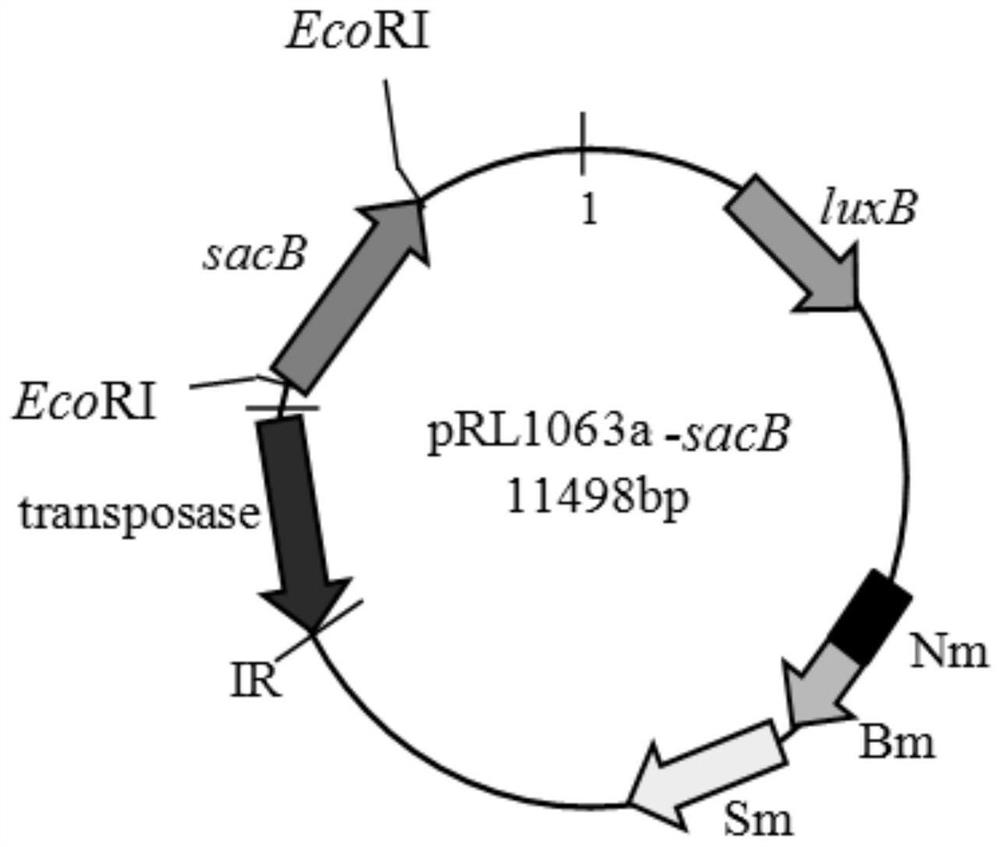
[0056] Embodiment 1, the acquisition of recombinant plasmid pRL1063a-sacB
[0057] 1. Extraction of pRL1063a plasmid and pJQ200SK plasmid
[0058] 1. Inoculate a single colony of Escherichia coli containing the pRL1063a plasmid into 5 mL of LB liquid medium, shake overnight at 37°C at 180 rpm, and then centrifuge at 12,000 rpm for 1 min to collect the cells.
[0059] 2. After completing step 1, take the bacteria, use the plasmid mini-extraction kit and follow the instructions to extract the plasmid, and obtain A 260 / A 280 pRL1063a plasmid solution with a concentration of 1.8-2.0 and greater than 34ng / μL (the solvent is ddH 2 O).
[0060] 3. Inoculate the single colony of Escherichia coli containing the pJQ200SK plasmid into 5 mL of LB liquid medium, shake overnight at 37°C at 180 rpm, and then centrifuge at 12,000 rpm for 1 min to collect the cells.
[0061] 4. After completing step 3, take the bacteria, use the plasmid mini-extraction kit and follow the instructions to e...
Embodiment 2
[0086] Embodiment 2, establishment of bradyrhizobium peanut three-parent hybridization method
[0087] 1. Establishment of three-parent hybridization method of Bradyrhizobium peanut and analysis of Tn5 transposition efficiency of inserting Tn5 transposon into Bradyrhizobium peanut CCBAU 53363
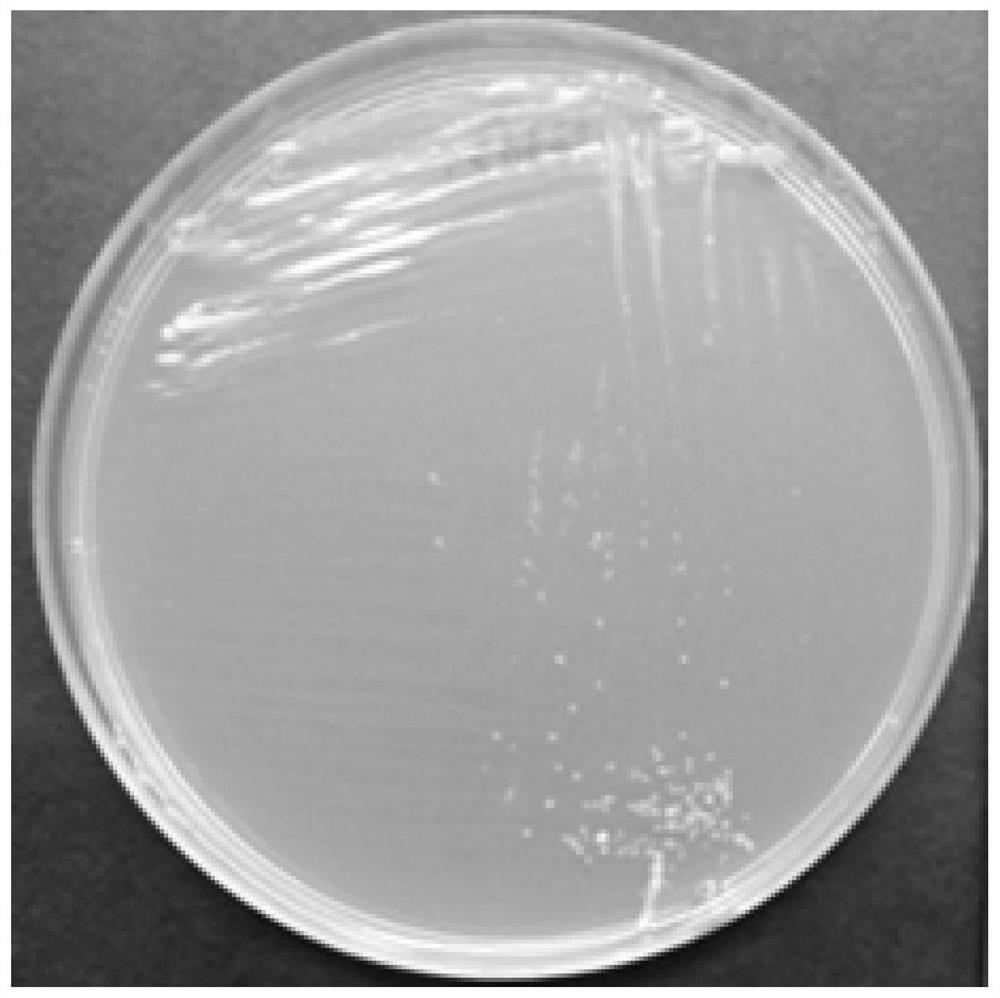
[0088] The recipient bacterium was Bradyrhizobium peanut CCBAU 53363. For the colony morphology of Bradyrhizobium peanut CCBAU 53363 see image 3 .
[0089] The donor bacterium is the Escherichia coli containing the recombinant plasmid pRL1063a-sacB prepared in Example 1.
[0090] The auxiliary bacteria are Escherichia coli containing the auxiliary plasmid pRK2013.
[0091] The inventor of the present invention has established a three-parent hybridization method for Bradyrhizobium peanut through a large number of experiments. Specific steps are as follows:
[0092] 1. Inoculate the recipient bacteria on TY solid medium and culture at 28°C for 14 days to obtain activated recipient b...
the structure of the environmentally friendly knitted fabric provided by the present invention; figure 2 Flow chart of the yarn wrapping machine for environmentally friendly knitted fabrics and storage devices; image 3 Is the parameter map of the yarn covering machine
Login to View More
PUM
Login to View More
Abstract
The invention discloses a method for improving the transposon transposition efficiency in super slow-growing peanut rhizobia. Experiments show that the Tn5 transposition efficiency of inserting Tn5 transposon into Bradyrhizobium peanut CCBAU 53363 by using the conventional rhizobium triparental hybridization method is 1.25%, and the method established by the present invention is used to insert the Tn5 transposon into Bradyrhizobium peanut CCBAU 53363. The Tn5 transposition efficiency of the Tn5 transposon was 18.75%-18.8%. Compared with the conventional three-parent hybridization method of Rhizobium, the method established in the present invention inserts Tn5 transposon into Bradyrhizobium peanut CCBAU 53363, and the Tn5 transposition efficiency is increased by nearly 15 times. The invention is very effective for transposon genetic manipulation of super slow-growing peanut rhizobia, and has important application value.
Description
technical field [0001] The invention belongs to the field of biotechnology, and in particular relates to a method for improving the transposition efficiency of a transposon in a super-brady peanut rhizobia. Background technique [0002] Rhizobium is a kind of Gram-negative bacteria widely distributed in soil. It can infect legumes and form root nodules. In the root nodules, it can differentiate into mature bacteroids that can fix nitrogen in the air and convert nitrogen into energy. Ammonia is absorbed and utilized by plants, while plants provide the carbon source needed for the life of rhizobia. Therefore, leguminous plants and rhizobia are in a mutually beneficial symbiotic relationship. According to statistics, the nitrogen fixed by this symbiotic relationship accounts for more than 65% of the total biological nitrogen fixation. The symbiosis between rhizobia and leguminous plants has great potential to improve soil fertility and reduce nitrogen fertilizer application. ...
Claims
the structure of the environmentally friendly knitted fabric provided by the present invention; figure 2 Flow chart of the yarn wrapping machine for environmentally friendly knitted fabrics and storage devices; image 3 Is the parameter map of the yarn covering machine
Login to View More
Application Information
Patent Timeline
Application Date:The date an application was filed.
Publication Date:The date a patent or application was officially published.
First Publication Date:The earliest publication date of a patent with the same application number.
Issue Date:Publication date of the patent grant document.
PCT Entry Date:The Entry date of PCT National Phase.
Estimated Expiry Date:The statutory expiry date of a patent right according to the Patent Law, and it is the longest term of protection that the patent right can achieve without the termination of the patent right due to other reasons(Term extension factor has been taken into account ).
Invalid Date:Actual expiry date is based on effective date or publication date of legal transaction data of invalid patent.



 Login to View More
  Login to View More