Optically transparent mark for marking gemstones

A marking and diamond technology, applied in jewelry, testing jewelry, laser welding equipment, etc., can solve the problems of mark generation, fluorescence concentration quenching, and no obvious drift of vacancies

CN112771595APending Publication Date: 2021-05-07阿尔罗萨私人有限公司
8 Cites 0 Cited by

Patent Information

Authority / Receiving Office
CN · China
Current Assignee / Owner
Publication Date
2021-05-07

Smart Images

  • Figure 1
    Figure 1
  • Figure 2
    Figure 2
  • Figure 3
    Figure 3
Patent Text Reader

Abstract

The invention relates to marks used for marking gemstones, inter alia rough or cut diamonds, containing various types of information such as, for example, an identification code, and more particularly relates to marks which are invisible to the naked eye and under magnifying glasses and various types of microscopes, and which are placed inside the body of a rough or cut diamond without producing an effect that is detrimental to the quality of said rough or cut diamond. The invention addresses the technical problem of extending the use of such a mark to rough diamonds containing different amounts and types of natural impurities, inter alia nitrogen, and achieves the technical result of solving said problem while at the same time simplifying the marking process and reducing the potential effect of said process on the properties of the stone. This technical result is achieved by the use of an optically transparent mark placed inside the body of a rough or cut diamond, said mark containing predetermined encoded information and consisting of a given combination of micron- or submicron-sized optically transparent elements that are regions containing an elevated concentration of atomic defects in the crystal lattice of a rough or cut diamond, said atomic defects in the crystal lattice of a rough or cut diamond being vacancies and interstitials, wherein information is encoded in at least two regions of elevated concentration of said atomic defects.
Need to check novelty before this filing date? Find Prior Art

Description

technical field

[0001] The present invention relates to markings for the marking of precious stones, including diamonds and glitter, and carrying information for various purposes, e.g., known only to a small group of people, such as identification codes, and particularly relates to the use of magnifying glasses and microscopes of various types, Impairment of diamond quality through facets (sparkle) and markings in uncut natural and synthetic diamonds (hereinafter simply referred to as diamonds) that cannot be seen by the naked eye without affecting their characteristics. Background technique

[0002] The problem of generating an image in a volume of a diamond crystal to, for example, mark a diamond for identification and tracking without compromising its quality and ultimately cost is well known, since some properties of diamonds make it difficult to generate such an image. very difficult.

[0003] It is well known that diamond is transparent at wavelengths in the visible s...

Examples

Embodiment Construction

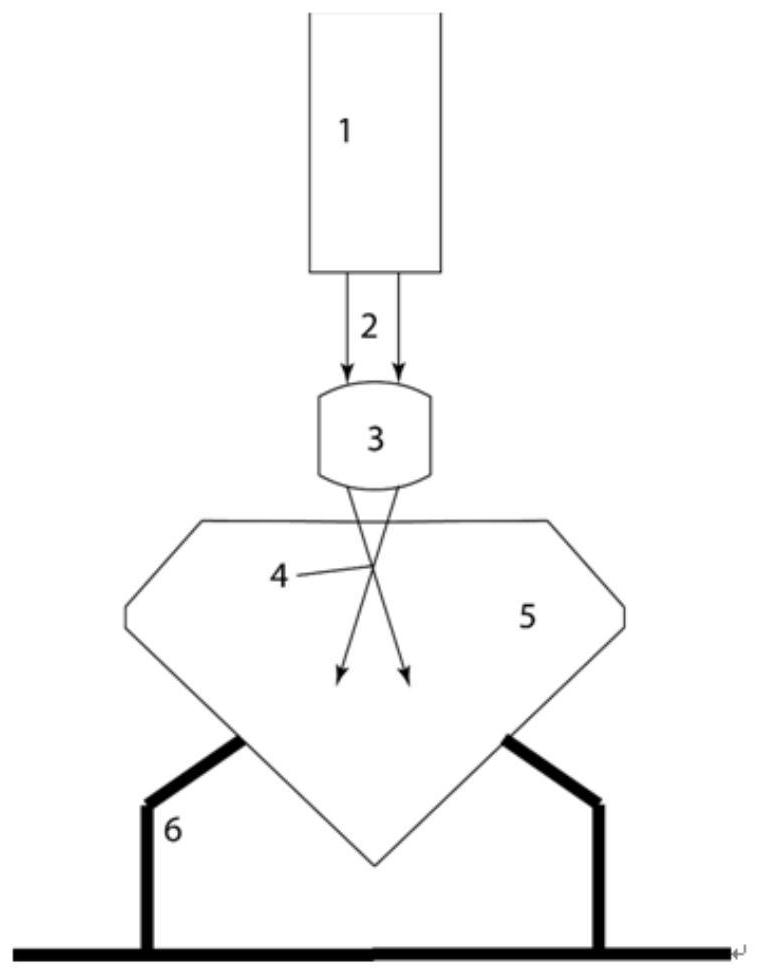
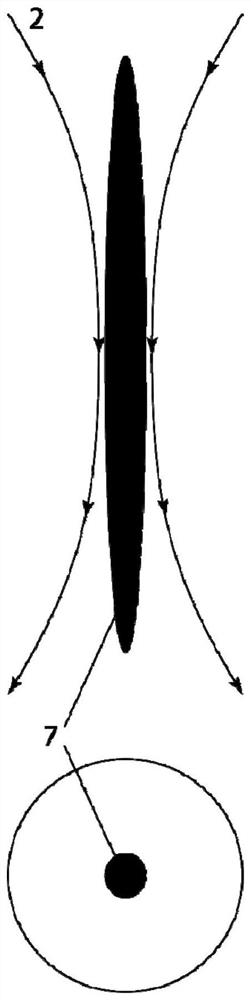
[0045] Marking system laser 1 ( figure 1 ) produces working radiation 2 in a series of pulses with parameters set so that diamond does not transform into graphite or another non-diamond form of carbon. Said radiation is focused by the focusing subsystem 3 (lens, objective) and forms the focal waist of the beam 4 in a focal region inside the volume of the diamond 5 on which a polished optically transparent culet has been previously made. The diamond 5 is mounted on a subsystem for movement 6 configured to move along three spatial coordinates and two other angular coordinates. Laser Radiation 2 ( figure 2 ) lead to the formation of atomic defects in regions of micron or submicron size7. Region 7 is the single element of the markup. After forming the marker elements in a given area inside the diamond, the sub-system for moving the diamond moves the diamond in space according to the digital model of the image to be recorded in the crystal volume entered by the user, and repeat...